
Oct
If you click on links we provide, we may receive compensation.
Somewhere on your face right now, roughly 400 to 900 tiny oil-producing structures are packed into every square centimeter of skin. These are your sebaceous glands – and most people spend their entire skincare lives either trying to suppress them or compensating for their decline, without quite knowing what they actually do. That gap matters. When you know how sebaceous glands work, why they change with age, and which ingredients support or calm them, the logic behind your routine stops being guesswork. Sebaceous glands are not the enemy of good skin. They are one of its essential engines. And the moment you stop treating them as a problem to be solved and start treating them as a system to be understood, a lot of skincare confusion clears up quickly.
What exactly are sebaceous glands?
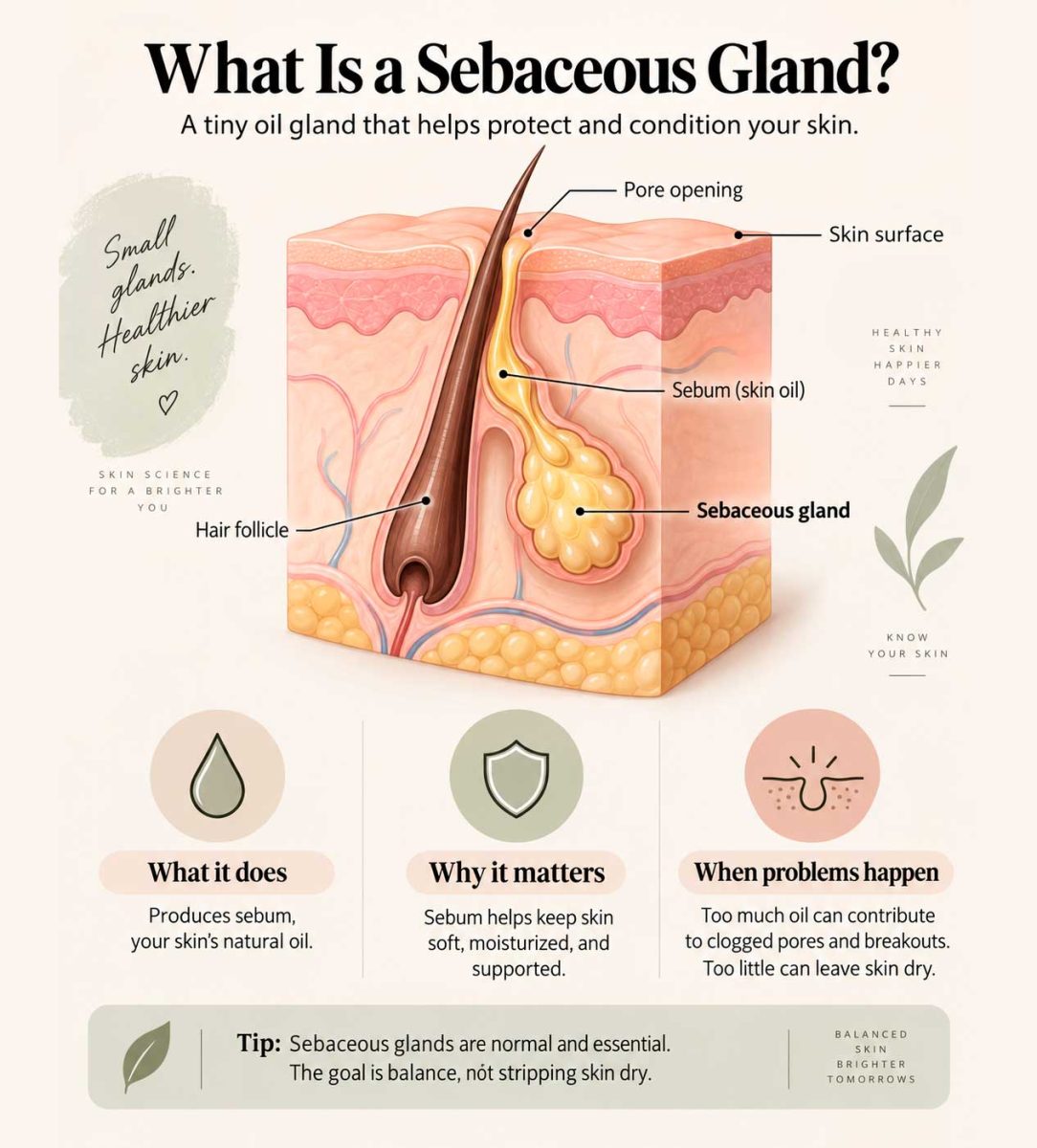
Sebaceous glands are small, sac-shaped exocrine glands embedded in the layer of tissue just beneath the skin’s surface – the dermis. They belong to a structure called the pilosebaceous unit, a functional complex that includes the hair follicle, the arrector pili muscle (the one responsible for goosebumps), and the sebaceous gland itself. Most sebaceous glands are connected to a hair follicle via a short duct, and the oily substance they produce – sebum – travels up that duct and onto the skin’s surface. On the eyelids, lips, and a few other areas, they open directly onto the skin rather than through a follicle. This is the exception rather than the rule, but it explains why those areas can feel unusually oily without obvious pores.
Sebaceous glands produce their secretion through a process called holocrine secretion, which is distinctive among gland types: the entire gland cell breaks down and releases its contents as sebum. New cells continuously regenerate to replace the ones that sacrifice themselves in this process. The whole cycle from new cell to secreted sebum takes about two to three weeks in healthy skin. Hormones – particularly androgens like testosterone and DHT – are the primary regulators of this cycle. When androgen levels rise, sebocytes (the fat-producing cells within the gland) work harder, accumulate more lipids, and push more sebum through the follicle. This is why teenagers experience oilier skin during puberty, why men tend to have more active sebaceous glands than women, and why hormonal fluctuations during the menstrual cycle can drive breakouts. The sebaceous gland is not a passive structure. It is one of the skin’s most hormonally responsive organs.
What does sebum actually do for your skin?
Sebum is often framed as something to be controlled, blotted, or removed – and the language of excess oil dominates most conversations about oily skin and acne. But sebum, in the right quantities, is doing an enormous amount of useful work. Human sebum is a complex mixture of lipids: by weight, it contains approximately 31% triglycerides, 25% free fatty acids, 25% wax esters, and 14% squalene, with smaller amounts of cholesterol and cholesterol esters making up the rest. (Source: https://www.ncbi.nlm.nih.gov/pmc/articles/PMC11788007/)
The triglycerides and fatty acids form part of the surface film that slows water evaporation from the skin – a key part of how the skin stays hydrated from the inside out. The free fatty acids, particularly linoleic acid, also have antimicrobial properties. They maintain a mildly acidic environment on the skin surface with a pH of around 4.5 to 5.5 – the so-called acid mantle – that discourages the growth of harmful bacteria and fungi while supporting the beneficial microbiome. The wax esters contribute water-repelling properties that help the skin manage moisture in wet or humid conditions. Squalene, which makes up roughly 12 to 14 percent of sebum, is an antioxidant that helps neutralize free radicals generated by UV exposure and environmental pollution before they can damage skin cells. (Source: https://www.ncbi.nlm.nih.gov/pmc/articles/PMC2963132/)
Beyond lipid production, sebaceous glands also participate in the skin’s immune response. They produce antimicrobial peptides and contribute to the skin’s ability to recognize and respond to pathogens. A 2025 review in the journal Cells described the sebaceous gland as a key player in the balance between skin homeostasis and inflammatory skin disease – meaning it is not just a passive oil producer but an active participant in keeping skin calm, resilient, and defended. (Source: https://www.ncbi.nlm.nih.gov/pmc/articles/PMC12109737/) When you think about sebum in those terms, the goal of skincare shifts from oil elimination to oil management. The two are very different strategies.
Where are sebaceous glands located on the body?
Sebaceous glands are present almost everywhere on the body. The only true exceptions are the palms of the hands and the soles of the feet, which have no hair follicles and therefore no pilosebaceous units. The face and scalp have the densest concentration – up to 400 to 900 glands per square centimeter in areas like the forehead, nose, and chin. This explains the T-zone: not a quirk of skin type but a direct reflection of where the most glands are packed together. The back, chest, and upper shoulders also carry significant numbers, which is why acne in those areas is common. The arms and legs have far fewer glands and produce minimal sebum, which is why skin there gets dry more readily and responds differently to the same products.
The size of sebaceous glands varies considerably across the body. On the face and scalp, they are large with substantial capacity. On the eyelids, a specialized form called Meibomian glands produce the oily component of the tear film that keeps eyes lubricated. On the nose and outer ear, sebaceous glands can be visibly enlarged – a normal anatomical feature that explains the characteristic texture of skin in those areas. This variation in size and density also explains why targeted treatment of different facial zones consistently outperforms a single-product approach. A formulation designed for a sebum-dense T-zone may be too aggressive for the drier skin around the eyes or mouth, where gland density drops sharply.
How do sebaceous glands connect to common skin conditions?
When sebaceous glands produce sebum at a rate that clogs follicle openings, the sequence toward acne begins. Excess sebum mixes with dead skin cells, the mixture blocks the follicle, and the bacterium Cutibacterium acnes proliferates in the oxygen-poor environment of the clogged pore. The immune system responds to the bacteria and the result is the redness, swelling, and pus of inflammatory acne. Sebum production is not the only driver – skin cell turnover rate, bacterial balance, and inflammatory response all contribute – but sebaceous gland activity sits at the center of the process. This is why treatments that reduce sebum production or prevent pore blockage tend to be more effective long-term than treatments that only address bacterial load.
Rosacea involves a different kind of sebaceous gland disruption. In rosacea-prone skin, the glands tend to be enlarged and hyperactive, and the skin is simultaneously more permeable and more reactive than average. Excess sebum, structural changes in the sebaceous ducts, and a compromised skin barrier create the chronic redness, visible capillaries, and pustules that define the condition. Seborrheic dermatitis – the condition behind flaky, greasy scalp and facial skin – is also tied to sebaceous gland activity. It tends to flare in areas of highest gland density, and the yeast Malassezia, which feeds on the fatty acids in sebum, plays a role in triggering the inflammatory cascade.
Enlarged pores are directly related to sebaceous gland size and activity. Pores do not actually open and close in response to temperature – that is a persistent skincare myth. Their visible size is determined mostly by the volume of the sebaceous gland below and the quantity of material accumulating in the follicle over time. Managing sebum production and keeping follicles clear through the right skincare routine is one of the few evidence-based strategies for reducing pore appearance. And sebaceous hyperplasia – the small, yellowish, donut-shaped bumps that appear on the faces of many adults in their 40s, 50s, and 60s – is literally an overgrowth of sebaceous gland tissue. The gland itself has expanded and become visible at the skin’s surface.
What happens to sebaceous glands as women get older?

Sebaceous gland activity is closely tied to androgen levels, which means any significant hormonal shift will affect sebum production. After menopause, when both estrogen and androgen levels decline, sebaceous gland output drops noticeably. Research shows that in postmenopausal women not using hormone replacement therapy, sebum excretion rates fall significantly during the first decade after menopause, while the time needed for sebum to replenish after removal increases. (Source: https://pubmed.ncbi.nlm.nih.gov/11834844/) The skin that once felt oily by midday may now feel tight and dull by mid-morning. This is not just a cosmetic shift – it reflects a fundamental change in the skin’s protective capacity.
But the glands themselves do not shrink. Paradoxically, sebaceous glands often enlarge with age, even as they produce less sebum. This is because cellular turnover within the gland slows down, causing the gland to expand rather than efficiently cycle through its normal sequence of cell growth, lipid production, and secretion. (Source: https://www.ncbi.nlm.nih.gov/pmc/articles/PMC9428133/) The result is a larger structure with lower output – which explains why sebaceous hyperplasia becomes more common in the decades after menopause, and why pores may appear larger even as oiliness decreases. It is one of the more counterintuitive aspects of how skin changes in this life stage.
The practical consequence of declining sebum is drier, duller, more easily irritated skin. Sebum normally supplies squalene, fatty acids, and wax esters to the skin surface continuously. Without those inputs, the acid mantle weakens, moisture escapes more readily through the epidermis, and the skin becomes more vulnerable to environmental stressors – sun, wind, pollution, and even vigorous cleansing. Women in this stage often find that products they relied on for years – particularly anything marketed for oily or combination skin – start to feel stripping or uncomfortable on skin that used to handle them fine. That discomfort is not imaginary. It reflects a genuine change in what the skin needs.
Skin aging after 50 also alters the composition of sebum, not just the volume. The proportion of squalene in sebum declines, and the ratio of saturated to unsaturated fatty acids shifts in ways that affect the skin’s ability to protect itself from oxidative damage. Women navigating their 50s, 60s, and beyond are often dealing with skin that is simultaneously less oily and less protected. Richer formulations, barrier-supporting ingredients, and facial oils are not marketing tricks for this age group – they are logical responses to documented biochemical changes in sebaceous gland function.
Which skincare ingredients support healthy sebaceous gland function?

For skin with overactive sebaceous glands – excess oil, enlarged pores, acne, or rosacea – several well-researched ingredients can help. Niacinamide, also known as vitamin B3, is one of the most useful. It reduces sebum production, calms inflammation, and supports the skin barrier, which makes it relevant for oily, acne-prone, and rosacea-affected skin alike. At concentrations of 2 to 5 percent, niacinamide can produce visible changes in oil control within four to eight weeks of consistent daily use. It is also one of the best-tolerated actives for reactive skin types. (Source: https://drdavidjack.com/blogs/beauty/niacinamide)
Retinoids – including retinol, retinaldehyde, and prescription tretinoin – work directly on sebocytes. They regulate sebocyte differentiation and reduce the rate at which cells accumulate lipids, effectively turning down sebum production at the cellular level. Isotretinoin, the oral prescription retinoid, applies the same mechanism at high intensity and remains the most effective available treatment for severe, persistent sebaceous-gland-driven acne. For over-the-counter use, retinol and retinaldehyde offer meaningful benefits for sebum regulation and pore appearance with consistent use over two to six months. Salicylic acid, a beta-hydroxy acid, complements these ingredients by penetrating directly into the follicle – it is oil-soluble, which lets it cut through the sebum-cell debris mixture that clogs pores. Zinc, both oral and topical, rounds out the toolkit with anti-inflammatory and sebum-reducing properties that are particularly useful in acne-prone skin.

For women with reduced sebum production – the far more common concern after 50 – the goal shifts entirely. Rather than reducing sebum, the aim is to replicate what declining gland output is no longer supplying. Squalane, the shelf-stable form of squalene, is one of the most compatible options available. Because it is structurally close to the squalene naturally produced by sebaceous glands, the skin accepts it readily without feeling greasy or clogged. Ceramides help rebuild the lipid barrier. Plant oils rich in linoleic acid – rosehip, sea buckthorn, evening primrose – can help restore fatty acid balance at the skin surface. The key insight is that dryness in this group is not simply about lacking water. It is about lacking the lipid film that keeps water in the skin and harmful elements out.
FAQs
Are sebaceous glands the same as sweat glands?
No. Sebaceous glands produce sebum – an oil-based secretion – while sweat glands produce sweat, which is primarily water and salt. They are separate structures with different locations, functions, and embryological origins. Eccrine sweat glands, which regulate body temperature, open directly onto the skin surface and are found all over the body including the palms and soles. Sebaceous glands are part of the pilosebaceous unit and are absent from those same areas.
Can you permanently shrink enlarged sebaceous glands?
Not with over-the-counter skincare alone. Consistent retinoid use can reduce gland size over time, and clinical treatments including in-office laser therapy have shown measurable results. But sebaceous glands tend to return toward their baseline size once treatment stops. Managing their activity – reducing excess secretion and keeping follicles clear – is a more realistic and sustainable goal for most people than permanent structural change.
Why does my skin feel oilier at certain points in my menstrual cycle?
Androgen levels fluctuate throughout the menstrual cycle, rising in the days before ovulation and again before menstruation. When androgens increase, sebaceous glands respond by producing more sebum. This is the biological driver behind premenstrual breakouts and the oilier skin texture many women notice at specific points in their cycle. It is a normal hormonal response, not a sign of a skin problem.
Is it harmful to strip all the oil from your face?
It can be counterproductive. Removing sebum entirely with harsh cleansers disrupts the acid mantle and weakens the skin barrier, which often triggers increased sebum production as the skin attempts to compensate – a pattern sometimes called rebound oiliness. The goal of a well-designed skincare routine is to keep sebum at a functional level, not eliminate it. Gentle cleansers that remove excess oil without stripping the surface entirely generally produce better long-term results.
What is sebaceous hyperplasia?
Sebaceous hyperplasia refers to benign, enlarged sebaceous glands visible on the skin as small, yellowish bumps with a central pore. They are most common on the face and tend to appear after the age of 40 or 50, particularly in areas of high gland density like the forehead and cheeks. They are harmless but can be cosmetically bothersome. Treatment options include topical retinoids for long-term management, laser therapy, and – for persistent or numerous lesions – in-office procedures with a dermatologist.
Does diet affect sebaceous gland activity?
Research points to a link between high-glycemic foods and increased sebum production. Blood sugar spikes stimulate insulin-like growth factor (IGF-1), which in turn drives androgen release, and androgens increase gland activity. Dairy consumption has been associated with acne in some studies, though the relationship is not fully established. Stress raises cortisol, which can indirectly drive androgen production and push sebum output up. These factors do not give you direct control over your sebaceous glands, but they do mean that what you eat and how you manage stress has a measurable effect on how your glands behave.
Sebaceous glands are not producing oil for its own sake. They are protecting, hydrating, and defending – and when their output shifts, whether it rises in your 20s or falls after menopause, that shift carries information about what your skin actually needs. Skincare that accounts for where your glands are in that arc works better than skincare that simply tries to override them. The biology here is not complicated once you see it. And once you do, it is hard to look at your skincare shelf the same way again.
Related Posts