

Nov
Skincare
Water or Oil? Why Your Serum’s Base Matters More Than Its Texture
If you click on links we provide, we may receive compensation.
You’ve probably stood in front of a shelf of serums and picked one based on what it promised. Brighter. Firmer. Plumper. Then you got it home and it either sank in like water or sat on your face like salad dressing. Most of us chalk that up to texture and move on. But the feel of a serum is a clue to something bigger, and it’s the part of the label almost nobody reads. The liquid an active ingredient is dissolved in decides whether that ingredient survives the bottle, whether it reaches your skin in working order, and whether you’ll actually enjoy using it every day. I think that’s worth a closer look, because it explains a lot of serums that didn’t work for you.
What does a solvent system actually mean in a serum?
Every serum is a delivery vehicle. The star ingredient – retinol, vitamin C, niacinamide, peptides – usually makes up a small slice of the formula. The rest is the base, and chemists call that base the solvent system. It’s whatever the active is dissolved or suspended in. In a traditional serum that’s mostly water, often with glycerin or propanediol. In an oil serum it might be squalane, plant oils or silicones, with no water at all. That second group is called anhydrous, which is just a fancy term that means water-free.
There’s a third group sitting between the two. An emulsified serum blends water and oil into one stable mix, held together by emulsifiers. Think of a thin lotion that still behaves like a serum. Each of these three bases has a different job. And the right one depends on the ingredient you want, the skin you have and what you’re trying to fix. A water serum and an oil serum with the same headline ingredient can perform very differently, so the base deserves as much attention as the active.
Why won’t some ingredients mix with water?
It comes down to the old rule that like dissolves like. Some ingredients love water. Hyaluronic acid, niacinamide, panthenol, most peptides and pure vitamin C (L-ascorbic acid) all dissolve easily in a water base. Others love oil. Retinol, vitamin E, coenzyme Q10, bakuchiol and the oil-soluble forms of vitamin C won’t dissolve in water without help. Drop retinol into a plain water serum and it won’t spread evenly through the formula. So the chemist has to pick a base that suits the active, or build a bridge between the two.
That bridge is the reason emulsions exist. An emulsion can carry niacinamide in its water phase and retinol in its oil phase at the same time. That’s handy when you want several ingredients in one step. Anhydrous bases solve a different problem. They let a formulator put a water-loving ingredient like vitamin C into a product as a fine suspended powder, where it never fully dissolves and so stays protected until it hits your skin. Neither approach is better across the board. They’re tools, and good brands match the tool to the ingredient.
Does the base change how deep a serum goes?
Yes, though maybe not the way the marketing implies. Your outer skin layer, the stratum corneum, is built like a brick wall. The bricks are flattened skin cells and the mortar is a mix of ceramides, cholesterol and fatty acids. That mortar is oily. Ingredients that are a little oil-friendly and small tend to slip through it more easily than ingredients that are purely water-loving. Dermatologists Jan Bos and Marcel Meinardi summed up the size side of this in their often-cited 500 Dalton rule, which proposes that molecules much larger than 500 Daltons have a hard time getting through healthy skin (https://pubmed.ncbi.nlm.nih.gov/10839713/).
That’s why large hyaluronic acid molecules mostly stay on the surface and hydrate from there, which is still useful. A water-based serum also loses its water quickly. As it evaporates, the active left behind becomes more concentrated on the skin, and that can push some ingredients in faster. Oils work more slowly. They form a light film that cuts down water loss and keeps oil-soluble ingredients in contact with the skin for longer. Emulsions land somewhere in the middle, giving fast hydration from the water phase and a softer, slower finish from the oil phase.
Advertisement

Why does vitamin C keep turning orange?
Stability is where the base matters most. Water is a reactive place. Dissolved oxygen, light and heat all speed up chemical breakdown, and some ingredients are fragile in that setting. Pure vitamin C is the classic example. Researchers at NAOS, the company behind Bioderma, described vitamin C as highly unstable in water and noted that oxidation shows up as a yellowish color along with a loss of activity (https://www.dovepress.com/anti-spot-lightening-effect-and-cutaneous-acceptability-of-a-stable-an-peer-reviewed-fulltext-article-CCID). That orange tint in an old bottle is the vitamin breaking down.
Water-based vitamin C serums can still work well. They just need help, like a low pH, extra antioxidants such as vitamin E and ferulic acid, and dark, airtight packaging. Anhydrous formulas take water out of the picture, so the vitamin C has far less to react with. Retinol has its own weak spots, mainly light and air, and it tends to hold up better in oil or in a well-built emulsion. Water-based products also need preservatives because bacteria and mold need water to grow. Water-free formulas still need care in manufacturing, but they’re less friendly to microbes from the start.
Why does one serum feel like silk and another like grease?
This is the part you notice first, and it matters more than people admit. If a serum feels bad, you’ll stop using it, and a serum you don’t use does nothing! Water-based serums usually feel light and cool. They absorb in seconds and play well under makeup. Some feel tacky as they dry, especially ones heavy in glycerin or hyaluronic acid. Emulsified serums feel creamier and more cushioned, a bit like a fluid lotion.
Anhydrous serums vary the most. A squalane-based oil can feel almost dry, while a richer plant oil leaves a visible glow. Silicone-based formulas often feel slippery and velvety. And suspensions, where a powdered active floats in the base, can feel gritty because you’re rubbing in undissolved particles. Fragrance, finish and how a product layers with sunscreen all shape the experience. If you hate the feel, it’s often the base you’re reacting to, not the active ingredient.

What are traditional water-based serums good for?
Water-based serums are the workhorses. They’re the best fit for dehydrated skin, oily or breakout-prone skin, humid climates and anyone who wants a light layer under moisturizer and sunscreen. They suit water-loving actives like hyaluronic acid, niacinamide, peptides and pure vitamin C. They’re easy to layer and rarely clog pores. The tradeoff is staying power, since a water serum alone won’t stop moisture from escaping. So follow it with a moisturizer, especially if your skin runs dry.


My first pick is The Ordinary Hyaluronic Acid 2% + B5 with Ceramides. It’s inexpensive and simple, with several sizes of hyaluronic acid plus vitamin B5 and ceramides for hydration. Apply it to damp skin and seal it in with a moisturizer. My second is Vichy Mineral 89, a fragrance-free gel built on Vichy’s mineral water and hyaluronic acid. It’s light enough for morning use under sunscreen and gentle enough for sensitive skin.

My third pick is Timeless 20% Vitamin C + E Ferulic Acid Serum. It uses pure L-ascorbic acid in a water base, with vitamin E and ferulic acid added to slow oxidation. It’s a strong choice for dullness and uneven tone at a fair price. But it’s also a good lesson in water-based stability, because this kind of formula darkens over time. Buy the smallest size, store it somewhere cool and dark, and toss it if it turns deep orange.
What makes an emulsified serum different?
Emulsified serums are the compromise, and for many people they’re the sweet spot. Because they hold water and oil together, they can carry both kinds of actives and deliver hydration and softness in one layer. They tend to suit normal, combination and dry skin, and they’re a gentle way to start retinoids. The oil phase cushions the skin, which can make strong actives easier to tolerate. They also absorb fast enough to fit a morning routine. The catch is that emulsions need emulsifiers and preservatives, and very reactive skin sometimes objects to those.


For retinoid beginners, I like The Ordinary Granactive Retinoid 2% Emulsion. It uses hydroxypinacolone retinoate, a retinoid ester that tends to cause less irritation than retinol, in a light lotion base. If you’re ready for something stronger, Paula’s Choice CLINICAL 1% Retinol Treatment pairs retinol with peptides and licorice extract in a fragrance-free emulsion. It’s a high-strength retinol, so start two nights a week and build up slowly. Both are night products, and both need daily sunscreen the next morning.

My third pick is Olay Regenerist Micro-Sculpting Serum, Fragrance-Free. It’s a drugstore favorite for good reason. The silky, silicone-rich emulsion carries niacinamide and peptides, and it feels lovely under makeup. It suits skin that wants hydration and smoothing without a heavy cream. And it’s easy to find and easy to replace.

When does an anhydrous serum make sense?
Water-free serums shine in three situations. The first is when the active is fragile in water, like pure vitamin C. The second is when the active is oil-soluble, like retinol. The third is when your skin is dry and needs help holding on to moisture. Anhydrous formulas often feel richer and work well at night. They’re a good match for dry, mature or barrier-damaged skin, though lighter oils like squalane can work for combination skin too. If you’re acne-prone, test slowly, since some heavier plant oils don’t agree with breakout-prone skin.


The Ordinary Vitamin C Suspension 23% + HA Spheres 2% is a textbook anhydrous formula. The vitamin C sits undissolved in a water-free base, which keeps it stable in the tube. It’s potent and cheap, but it feels gritty and can tingle, so many people use it at night or mix a small amount into moisturizer. The Ordinary Retinol 0.5% in Squalane is retinol dissolved in squalane with no water at all. It’s a mid-strength option, and the brand also makes a 0.2% version for beginners.

For a more luxurious option, BIOSSANCE Squalane + Vitamin C Rose Oil pairs squalane with an oil-soluble form of vitamin C. It brightens more gently than a high-strength L-ascorbic acid serum, and it doubles as a nourishing last step at night. It costs more than my other picks. But it’s a good choice if pure vitamin C has stung you before, or if your skin wants comfort as much as brightening. A few drops pressed over moisturizer is plenty.
How does mature skin change the choice?
Skin changes a lot after midlife, and the base of your serum should change with it. Oil production drops with age, and the drop is especially noticeable around menopause. The American Academy of Dermatology notes that skin loses about 30 percent of its collagen in the first five years of menopause, then about 2 percent a year for the next 20 years (https://www.aad.org/public/everyday-care/skin-care-secrets/anti-aging/skin-care-during-menopause). The AAD also points out that menopausal skin has a harder time holding on to water, which is why dryness often shows up at the same time as fine lines. That combination makes the oil phase of a serum more important than it was at 30.
For most readers over 50, a water-based hydrator alone won’t be enough. Follow it with an emulsion or a light oil, or choose emulsified and anhydrous serums for your main actives. Retinoids in an oil or emulsion base tend to feel kinder on thinner, drier skin. Anhydrous vitamin C can help with brown spots and dullness without the sting some water-based versions cause. And if your skin feels tight within minutes of cleansing, that’s a sign it wants more lipids, not another layer of hyaluronic acid on its own. Women in their 30s and 40s can use the same thinking in reverse, leaning on lighter water serums and saving richer bases for drier months.

How should you layer different serum types?
The simple rule is thin to thick, which usually means water first, then emulsion, then oil. Water-based serums go on clean skin, ideally while it’s still a little damp. Emulsified serums come next, followed by your moisturizer. Oils usually go last at night because they slow the passage of anything applied on top. In the morning, sunscreen is always the final step.
You don’t need all three types at once. Most people do well with two serums at most, one for hydration and one for a targeted concern. A practical routine might be a hyaluronic serum and vitamin C in the morning, then a retinoid in an oil or emulsion base at night. Keep strong actives on separate schedules when you’re starting out. That makes it easier to tell what’s helping and what’s causing irritation.
What else do people ask about serum bases?
Are oil-based serums bad for acne-prone skin?
Not always. Light oils like squalane rarely cause trouble, and some oil-based retinoids help breakouts. Heavier oils like coconut oil are more likely to clog pores. Patch test any new oil serum for a couple of weeks before using it on your whole face.
How can I tell if a serum is water-based or anhydrous?
Check the first ingredient. If it’s water, aqua or a floral water, the serum is water-based or an emulsion. If the list starts with an oil, squalane or a silicone such as dimethicone and water doesn’t appear at all, it’s anhydrous.
Does an anhydrous serum need preservatives?
Often fewer, because microbes need water to grow. Some still include them for safety, especially if water could get in during use. Keep the cap closed and your fingers dry.
Can I mix a water serum and an oil serum in my palm?
You can, and many people do. It won’t form a stable emulsion, but it spreads the oil more evenly and saves a step. Apply it right away rather than mixing it ahead of time.
Why did my vitamin C serum change color?
It’s oxidizing. A pale yellow tint is normal over time, but a dark orange or brown shade means much of the vitamin C has broken down. Replace it and store the next bottle away from heat and light.
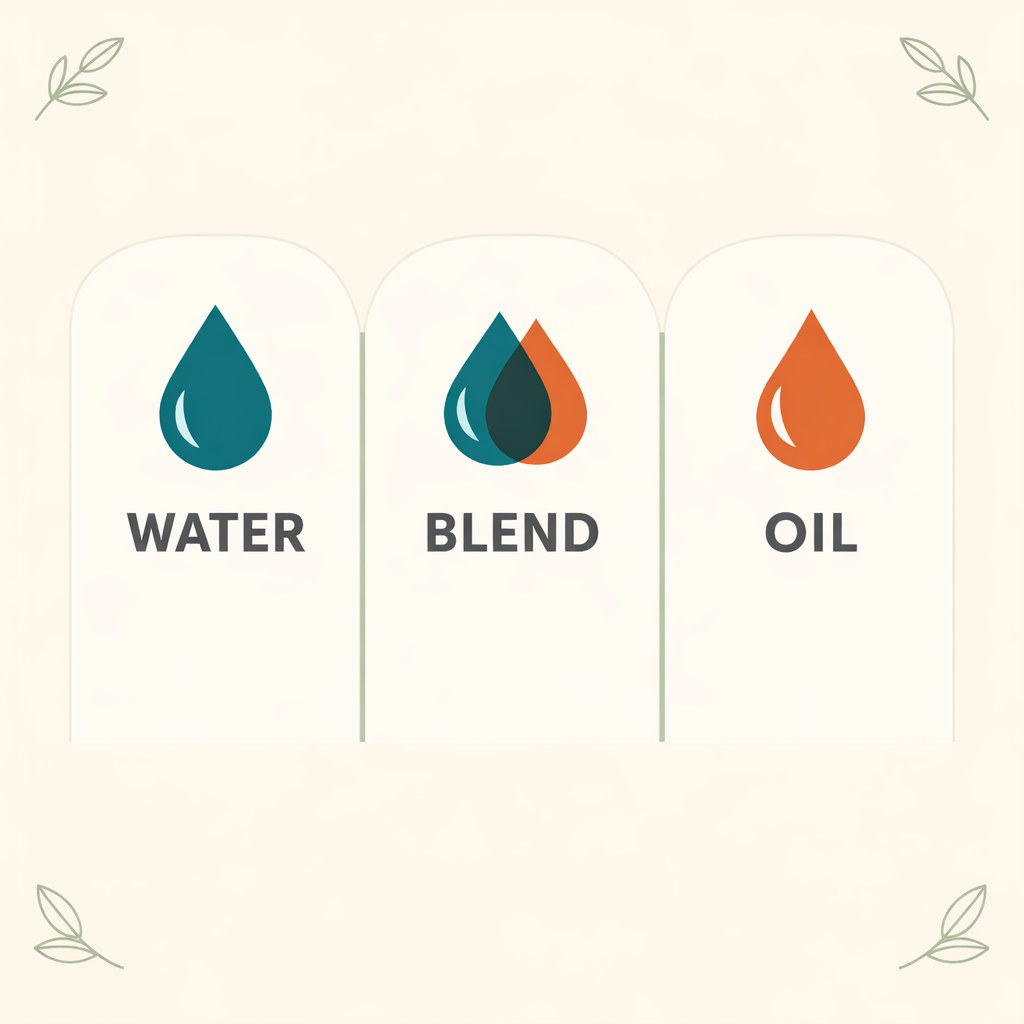
A serum is more than its headline ingredient. The base decides whether that ingredient stays stable, whether it reaches your skin in a useful form and whether the product feels good enough to use twice a day for months. Water-based serums are light and fast, and they suit hydration and water-loving actives. Emulsions blend the two worlds and make strong ingredients easier to live with. Anhydrous serums protect fragile actives and give drier, older skin the lipids it’s missing. So the next time you pick up a bottle, turn it over and read the first few ingredients. They’ll tell you more than the front label ever will.
Related Posts
 Sebaceous Glands: Your Skin Has Its Own Oil Factory and Here Is Why That Matters
 Your Bentonite Clay Has a Hometown and That Actually Matters for Your Skin
 Vitamin C Is an Acid but It Is Not an Alpha Hydroxy Acid and That Difference Matters
 The Best Peptide Creams and Serums Your Skin Has Been Waiting For
 The 10 Best Hand Moisturizers for Winter That Actually Fix Dry Skin
 Encapsulation in Skincare Sounds Impressive but Does It Actually Work
 Why Your Skin Takes So Much Longer to Bounce Back After 50
 Your Skin Has an Immune System and It Changes With Age
 Why Your Skincare Dupe Isn’t a Twin Even When the Ingredients Match
 Is Medical Grade Skincare Real or Just Clever Marketing
 What You’re Paying For in a $150 Moisturizer
 Darker Skin Doesn’t Age Later, It Ages Differently
