

Nov
If you click on links we provide, we may receive compensation.
You went to bed looking like yourself. Maybe you even caught your reflection in the hallway mirror on the way to brush your teeth and thought, not bad. Then morning comes, and the face in the bathroom mirror looks like it aged overnight. The eyes are heavier, there’s a crease running down one cheek, and the skin looks flat and a little gray. It’s an unsettling way to start the day, and it can sour your mood before you’ve even had coffee! The good news is that most of what you see at 7 a.m. isn’t aging at all. It’s plumbing, pressure and a skin barrier that’s had a long night, and most of it clears up on its own.
What happens to your face while you sleep?
Your body holds a lot of water, and gravity decides where much of it goes. During the day, when you’re upright, fluid tends to settle toward your legs and feet. That’s why shoes can feel tight by evening. When you lie flat for seven or eight hours, that pull changes direction, and fluid spreads more evenly through your body, including your face. The tissue around your eyes is thin and loose, so it’s one of the first places that extra fluid shows up. Cleveland Clinic describes morning puffiness as fluid building up in the thin layers of tissue around the eyes and eyelids, which can look like bags or dark circles (https://health.clevelandclinic.org/how-to-get-rid-of-bags-under-your-eyes). Once you’re up and moving, that fluid starts draining again, and most of the swelling fades within an hour or two.
This fluid shift doesn’t only affect the eyes. Some people notice a softer jawline, fuller cheeks or a slightly blurred look around the nose and mouth first thing in the morning. It’s subtle, but it changes how light falls on your face. Sharp edges catch light and read as lifted, while soft, swollen areas read as heavy. So a face that’s carrying a little extra water can look older even though nothing about its structure has changed. And because the swelling isn’t even, one side can look puffier than the other, especially if you slept on that side.
Can the way you sleep leave marks on your face?

Yes, and plastic surgeons have studied it. In a 2016 review in Aesthetic Surgery Journal, Goesel Anson, Michael Kane and Val Lambros described what they called sleep wrinkles. These form when your face is pressed against a pillow, which pushes, pulls and twists the skin in ways that don’t happen when you’re standing up. They noted that side sleeping is the most common position, at about 65 percent of sleep time in the studies they reviewed, with back sleeping around 30 percent and stomach sleeping about 5 percent (https://theaestheticsociety.org/media/press-releases?page=4). Those are the creases you see running down a cheek or across the forehead when you wake up.
What makes sleep wrinkles different is their direction. Expression lines come from muscles moving, so they run across the forehead or fan out from the eyes. Sleep lines often run in the opposite direction, at right angles to expression lines, and they tend to sit near the ligaments that anchor facial skin. The authors pointed out that this is why Botox doesn’t help them, since no muscle is causing the fold. Most mornings, the crease fades within minutes to a few hours as the skin bounces back. But younger skin bounces back faster than older skin, and that difference matters more over time.
Why does your skin look duller and drier first thing?
Your skin runs on a daily clock, and its barrier behaves differently at night. A 1998 study in the Journal of Investigative Dermatology measured water loss through the skin at different times of day and found clear daily rhythms (https://pubmed.ncbi.nlm.nih.gov/9424081/). The researchers concluded that skin is more permeable in the evening and at night than in the morning. More permeable skin lets more water escape, and it also lets more of what you apply soak in. If your bedroom air is dry, especially with the heat running in winter, you can wake up with skin that has lost more water than it took in.
Dry skin doesn’t reflect light evenly. Fine lines that you’d barely notice on well-hydrated skin become sharper when the surface is a little dehydrated. The skin can look gray or flat instead of bright. Add a few hours of lower blood flow while you’re lying still and you lose some of the color that makes a face look awake. None of this is permanent. A splash of water, a moisturizer and a walk to the kitchen often change the picture within the first hour.
Advertisement
Alcohol and salty dinners make all of this worse. Mayo Clinic lists fluid retention, lack of sleep and allergies among the common causes of bags under the eyes (https://www.mayoclinic.org/diseases-conditions/bags-under-eyes/symptoms-causes/syc-20369927). A late takeout meal or a couple of glasses of wine can leave you holding more water and sleeping less deeply. Both show up on your face. If your puffiest mornings line up with restaurant nights, that’s not a coincidence.
Does a bad night of sleep show on your face?

It does, and other people can see it. Researchers at the Karolinska Institute in Sweden photographed 10 people twice, once after a normal night’s sleep and once after 31 hours awake. Forty raters then looked at the photos without knowing which was which. In the sleep-deprived photos, people were seen as having more hanging eyelids, redder and more swollen eyes, darker under-eye circles, paler skin, more fine lines around the eyes and droopier corners of the mouth (https://pmc.ncbi.nlm.nih.gov/articles/PMC3738045/). They also looked sadder. That’s a long list of changes from one missed night, and almost every item on it reads as older.
Chronic poor sleep may do more than make you look tired. A study published in Clinical and Experimental Dermatology in 2015 compared 60 women aged 30 to 49, half good sleepers and half poor sleepers. After the researchers disrupted a small patch of skin barrier with tape, good sleepers recovered 30 percent more barrier function at 72 hours than poor sleepers did (https://pubmed.ncbi.nlm.nih.gov/25266053/). Good sleepers also had lower scores for intrinsic aging signs and recovered faster from UV redness. It’s a small study, and it was funded by a cosmetics company, so I wouldn’t treat it as the final word. But it points in the same direction as everything else. Skin that doesn’t get its overnight repair time doesn’t bounce back as well.
How can you tell temporary changes from real aging?
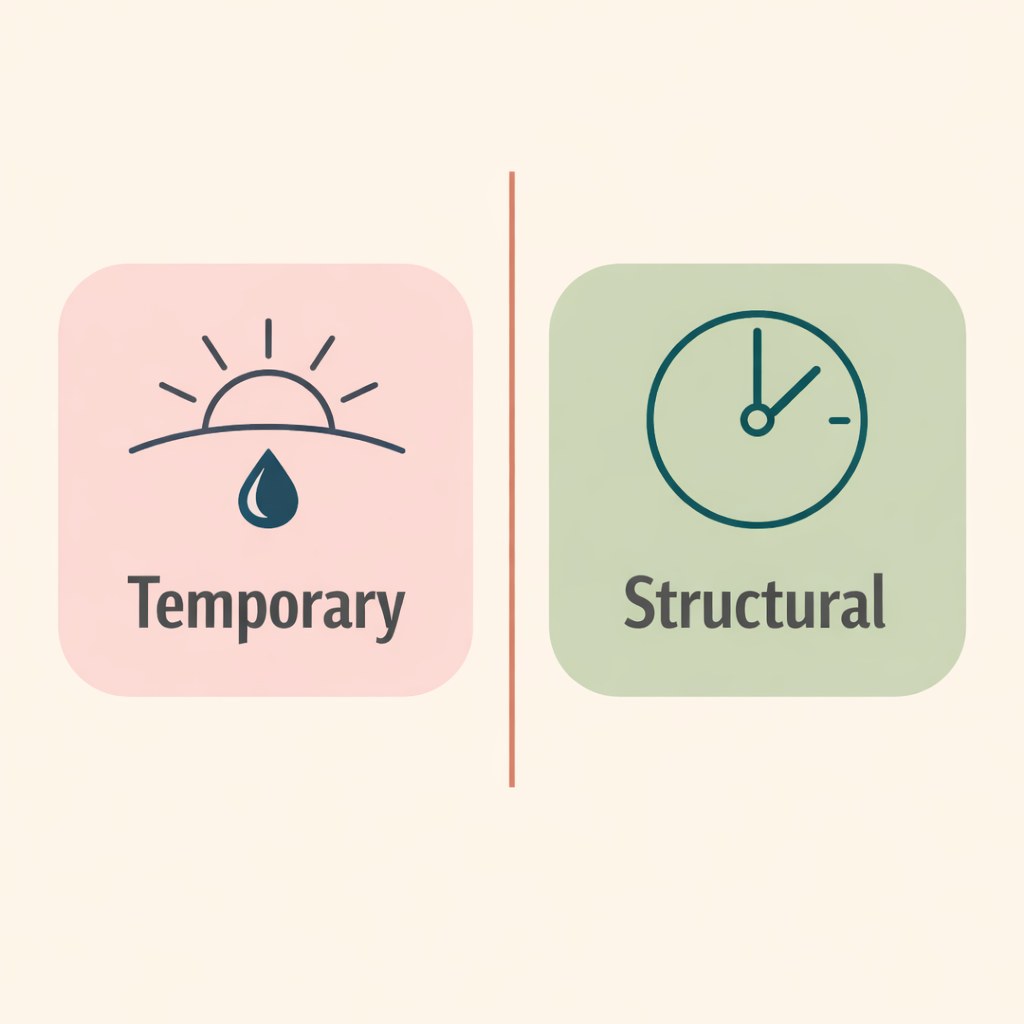
This is the question that matters most, because it tells you where to spend your money and your worry. The simplest test is time. Look at your face when you wake up and again around noon. If the puffiness, creases and dullness are mostly gone by lunch, you’re looking at fluid, pressure and dehydration. If the same features are there at noon, at 5 p.m. and the next morning, you’re looking at structure. Structure means changes in collagen, fat pads, bone and the ligaments that hold everything in place.
Mayo Clinic describes the structural side of under-eye bags clearly. As you age, the tissues around your eyes weaken, including some of the muscles supporting the eyelids, and fat that normally supports the eye can move forward into the lower lids. That kind of bag doesn’t drain away after breakfast. It’s there all day, it may look worse in overhead light, and it usually has a defined edge or a shadow beneath it. Morning fluid, by contrast, tends to look soft, spread out and a bit shiny. You can often press it gently and see it shift.
Sleep creases follow the same logic. A line that appears in the morning and fades by mid-morning is a temporary fold. A line that’s still there at the end of the day, in the same spot where you always sleep, has started to become permanent. The Anson review made exactly this point. Sleep wrinkles worsen over time because the same compression repeats night after night, combined with thinner skin and less elasticity as we age (https://practicaldermatology.com/news/study-sleeping-it-off-is-no-wrinkle-cure/2458486/). So a temporary crease today can be a structural line in ten years if nothing changes.
Why does this get worse with mature skin?
Everything I’ve described happens at any age, but it hits harder after 50 and harder still after 60. Thinner skin shows swelling and creasing more easily because there’s less cushion between the surface and what’s happening underneath. Less elastic skin takes longer to recover from a fold, so a sleep crease that disappeared in ten minutes at 35 might hang around until lunch at 65. The barrier also tends to hold water less well with age, which makes overnight dryness more visible. And the supports around the eyes are weaker, so fluid has more room to collect.
There’s another detail from the sleep wrinkle research that surprised me. The number of times people shift position during the night drops with age, from about 27 shifts to about 16 (https://practicaldermatology.com/news/study-sleeping-it-off-is-no-wrinkle-cure/2458486/). Fewer shifts means longer stretches with the same part of your face pressed into the pillow. Over years, that adds up. It’s one reason many people over 60 notice that one side of their face has more lines than the other, and it’s usually the side they sleep on.
None of this is cause for alarm. It just means that for mature skin, the line between a temporary morning look and a lasting change is thinner. The habits that reduce morning puffiness and creasing are also the habits that slow down how quickly those temporary changes become permanent ones. That makes them worth doing, even if the payoff takes years to see. And the morning fixes still work, they just may take a little longer.
Which skincare habits make a visible difference in the morning?

Cold is the most reliable quick fix. A cool compress, a chilled gel mask or a washcloth run under cold water can shrink swelling around the eyes within minutes. Cleveland Clinic suggests lying down with a cold, wet washcloth over your eyes for a few minutes, since the cold narrows blood vessels and reduces swelling. Mayo Clinic also lists cool compresses among the at-home remedies that help. It won’t change your face for the day, but it speeds up what your body would do anyway once you’re upright. A gel mask kept in the fridge is handy for mornings when you have somewhere to be.
Caffeine eye creams have some evidence behind them, though it’s modest. Caffeine narrows blood vessels when applied to the skin, which can reduce puffiness and the bluish tone of some dark circles for a few hours. Most of the studies are small and many are run by brands, so expect a mild, short-term improvement rather than a dramatic one. Keeping the cream in the refrigerator adds the benefit of cold. Pat it on with your ring finger rather than rubbing, because rubbing the eye area can make swelling worse.
Night moisturizer matters more than most people think. Since skin loses more water overnight, a moisturizer with humectants like glycerin or hyaluronic acid, plus something that seals water in, like ceramides, squalane or a light occlusive, helps you wake up with plumper skin. Plump skin hides fine lines better, and that’s a visible difference you can see the next morning. A humidifier in the bedroom during heating season helps for the same reason. One caution for the eye area is that very rich creams applied close to the lash line can leave some people puffier in the morning. If that happens to you, stop your night cream about a finger’s width below the lower lashes.
Head position is free and it works. Mayo Clinic suggests sleeping with your head slightly raised, either with an extra pillow or by propping up the head of the mattress. A small incline gives fluid a direction to drain overnight. If you’re a stomach sleeper, moving to your side is an improvement, and moving to your back is better still. The Anson team admitted that changing sleep position is hard to do on purpose, but contoured pillows designed to keep your face off the pillow surface can help.
What about silk pillowcases, face rollers and drinking more water?
Silk and satin pillowcases are popular, and the reasoning makes sense. They create less friction than cotton, so your skin may slide instead of being dragged into a fold. But the evidence for silk reducing wrinkles is thin, and it won’t prevent compression if you’re pressing your face into the pillow for hours. Think of it as a small comfort upgrade, not a treatment. If you like how it feels, there’s no harm in using one. Just don’t expect it to undo side sleeping.
Face rollers, gua sha and gentle facial massage can move morning fluid along faster. Light strokes from the center of the face outward and down toward the neck follow the general path of lymph drainage, and many people see less puffiness after a few minutes. The effect is temporary, like a cold compress. Use light pressure and a little moisturizer or oil so you’re not tugging the skin. Done gently, it’s a pleasant way to speed up what happens naturally once you’re up and about.
Drinking more water is good for you, but it’s not a direct skin fix for most people. If you’re truly dehydrated, your skin will show it, and drinking more will help. But for people who already drink a normal amount, extra glasses don’t seem to plump the skin in a way you can see. Ironically, cutting back on salt and alcohol at night often does more for morning puffiness than drinking more water. Your body holds onto water when it’s processing sodium, and that’s what shows up under your eyes.
Which habits change how your face ages over time?

The morning fixes deal with fluid and dryness. They don’t touch collagen, fat pads or bone. For the structural side, the tools are the same ones dermatologists have recommended for years. Daily broad-spectrum sunscreen is the most proven way to slow visible skin aging, because UV light breaks down collagen and elastin. Retinoids, used at night, help skin make new collagen over months, which can make skin thicker and better at bouncing back from folds. Both work slowly, and neither will make a difference you can see tomorrow morning.
Sleep itself belongs on this list. The Swedish and Cleveland studies both suggest that skin recovers better when you sleep well. That’s hard advice to follow when sleep gets lighter with age, but small changes help. A cooler bedroom, less alcohol close to bedtime and a consistent wake time all support deeper sleep. Better sleep won’t erase lines you already have. But it gives your skin its full repair window every night.
Sleep position is the long-term habit most people never think about. If you always sleep on your right side with your face pressed into the pillow, you’re repeating the same fold thousands of times a year. Training yourself to sleep on your back is difficult, and plenty of people never manage it. A contoured pillow or a slightly firmer pillow that keeps your cheek from sinking in is a reasonable middle ground. Over years, reducing that pressure may mean fewer deep creases on your sleep side.
FAQs
Why do I look older in the morning than at night?
Mostly because of fluid that spreads into your face while you lie flat, creases from pressing your face into the pillow, and skin that lost water overnight. All three make the face look heavier and less smooth. Most of it fades within a few hours of getting up. If something is still there in the evening, it’s more likely a structural change.
How long does morning face puffiness usually last?
For most people, it settles within one to two hours of being upright and moving. Cold compresses, gentle massage and a splash of cold water can speed that up. Puffiness that lasts all day, keeps getting worse or comes with itching, redness or vision changes is worth showing to your doctor. Mayo Clinic notes that persistent swelling can sometimes be linked to allergies, thyroid problems or other conditions.
Are sleep lines permanent?
Not at first. A sleep crease is a temporary fold that fades as the skin recovers. But repeated night after night, in the same spot, it can become a lasting line, especially as skin loses elasticity with age. Changing your sleep position or pillow can reduce how often that fold forms.
Do caffeine eye creams work for morning puffiness?
They can help a little. Caffeine narrows blood vessels, which may reduce swelling and some dark circles for a few hours. The research is mostly small studies, so expect a mild effect. Keeping the cream cold and applying it gently adds to the benefit.
Can a better night cream make me look younger in the morning?
It can make you look more rested. A moisturizer that attracts and holds water helps your skin stay plump overnight, so fine lines are less visible when you wake up. It won’t change structural aging on its own. For that, daily sunscreen and a nighttime retinoid are the better-proven choices.
The face you see at 7 a.m. is a rough draft. It’s your face plus a night of gravity, pillow pressure and dry air, and most of that edits itself out by midmorning. That’s worth remembering on the mornings when the mirror feels unkind. The changes that stay with you all day are the ones worth long-term attention, and those respond to slow, steady habits like sunscreen, retinoids, good sleep and less pressure on your face at night. The rest is just morning. Give it an hour, a cold splash and a cup of coffee before you judge.
Related Posts
 The Foam on Your Face Wash Might Be the Problem
 The Exfoliation Secret Older Skin Has Been Waiting For
 What to Actually Look for in an Under Eye Dark Circle Cream
 Why Doctors Call Part of Your Face the Triangle of Death
 Beauty Breakthroughs That Actually Matter: What Innovation Looks Like Beyond the Label
 Why Pharmaceutical Grade on a Skincare Label Isn’t the Promise It Sounds Like
 What a Hot Delivery Truck Really Does to Your Skincare
 Why Your Skincare Dupe Isn’t a Twin Even When the Ingredients Match
 What You’re Paying For in a $150 Moisturizer
 Can Glitter Eye Makeup Hurt Your Eyes? Here’s the Honest Answer
 What Your Eye Cream Can Fix and What It Never Will
 Why Your Hair Is Changing Right Along With Your Skin
