Nov
If you click on links we provide, we may receive compensation.
You find the perfect shimmer for a holiday party. It catches the light every time you laugh, and for a few hours you feel a little more like yourself. Then, somewhere around dessert, one eye starts to sting. You’re dabbing at it with a napkin and trying to look like nothing’s wrong. It happens to a lot of people, and it raises a fair question. Is a bit of sparkle worth it, or are you pressing tiny bits of metal, glass and plastic onto the most delicate skin on your face? The short answer is that eye glitter is mostly safe when you pick the right product and use it with some care. But “mostly” carries a lot of weight here, and the details matter more than most labels let on.
What is eye glitter made of, anyway?
Sparkle in makeup comes from a handful of materials, and they don’t all behave the same way. The most common is mica, a natural mineral that splits into very thin, flat flakes. Makers coat those flakes with titanium dioxide or iron oxides to get pearl, gold, bronze and colored shimmer. Synthetic mica, which you’ll see listed as synthetic fluorphlogopite, is grown in a lab and tends to be smoother and more uniform than the mined kind. Then there are glass-based flakes, listed as calcium sodium borosilicate or calcium aluminum borosilicate, which give that sharp, multi-colored flash you see in “glitter” shadows and toppers.
Classic glitter is something else. It’s usually a thin plastic film, often PET, coated with a layer of aluminum and color, then cut into tiny squares or hexagons. Some products also use pure metal powders, like aluminum, bronze or copper powder, for a foil look. Shape and size matter as much as the material. A fine shimmer you can barely feel between your fingertips sits flat on the skin and moves with it. A chunky hexagon you can see from across the room has edges and corners, and those edges are what you don’t want rolling around under your eyelid.
What does the FDA allow near your eyes?
In the U.S., the FDA regulates the coloring ingredients in cosmetics, and the eye area gets its own, shorter list. The agency says plainly that a number of color additives approved for cosmetics in general are not approved for use around the eye (https://www.fda.gov/cosmetics/cosmetic-products/eye-cosmetic-safety). Its color additive chart shows mica, aluminum powder, bronze powder and copper powder as permitted in the eye area (https://www.fda.gov/cosmetics/cosmetic-ingredient-names/color-additives-permitted-use-cosmetics). That’s why so many shimmer shadows lean on mica and metal powders. They’re on the approved list for this exact use.
Plastic glitter is a grayer area. The FDA’s list covers colors, not plastic flakes, and coated PET glitter doesn’t appear on it by name. Cosmetic suppliers have debated for years whether that makes it a color additive that needs approval, and plenty of eye products still contain it. I won’t pretend the rules here are tidy, because they’re not. The practical move is simple. Buy products that say they’re made for the eyes, and when a jar of loose pigment or body glitter says “not intended for use in the immediate eye area,” take that warning at its word.
Craft glitter is the one firm no. It’s cut from hard plastic or metal-backed film, the pieces are often larger and sharper, and the dyes aren’t made for skin. All About Vision describes craft glitter as unsuitable for skin, let alone the eyes (https://www.allaboutvision.com/eye-care/cosmetic/glitter-eye-makeup/). The same goes for craft glue, even the kind labeled non-toxic. Non-toxic means it won’t poison a child who eats it. It doesn’t mean it’s safe on a thin eyelid or near a wet eye.
Can glitter really scratch your eye?

Yes, it can. The American Academy of Ophthalmology names glitter eye makeup as a common cause of corneal irritation and infection, especially in contact lens wearers, and warns that larger glitter can scratch the eye (https://www.aao.org/eye-health/tips-prevention/eye-makeup). The cornea is the clear front surface of your eye, and it’s packed with nerve endings. That’s why a speck you can’t even see feels like a boulder. A scratch on it is called a corneal abrasion. It usually brings a gritty, something’s-in-there feeling, watering, redness, light sensitivity and sometimes blurry vision.
Most small scratches heal in a few days. The bigger worry is what a scratch lets in. The FDA notes that even a slight scratch from a makeup applicator can lead to a serious infection, and that eye cosmetic infections have, in rare cases, caused temporary or permanent blindness (https://www.fda.gov/cosmetics/cosmetic-products/eye-cosmetic-safety). The way most people turn a nuisance into an injury is rubbing. A flake trapped under the upper lid gets dragged back and forth across the cornea every time you rub, and every pass is another chance to scratch. If you remember one thing from this article, make it that. Don’t rub.
How does glitter get into your eye in the first place?
Some of it falls in while you’re applying it. Loose glitter and dry, flaky formulas shed onto your lashes and lower lid, and from there it’s a short trip. The rest migrates over the day as you blink, tear up, laugh and touch your face. A study from the University of Waterloo, published in Eye and Contact Lens, tracked glitter eyeliner and found particles moving into the tear film within five minutes (https://uwaterloo.ca/news/news/study-finds-eyeliner-application-may-cause-eye-problems). When liner went on inside the lash line, 15 to 30 percent more particles reached the tear film than when it was applied outside the lashes.
Advertisement
That finding matters because placement is something you control. The rim of your eyelid holds a row of tiny oil glands called meibomian glands. They release the oily layer that keeps your tears from evaporating too fast. The AAO advises keeping makeup outside the lash line because product there can block those glands. Sparkly liner on the waterline is about the worst combination there is. You’re putting particles right where they can slide into the eye and clog the glands that protect it.
Who is more likely to have trouble with eye glitter?
Contact lens wearers top the list. A lens can trap a flake against the cornea, so there’s nowhere for it to go and nothing to cushion it. Dr. Alison Ng, who led the Waterloo study, also pointed out that makeup deposits build up on lenses and can make them cloudy. If you wear contacts, put them in before makeup and take them out before you remove it. Daily disposable lenses help, because you start each day with a clean lens.
People with sensitive eyes, dry eyes or eyelid eczema tend to react faster too. Sometimes the sparkle isn’t the problem at all. Fragrance, preservatives, binders and certain dyes in the formula can irritate thin lid skin on their own. If one shimmer bothers you and another doesn’t, the difference may be the base rather than the glitter. A small patch test on the inner arm or behind the ear, done a day or two before a big night out, can save you a red, puffy eye at the worst possible time.
Why do older eyes and mature skin need extra care with sparkle?
Dry eye becomes much more common with age, and that changes how your eyes handle anything that lands in them. A study of U.S. adults found that about 6.8 percent, or roughly 16.4 million people, had diagnosed dry eye disease (https://pubmed.ncbi.nlm.nih.gov/28705660). The rate rose from 2.7 percent in adults 18 to 34 to 18.6 percent in those 75 and older. Women were affected nearly twice as often as men, at 8.8 percent versus 4.5 percent. Fewer tears means less fluid to wash a stray flake out, so particles linger and feel scratchier.
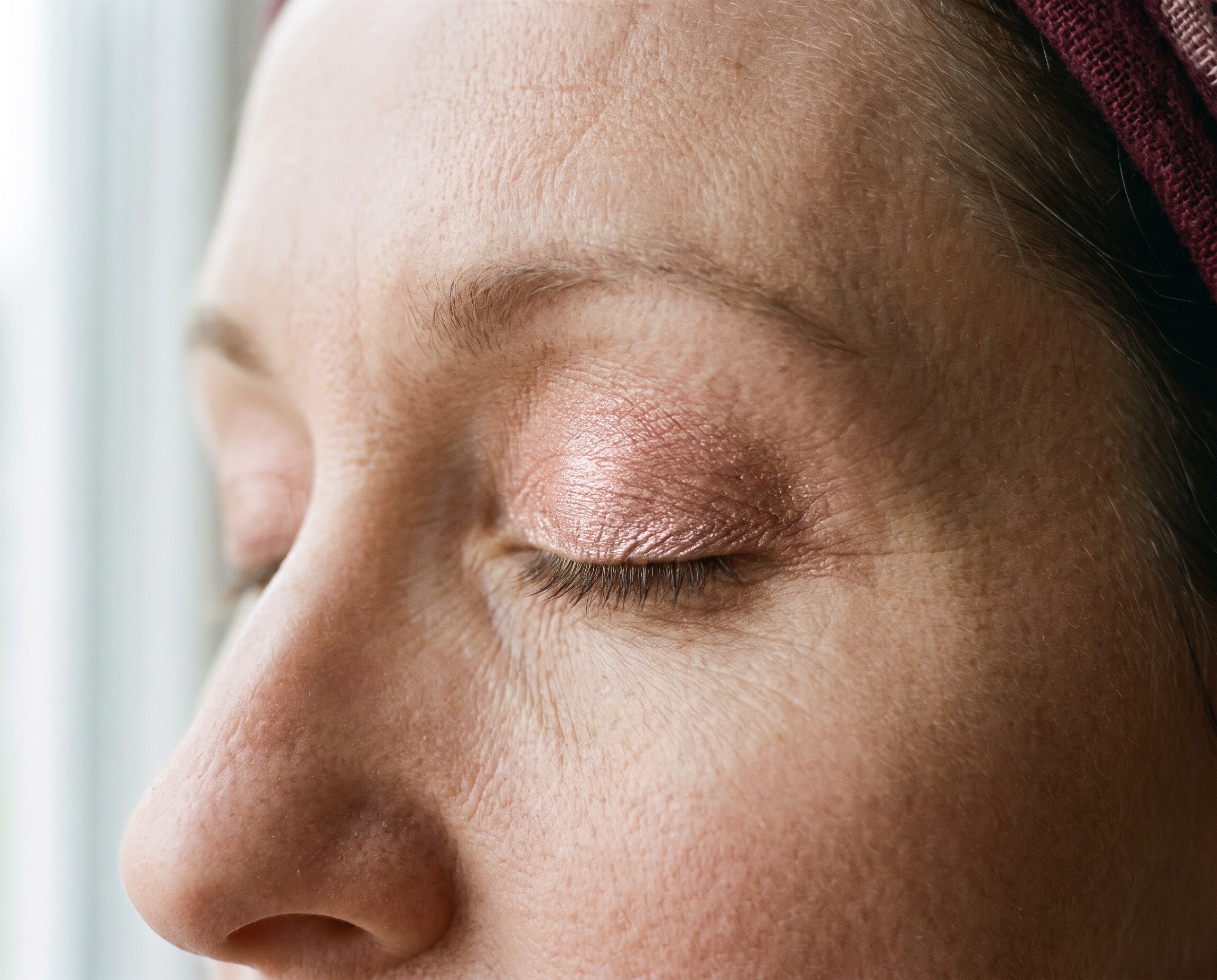
The skin around the eye changes too. Eyelid skin thins, loses some firmness and develops a crepey texture. Many of us end up with lids that hood a little over the crease. Chunky glitter settles into those folds and lines and makes them look deeper, which is the opposite of what most people want from sparkle. On hooded lids, product also gets pressed against the skin above the crease all day and sheds as it rubs. A fine, satin shimmer on the center of the lid catches light softly and stays put far better than big flecks.
A few more things are worth thinking about after 50 and 60. Oil gland problems along the lid margin get more common with age, which is one more reason to keep anything sparkly well away from the lash line. If you’ve had cataract surgery, LASIK or eyelid surgery, your surgeon will tell you how long to skip eye makeup, and glitter should be the last thing you bring back. And if you wear readers, apply your eye makeup with a magnifying mirror. It’s easy to overload a lid you can’t see clearly, and more product means more fallout.
How can you wear sparkle more safely?

Start with the product. Choose formulas made for the eyes, and lean toward fine shimmer over chunky glitter. Pressed powders, creams and liquid glitter shadows hold particles in a binder, so they shed far less than loose glitter in a jar. If you love loose glitter, use a primer or glitter base made for the eye area, not a lash glue and never a craft glue. Pressing glitter into a tacky base keeps it on the lid rather than in your lashes.
Technique matters just as much. Look down into a mirror held below your face so your lid is smooth and your eye is partly covered. Tap off excess from the brush before it goes near your face. Lay a tissue or a strip of cotton under your eye to catch fallout, and do your eye makeup before foundation so any specks are easy to clean up. Keep sparkle on the center of the upper lid and away from the waterline and inner corner. And skip the car or train. The FDA specifically warns against applying eye makeup in a moving vehicle, because one bump can put an applicator in your eye.
Basic hygiene does a lot of quiet work here. The FDA says not to share eye cosmetics, not even with your best friend, because someone else’s germs may be harmful to you. The AAO suggests tossing liquid and creamy eye products after three months, since bacteria grow easily in them. Wash your brushes regularly. And if you’ve had an eye infection, throw out whatever you were using when it started.
What’s the right way to take glitter off?

Glitter removal is where a lot of irritation happens, because people scrub. Take out contact lenses first. Then soak a lint-free pad with an oil-based cleanser or micellar water and hold it against your closed eye for 20 or 30 seconds. That loosens the binder so the particles let go. Wipe gently down and out, away from the eye, rather than rubbing in circles.
Leftover specks are easier to lift than to wipe. All About Vision suggests using a clean cotton swab with your eyes closed to pick off what’s left (https://www.allaboutvision.com/eye-care/cosmetic/glitter-eye-makeup/). Rinse with lukewarm water and pat dry. Check your lashes in good light, because glitter loves to hide at the base of them. Then follow up with your usual eye cream or a plain, fragrance-free moisturizer. And please don’t sleep in it. The AAO recommends removing all eye makeup every night, and glitter is the last thing you want working its way onto your pillow and into your eyes at 3 a.m.
What should you do if glitter gets in your eye?
First, don’t rub. Blink a few times and let your tears try to do the job. If that doesn’t work, rinse the eye with preservative-free artificial tears or sterile saline. If you wear contacts, take the lens out, rinse your eye, and leave the lens out until the eye feels normal again. Don’t use redness-relief drops to cover the problem, because they can hide symptoms you need to notice.
Most of the time, the gritty feeling fades once the particle is gone. Call an eye doctor if pain, blurred vision, light sensitivity or redness keeps going after rinsing, or if you still feel like something is stuck in there. Discharge, swelling or worsening pain over the next day or two can mean infection and need prompt care. An eye doctor can find a trapped flake with a special light and dye, remove it safely and check the cornea for a scratch. Treatment is often simple, like lubricating drops or antibiotic drops, but only if you get it on time.
FAQs
Is mica safe to use around the eyes?
Mica is on the FDA’s list of color additives permitted in the eye area, and it’s the base of most shimmer eyeshadows. The flakes are thin and flat, so they sit smoothly on the lid. Problems usually come from too much product, loose formulas that shed, or application on the waterline. Keep it on the lid and remove it fully at night.
Is loose glitter worse than pressed or cream glitter?
In general, yes. Loose glitter has no binder holding it in place, so more of it falls onto your lashes and lower lid. Pressed, cream and liquid formulas grip the particles and shed much less. If you use loose glitter, press it into an eye-safe glitter base and catch fallout with a tissue.
Can I wear glitter eyeshadow if I wear contact lenses?
You can, but take extra care. Put your lenses in before makeup and take them out before removal. Stick with fine shimmer over chunky glitter, keep it off the lower lid, and consider daily disposable lenses. If a flake gets under a lens, remove the lens right away rather than blinking through it.
Is biodegradable glitter safer for my eyes?
Not necessarily. Biodegradable and plant-based glitters are an answer to plastic pollution, not to eye safety, and a sharp flake is still a sharp flake. The EU began restricting plastic microplastic glitter in October 2023, though makeup products have until October 2035 to comply (https://www.gcimagazine.com/ingredients/regulatory/news/22877020/how-the-eu-microplastics-ban-affects-glitter). Judge any glitter on size, shape and whether it’s labeled for eye use.
Can I use body or face glitter on my eyelids?
Only if the label says it’s safe for the eye area. Many body and face glitters use larger particles or colors that aren’t approved near the eye. When the package says to avoid the immediate eye area, follow that. It’s there for a reason.
How do I know if I’ve scratched my cornea?
A scratched cornea usually feels like sand or grit that won’t go away, even after rinsing. You may also notice watering, redness, light sensitivity or blurry vision. These signs mean it’s time to see an eye doctor rather than wait it out. Early care lowers the chance of infection.
I don’t think you need to give up sparkle to protect your eyes. You just need to be a little picky about it. Choose products made for the eye area, favor fine shimmer over chunky flakes, keep it off the waterline, and take it off gently every night. If your eyes run dry, or you wear contacts, or you’ve had eye surgery, give yourself even more margin. A bit of shimmer on the lid can lift a whole look, and it shouldn’t come with a sore, red eye the next morning. Wear it with care, and it can stay what it’s meant to be, which is fun.
Related Posts