
Oct
If you click on links we provide, we may receive compensation.
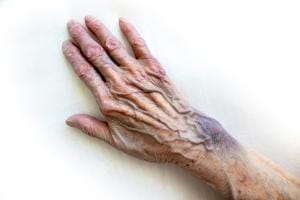
Around 60 percent of adults over the age of 70 deal with dry, flaky skin – a condition dermatologists call xerosis cutis – according to a systematic review published in Geriatric Nursing (https://www.sciencedirect.com/science/article/abs/pii/S0197457223002422). It is one of the most common skin complaints in older age, yet many families treat it as an unavoidable fact of life rather than something that can genuinely be improved. If your grandmother’s skin looks scaly on her shins, arms, or hands, or if she is constantly scratching at dry patches, there are real biological reasons behind it and practical steps that make a meaningful difference. Flaky skin in older adults is not a sign of poor hygiene or neglect. It is the result of decades of gradual change inside the skin itself, often made worse by habits that once felt perfectly harmless.
The science behind it is more interesting than most people expect. Older skin does not simply dry out the way a sponge dries out in the sun. The entire architecture of the skin’s surface layer changes, and several systems that used to work together start falling behind at the same time. Knowing what is actually happening makes it far easier to choose the right care – and to stop doing things that make the problem worse without meaning to.
What Actually Happens to Skin As We Age?
The outermost layer of skin – the stratum corneum – is a tightly packed arrangement of dead cells held together by a mix of fats called ceramides and a group of water-binding molecules called natural moisturizing factor, or NMF. In younger skin, a protein called filaggrin is produced deeper in the epidermis and then breaks down into amino acids, lactic acid, and other compounds that form NMF. These molecules pull water from the surrounding environment and hold it inside the cells, keeping the surface soft and flexible. As skin ages, filaggrin production slows, NMF levels fall, and the skin’s ability to bind its own moisture quietly declines. The surface begins to feel rough and eventually starts to flake.
At the same time, the sebaceous glands – the small oil-producing glands attached to hair follicles – reduce their output as part of the normal aging process. Their secretions form part of the surface film that seals moisture inside and prevents environmental irritants from getting through. With less of that film, water evaporates more rapidly through the skin in a process called transepidermal water loss, or TEWL. Ceramide levels also drop with age. A 2017 study published in the Journal of Dermatological Nursing found that a skincare regimen using a ceramide and filaggrin formulation significantly improved xerosis, pruritus, and quality of life in older adults within just one week (https://pubmed.ncbi.nlm.nih.gov/28600081/). That rapid improvement tells you how important these molecules are when they are properly replenished from the outside.
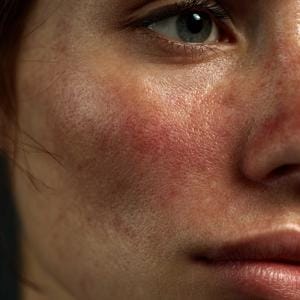
The result is a skin barrier that functions like a slightly crumbled wall rather than a smooth one – with gaps where moisture escapes too fast and patches where irritants get through too easily. The surface catches light differently, giving that characteristic dull, powdery, or flaky appearance that is so common in older women. None of this happens overnight. It accumulates over decades, which is why the change feels gradual to the person living in that skin and can look sudden to family members who see them less often.

Why Does Menopause Make Flaky Skin So Much Worse?
This deserves its own section because menopause adds another significant layer of change on top of what normal biological aging already does – and it affects women in a way that is measurable, specific, and frequently underappreciated by both patients and their families. Estrogen stimulates the production of both collagen and hyaluronic acid, the large molecule responsible for binding water in the deeper layers of skin tissue. When estrogen levels begin to fall during perimenopause and then drop sharply after menopause, both of those systems are dialed down at the same time. Research published in the GREM Journal in 2024 found that skin loses approximately 30 percent of its collagen in the first five years after menopause (https://gremjournal.com/journal/01-2024/menopause-and-the-effects-of-hormone-replacement-therapy-on-skin-aging-a-short-review/). That is not a slow background erosion – it is a rapid structural change happening while everything else is also shifting.
The thinning of the dermis that follows means the skin holds less water overall. The drop in sebum production that accompanies estrogen decline means less surface oil to trap what moisture remains. And the slowed cellular turnover that comes with both aging and low estrogen means dead skin cells pile up at the surface rather than shedding smoothly – which is a key reason flaky patches often look powdery or have a slightly whitish cast rather than just feeling dry to the touch. For women who crossed menopause more than a decade ago, which describes many grandmothers in their late 60s or 70s, all of these changes have had years to compound. A woman in that age range may be managing the aftermath of natural aging, the hormonal effects of menopause, and the cumulative result of years of care products that were never designed for this kind of skin, all at once.
Hormone replacement therapy can improve skin hydration, elasticity, and thickness in some post-menopausal women – and recent data suggests topical estrogen preparations may have direct skin-level benefits as well. But it is not the right path for everyone, and it is not the only path. What matters for daily skin care is accepting that post-menopausal skin needs formulas engineered to rebuild what the body is no longer making in sufficient quantities, rather than lighter lotions designed for younger skin.
Are Everyday Habits Making Things Worse?
In many cases, yes – and this is actually encouraging, because habits can be changed. The most controllable culprit is hot water. Long, hot showers dissolve the thin film of natural oil on the skin surface, and the longer the shower runs, the more of that film is stripped away. Older skin has less of it to begin with, so even a moderately warm shower taken daily can tip a fragile barrier into visible flaking. Dermatologists at the American Academy of Dermatology recommend warm – not hot – water and showers of five to ten minutes, followed by moisturizer applied within a few minutes of patting dry (https://www.aad.org/public/everyday-care/skin-care-basics/dry/dermatologists-tips-relieve-dry-skin).
The choice of cleanser matters enormously. Most traditional bar soaps have an alkaline pH of around 9 to 10, but the healthy skin surface sits at around 5 to 5.5 on the pH scale. Using an alkaline product repeatedly disrupts this balance, activating enzymes that break down the lipid barrier and actually suppressing the production of new ceramides. The National Institute on Aging notes that older adults with dry skin should choose mild, fragrance-free cleansers with a low alkaline rating (https://www.nia.nih.gov/health/skin-care/skin-care-and-aging). Fragrance is a common sensitizer in already-compromised skin, whether it appears in soap, body wash, or lotion.
Indoor environments contribute more than many people realize. Central heating and air conditioning both strip humidity from the air, which raises TEWL continuously throughout the day and overnight. A room humidifier kept in the bedroom – set to around 50 percent relative humidity – can noticeably reduce how dry skin feels by morning. And scratching at flaky patches, however satisfying in the moment, damages the barrier further, introduces potential for infection, and creates a cycle of irritation and dryness that takes considerably longer to resolve than the original dryness did.

Which Ingredients Actually Repair Flaky Older Skin?
Not all moisturizers do the same work. Older, very dry skin needs a combination of three types of ingredient: humectants to pull water into the skin cells, emollients to fill the gaps between cells and smooth the surface texture, and occlusives to seal moisture in and slow evaporation. A lotion containing only glycerin – a good humectant – will feel refreshing but will not hold moisture in very dry or compromised skin for long on its own. A thick petrolatum-based balm seals well but does not actively hydrate. The most effective products for older skin combine all three categories in a single formula.


Urea is one of the most effective and underused ingredients for flaky skin in older adults. It is a natural component of NMF, which means skin already knows how to work with it. At concentrations of 5 to 10 percent, urea acts as a powerful humectant. At 10 to 20 percent, it also gently loosens the bonds between dead surface cells, which reduces visible flaking without the abrasion or irritation that can come from physical scrubbing. Research consistently rates urea as effective for geriatric xerosis, and it is available in pharmacy creams without a prescription. Lactic acid at 5 to 12 percent works similarly – it both loosens dead cells and stimulates ceramide production inside the stratum corneum, addressing two parts of the problem at once.
Ceramides applied topically can reinforce the barrier’s structure directly. Hyaluronic acid in a serum applied to damp skin draws water from the surface moisture layer into the skin. And niacinamide at 4 to 5 percent helps rebuild barrier lipids while also reducing redness and uneven tone – both common in post-menopausal skin. None of these ingredients require a prescription. They appear in drugstore and pharmacy products at various price points, though concentration matters: an ingredient listed near the bottom of a product’s label may not be present in any meaningful amount.
Applying moisturizer to completely dry skin produces noticeably worse results than applying it to skin that is still slightly damp – within three to five minutes of stepping out of the shower or bath.
How Should Moisturizer Actually Be Applied?
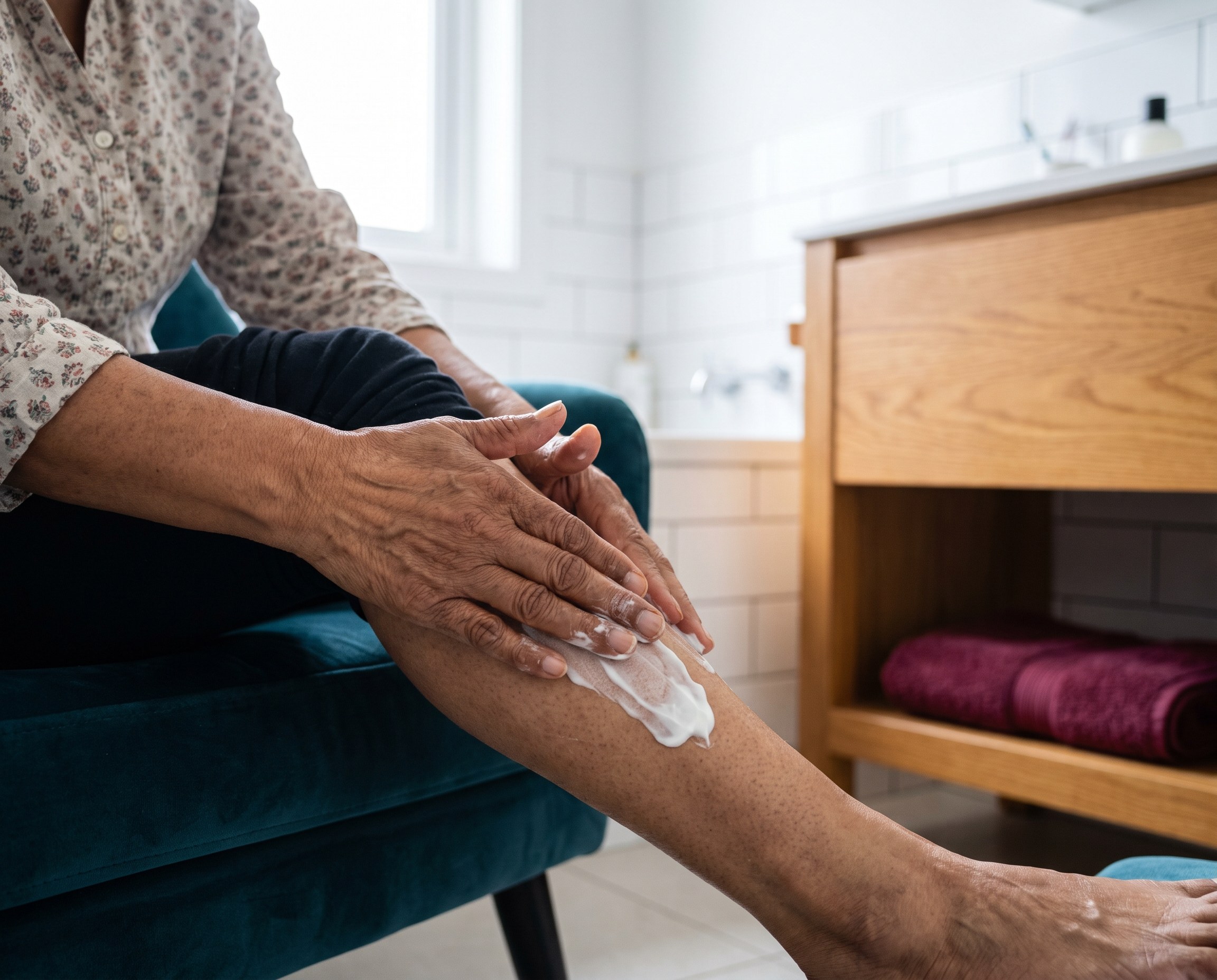
Technique is underestimated. Applying moisturizer to completely dry skin produces noticeably worse results than applying it to skin that is still slightly damp – within three to five minutes of stepping out of the shower or bath. The moisturizer traps the residual surface water rather than having nothing to work with. Skin should be patted rather than rubbed with a towel, leaving a slight moisture film on the surface before the cream goes on. This one change alone often produces a visible improvement in how well a moisturizer performs, especially for legs and shins where flaking tends to be most severe.
The lower legs deserve particular attention because the skin there has fewer sebaceous glands than almost anywhere else on the body, and the circulation to that area is slower, both of which make it harder to maintain a healthy barrier without extra help. A thick cream or ointment rather than a lightweight lotion works better for this area. Body lotions are typically 60 to 70 percent water and absorb quickly – which feels pleasant but may not provide sufficient occlusion for very dry, aged skin. Applying a heavier cream twice a day – once after bathing and once before bed – produces better outcomes for most older adults than once-daily use.

When Should Flaky Skin See a Doctor?
Most flaky skin in older adults is simple xerosis that responds to gentler habits and better moisturizer within a few weeks. But some conditions that cause flaking in later life are not xerosis at all, and it is worth knowing the difference. Psoriasis produces thick, silvery-white scales over sharply defined red plaques and can appear for the first time in later life. Eczema in older adults tends to show up on the inner arms, behind the knees, and on the hands, often accompanied by intense itching and occasional weeping. Hypothyroidism – an underactive thyroid – is more prevalent in older women and commonly causes dry, rough skin over most of the body; it is diagnosed easily with a blood test.
If the flaking is paired with persistent and intense itching but no obvious rash or scaling, the condition may be senile pruritus – a form of chronic itch in older adults that can stem from kidney or liver changes, medication side effects, or changes in peripheral nerves rather than barrier breakdown alone. Any flaking that does not improve with consistent moisturizer use over four to six weeks, that is associated with other unexplained symptoms, or that appears as sharply defined raised plaques rather than diffuse dry skin, is worth bringing to a dermatologist or a GP rather than managing at home.
FAQs
Is flaky skin on the legs normal for elderly women?
Very common is a better description than normal, since normal implies it is inevitable when it is actually manageable. Studies show roughly 60 percent of adults over 70 experience xerosis (https://www.sciencedirect.com/science/article/abs/pii/S0197457223002422). The lower legs tend to be the worst-affected area because the skin there has few oil glands and receives less circulation, making it harder to maintain a healthy barrier. A thick cream with urea or ceramides applied daily after bathing will usually reduce leg flaking noticeably within two to three weeks.
Can drinking more water fix grandma’s flaky skin?
Only marginally. Drinking water improves internal hydration but has a limited direct effect on surface skin dryness in older adults, particularly those already drinking adequate fluids. The barrier problem is structural – it is about what the skin can hold onto, not just about how much water comes in. Topical moisturizers that reinforce the barrier are far more effective for visible flaking than increased water intake on its own.
Should older skin be exfoliated?
Gently and selectively, yes. The buildup of dead cells contributes to the powdery, dull look of flaky skin, and a mild chemical exfoliant – lactic acid at 5 to 10 percent, or urea at 15 to 20 percent – can help the surface shed more evenly. Physical scrubs are generally too harsh for fragile older skin and can cause small tears that worsen the barrier. Once or twice a week is usually enough; more frequent exfoliation can strip what little barrier remains.
Does diet affect how flaky skin gets?
Yes, though it is a supporting factor rather than the primary driver. Omega-3 fatty acids, found in fatty fish, walnuts, and flaxseed, support the lipid layer of the stratum corneum. Vitamin D deficiency – common in older adults who spend less time outdoors – is associated with dry, rough skin and impaired barrier function. Zinc supports skin cell regeneration. A diet consistently low in these nutrients can make skin more prone to dryness, but the main cause of xerosis in older adults remains the age-related and hormonal changes in the skin barrier, not diet alone.
What is the best moisturizer for very flaky elderly skin?
Look for a product that combines a humectant (urea at 5 to 10 percent, or hyaluronic acid), an emollient (glycerin, shea butter, or squalane), and an occlusive (petrolatum, beeswax, or dimethicone). Ceramide-containing creams have strong clinical backing specifically for older skin. Avoid products with fragrance, alcohol high on the ingredients list, or marketing terms like anti-aging in the absence of actual barrier-repair ingredients. A plain, thick pharmacy cream with ceramides and urea at a moderate price point will outperform an expensive but thinly formulated luxury lotion on very dry skin.
Flaky skin is nearly universal past 70, but it does not have to simply be accepted. The biology behind it – declining NMF, ceramide loss, estrogen withdrawal, years of alkaline soaps and hot showers – is well-documented and responds to changes that are actually straightforward to make. A pH-balanced cleanser, a ceramide-and-urea cream applied to damp skin twice a day, and a humidifier in the bedroom are not glamorous interventions. But for many older women, they represent a real and fast improvement in comfort and skin appearance – often within weeks. The skin your grandmother has carried her whole life is still there, working hard with fewer resources than it once had. It just needs a different kind of support now.
Related Posts