

Nov
If you click on links we provide, we may receive compensation.
You’ve probably seen it on a jar or a product page. Pharmaceutical grade. Medical grade. Clinical strength. The words feel reassuring, especially if your skin has gotten touchier over the years and you’ve been let down by a product that promised far more than it delivered. I get the appeal. When you’re standing in an aisle or scrolling through reviews late at night, a phrase that sounds like it came from a pharmacy feels like a shortcut to trust. But the grade of an ingredient and the safety of the product in your hand are two different things, and the gap between them is where a lot of marketing lives.
This piece looks at what those grade labels mean to the people who make and buy raw materials. We’ll walk through who defines the grades, what a purity specification contains, how suppliers prove a lot meets its grade, and what paperwork changes hands along the way. Then we’ll look at why none of that, on its own, tells you whether a finished cream is safe or whether it works. It’s a little technical in places. I’ve kept it plain, because you deserve to know what you’re paying for.
What is an ingredient grade, really?
A grade is a quality label attached to a raw material before it ever goes into a formula. It tells a buyer that a specific lot of glycerin, zinc oxide or niacinamide was made and tested to a particular set of requirements. Those requirements usually cover identity (is it what it claims to be?), assay (how much of the pure substance is there?) and impurity limits (how much of the stuff you don’t want is allowed?). Chemical suppliers sell many grades of the same molecule. You’ll see technical grade, food grade under the Food Chemicals Codex, reagent or ACS grade, cosmetic grade, and pharmacopeial grades such as USP, NF, EP or BP. Each one answers a different question for a different buyer. A grade describes fitness for a purpose, and the purpose behind a lab reagent is very different from the purpose behind a face cream.
Glycerin is a good example because it shows up in almost everything. A supplier might sell it as a technical grade for industrial use, as food grade for baking and beverages, and as USP grade for medicines. The molecule is the same in every drum. What changes is how tightly the maker controls the process, which tests they run on each batch, which impurities they’re required to look for, and what paperwork comes with the shipment. Those differences matter. They’re also invisible to anyone who only sees one word on a label.
Who decides what pharmaceutical grade means?

In the United States, the closest thing to an official definition comes from the United States Pharmacopeia. USP is an independent, nonprofit standards body that publishes the USP-NF, a compendium of monographs for drug substances, dietary ingredients and excipients. Each monograph spells out the tests, methods and acceptance criteria a material has to meet. When a drum is labeled USP or NF, the supplier is claiming the contents meet every requirement in the matching monograph. That claim has teeth for drugs. Under federal law, a drug ingredient sold under a name recognized in the USP-NF can be considered adulterated if it falls short of the compendial standards for strength, quality or purity.
Here’s the catch. “Pharmaceutical grade” isn’t a formal grade name in the USP-NF, and it isn’t a defined term in US cosmetic regulation. When a skincare brand says it uses pharmaceutical grade ingredients, it usually means some of its raw materials carry a USP, NF or European Pharmacopoeia designation. Sometimes it means all of them do. Sometimes it means one of them does and the rest of the formula was bought on price. No rule requires the brand to tell you which, and FDA doesn’t approve cosmetic ingredients before they go to market, apart from color additives (https://www.fda.gov/cosmetics/resources-industry-cosmetics/small-businesses-homemade-cosmetics-fact-sheet). So the phrase on a cosmetic label is a marketing claim laid over a technical standard, and it’s only as meaningful as the brand’s willingness to back it up.
So what does cosmetic grade mean?
Even less, legally. There’s no federal cosmetic grade standard and no official certification program behind the term. In practice, a supplier uses cosmetic grade to say a material is suitable for topical products, that it fits the rules of the markets where it’ll be sold, and that it comes with the documents cosmetic manufacturers expect. A good cosmetic grade material can be very clean. Some are identical to the supplier’s USP lot, sold under a different label at a lower price because the buyer doesn’t need the full monograph testing. Others are looser, with wider ranges for color, odor, moisture or impurities. You can’t tell which kind you’re looking at from the words alone.
Advertisement
It’s also worth knowing that a higher grade doesn’t always mean a better fit for skin. Pharmacopeial specs were written for drugs, many of them swallowed or injected, and they focus on the hazards that matter in those settings. A cosmetic chemist might care more about things a monograph doesn’t address at all, like particle size in a mineral sunscreen, the scent of a plant oil, or how a cleanser behaves at a certain pH. The right grade is the one whose specification controls the risks that matter for how the ingredient will be used. Sometimes that’s USP. Sometimes it’s a carefully written supplier spec with no pharmacopeia letters attached.
What’s inside a purity specification?
A specification is the document that turns a grade into numbers. It lists each test, the method used to run it, and the result that counts as a pass. For a common humectant, that might include an identity test by infrared spectroscopy, an assay showing it’s at least a certain percent pure, limits on water content, a ceiling on residual solvents and limits on specific contaminants. Heavy metals and other elemental impurities such as lead, arsenic, cadmium and mercury are routine line items. Botanical extracts often add pesticide residues and microbial counts. Mineral powders may add asbestos screening for talc or particle size data for zinc oxide and titanium dioxide.
The glycerin monograph shows why one line can matter so much. USP sets a 0.1% limit for diethylene glycol (DEG) in glycerin, as FDA noted when it first issued testing guidance on the contaminant (https://www.pharmtech.com/view/fda-issues-guidance-testing-deg-contaminated-glycerin). DEG is a cheap industrial solvent that looks and tastes much like glycerin, which has made it a tool for fraud for decades. USP reports that in 2022 and 2023, multiple countries recorded more than 300 deaths tied to liquid medicines contaminated with DEG and ethylene glycol (https://qualitymatters.usp.org/ensuring-product-safety-us-fda-guidance-testing-high-risk-drug-components). Those were oral drugs, and skin exposure is a very different risk. Still, the lesson carries over. A spec only protects anyone if someone runs the test, on the right lot, with a method that can catch the problem.
How do suppliers prove an ingredient meets its grade?

Mostly with paperwork, and the paperwork varies a lot in quality. The main document is the certificate of analysis, or CoA. It’s tied to a single lot and lists the tests performed, the specification limits and the results. A strong CoA comes from the original manufacturer, names the methods and reports measured numbers. A weak one comes from a repacker several steps down the chain and simply says “conforms” next to each line, which tells you very little about whether anyone tested anything. Alongside the CoA, buyers usually ask for a safety data sheet, a specification sheet, statements on allergens and residual solvents, and the country of origin.
Careful manufacturers don’t stop at the supplier’s word. FDA’s 2023 guidance for drug makers recommends testing every container of high-risk components like glycerin and propylene glycol for DEG and EG before use (https://www.fda.gov/media/167974/download). USP has pointed to weak supplier qualification, missing identity testing and long, murky supply chains as the main reasons contamination slips through. Cosmetic makers that follow ISO 22716, the international guideline for cosmetic good manufacturing practice, are expected to choose and evaluate raw material suppliers through approved procedures and to check incoming materials against their specifications. That kind of system is what gives a grade meaning. The letters on the drum are a promise, and identity testing on receipt, supplier audits and a clear chain of custody are how a manufacturer keeps that promise honest.
Why doesn’t a premium grade make a finished product safe?
Because safety belongs to the finished product, and a lot can happen between the drum and the jar. A formula is a system. Twenty clean ingredients can still combine into a cream that irritates, separates, grows mold or loses its preservative strength in a humid bathroom. The concentration of each ingredient matters, and so do the pH, the preservative system, the packaging, and how the batch was mixed, filled and stored. A USP-grade ingredient that picks up bacteria on a poorly cleaned filling line is no safer than a technical grade one. And a perfectly pure fragrance allergen will still cause a reaction in someone who’s sensitive to it.
US law now puts that responsibility squarely on the brand. Under the Modernization of Cosmetics Regulation Act of 2022 (MoCRA), every company that markets a cosmetic must keep adequate substantiation that the product is safe, a requirement that took effect on December 29, 2023 (https://www.jdsupra.com/legalnews/mocra-updates-to-fda-safety-2681531). Before MoCRA, a company could skip that step and print a warning that the product’s safety hadn’t been determined. That option is gone. The substantiation covers the product as sold, built from ingredient data, toxicology, microbiological testing, stability work and sometimes clinical patch testing. Ingredient grade is one input to that file, and it can’t stand in for the rest of it.
MoCRA also told FDA to write mandatory good manufacturing practice rules for cosmetic facilities, with a final rule due by December 29, 2025. FDA missed that deadline, and in 2025 it moved the work to its long-term agenda (https://www.cov.com/en/news-and-insights/insights/2025/09/mocra-implementation-fda-spring-2025-unified-agenda-update). As of this writing, no federal cosmetic GMP rule is in force. Plenty of manufacturers follow ISO 22716 voluntarily, and many do it well. That means the quality of the process behind a jar of moisturizer depends heavily on the company that made it, which is one more reason a single word on the label can’t carry the weight it’s being asked to carry.
Does a higher grade make skincare work better?

Rarely on its own. Effectiveness comes from the right ingredient at the right dose, in a form your skin can use, kept stable long enough to reach your face. Vitamin C is the classic example. You can start with the purest L-ascorbic acid available, and if the formula’s pH is off or the jar lets in light and air, it’ll oxidize and turn orange before you’re halfway through. Retinol has similar problems with light and oxygen. A pharmacopeial label on the raw powder tells you nothing about any of that. It tells you the powder was what it said it was on the day it was tested.
Grade also says nothing about evidence. Whether an ingredient helps with dryness, fine lines or uneven tone depends on studies at realistic concentrations, ideally in a finished product on real people. Many useful cosmetic ingredients don’t have a USP monograph at all, simply because no drug uses them. Peptides, many plant extracts and newer emollients fall into this group, and their absence from the USP-NF says nothing about whether they work. If anything, a brand that leans hard on “pharmaceutical grade” while saying little about concentration, testing or results is telling you where its confidence lies. I’d rather see a brand show its work.
What does this mean for mature and aging skin?
Skin after 60 tends to be thinner and drier, with slower barrier repair and less oil to buffer irritants. That makes the finished formula even more important than the purity of any one raw material. A gentle, well-preserved cream made with fragrance-free, low-irritant ingredients will often do more for aging skin than a product packed with high-grade actives at levels your skin can’t tolerate. Mature skin also tends to sit under more layers, from prescription creams to sunscreen, so the way formulas interact matters too. Purity still counts. Lower levels of impurities and residual solvents mean fewer unknowns, and fewer unknowns are a good thing when your barrier is more fragile.
So what should you weigh? I’d look first at whether a brand tells you how it tests finished products, whether it does patch testing or dermatologist testing, and whether it can answer basic questions about preservation and packaging. Airless pumps and opaque tubes protect delicate ingredients better than open jars, and they cut down on fingers in the product. If a product claims pharmaceutical grade, it’s fair to ask which ingredients and which standard. A company that knows its supply chain can answer that in a sentence. And patch test anything new on your inner forearm for a few days before it goes on your face, no matter what the label says!
How can you tell if a brand takes ingredient quality seriously?

Look for specifics in place of adjectives. A brand that names the pharmacopeia (USP, NF or Ph. Eur.) for particular ingredients, describes its manufacturing standard and explains its testing is giving you something you can check. Vague phrases like “medical grade,” “clinical grade” or “pharmaceutical quality” with nothing behind them are mood music. Customer service is a good test. Email and ask whether the company keeps a certificate of analysis for each raw material lot and whether it runs identity tests on incoming materials. A serious manufacturer will say yes without hesitation, even if it won’t share the documents themselves.
Also notice what the brand says about the finished product. Stability testing, preservative efficacy testing (often called challenge testing) and safety assessments are where product quality gets proven. Those tests are less glamorous than a purity claim, so they show up less often in ads. They’re also the ones that tell you whether the jar will stay safe in your bathroom for six months. A brand that talks about them openly usually has nothing to hide about its ingredients either. And if you’re ever unsure, your pharmacist or dermatologist can help you read between the lines.
FAQs
Is pharmaceutical grade skincare regulated by the FDA?
The phrase itself isn’t defined or approved by FDA for cosmetics. Individual ingredients labeled USP or NF are tied to official standards, but a cosmetic brand doesn’t need FDA approval to make the claim. What FDA does require is that the finished product be safe, properly labeled and backed by safety substantiation under MoCRA.
Is USP grade the same as pharmaceutical grade?
In everyday use, people treat them as the same thing. Technically, USP or NF means a material meets a specific monograph in the USP-NF, while “pharmaceutical grade” is an informal term. If a brand uses the informal phrase, it’s reasonable to ask which standard it means.
Are cosmetic grade ingredients unsafe?
No. Many cosmetic grade materials are very clean, and some come from the same production lots as pharmacopeial grades. The term just doesn’t guarantee a specific level of purity, so its value depends on the supplier’s specification and the manufacturer’s testing.
Is it worth paying more for pharmaceutical grade skincare?
Only if the extra cost buys something you can verify, like tighter testing, better packaging or clinical data on the finished product. A higher grade raw material doesn’t make a product more effective by itself. Concentration, formulation and stability usually matter more.
Can I ask a brand for a certificate of analysis?
You can ask, and some brands will share one. Many keep them confidential because they reveal supplier details. Even so, a company should be able to confirm that it keeps CoAs for every raw material lot and tests incoming materials.
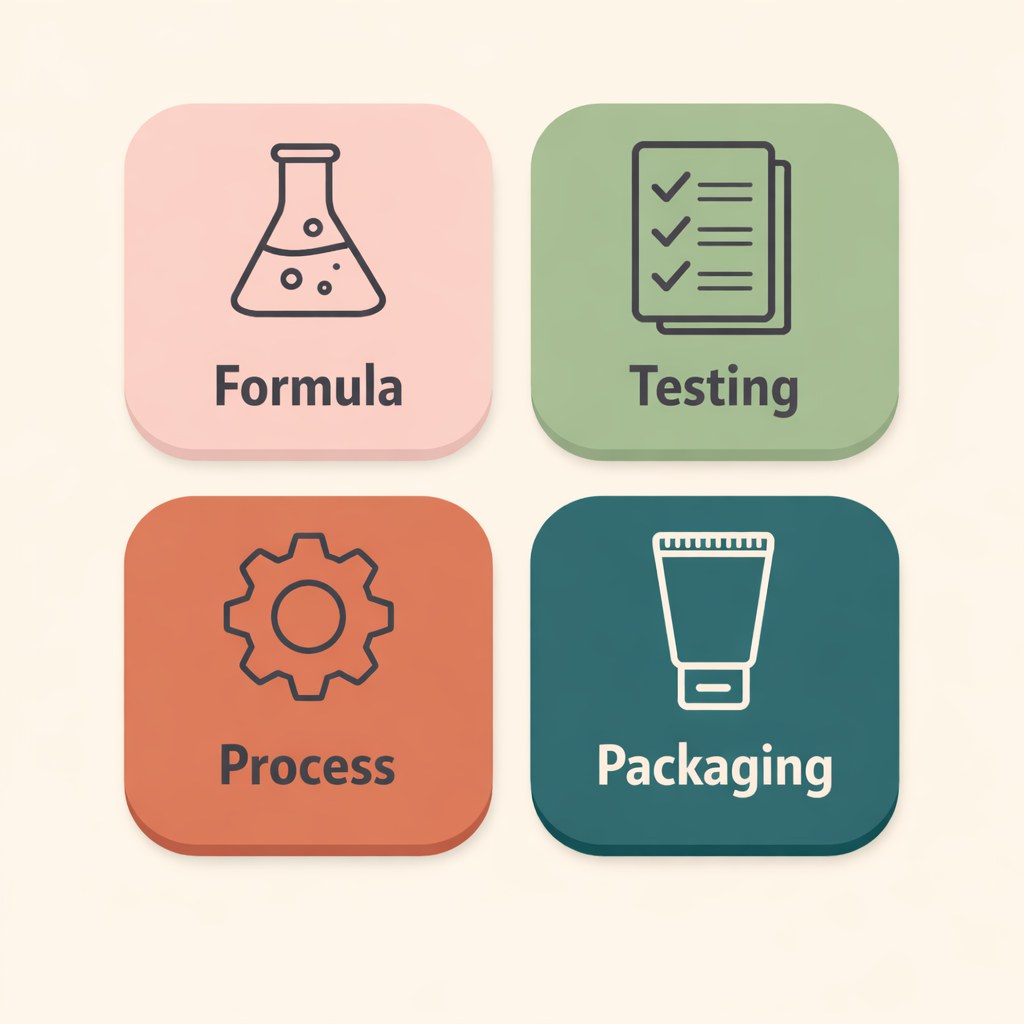
Grade labels are useful tools for the people who buy raw materials. They set expectations, they organize testing and they create a paper trail when something goes wrong. But they were never meant to be a verdict on the product sitting on your bathroom counter. That verdict comes from the whole formula, the factory that made it, the tests run on the finished batch and the evidence behind its claims. Next time a label leans on “pharmaceutical grade,” treat it as the start of a question. The brands worth trusting are the ones happy to answer it.
Related Posts
 10 Best Private Label Skincare Manufacturers to Launch Your Own Brand
 What a Hot Delivery Truck Really Does to Your Skincare
 Why Your Skincare Dupe Isn’t a Twin Even When the Ingredients Match
 Preservative Free Sounds Safer Until You Open the Jar
 Everything I Wish I Had Known About Skincare in My Twenties
 The Salmon DNA Skincare Ingredient Dermatologists Love and Its Vegan Rival
 Switch This One Thing in Your Skincare Routine When Fall Arrives
 Three Skincare Products That Actually Do the Heavy Lifting
 The Age to Start Anti-Aging Skincare Will Probably Surprise You
 The Skincare Ingredients Worth Your Attention Right Now in 2026
 Your Drugstore Is Hiding Some of the Best Skincare Money Can Buy
 What Actually Reaches Your Dermis and Why Most Skincare Stops Short
