
Sep
Skincare
Why Does Skin Start to Look Crepey After 50
If you click on links we provide, we may receive compensation.
By the time a woman reaches menopause, her skin has already lost up to 30 percent of its collagen – and the rate of loss accelerates from there. That loss is not just cosmetic. It changes the fundamental structure of the skin, thinning the dermis, depleting the fat pads underneath, and stripping out the proteins that give skin its snap and bounce. The result is that thin, finely wrinkled texture that looks like crinkled paper – and it has a name: crepey skin. Knowing why it happens, and what drives it, is the first step to doing something about it.
What Actually Makes Skin Look Crepey in the First Place?
The word crepey describes skin that has lost its thickness and resilience so completely that it crinkles under its own weight. This is different from a wrinkle, which is a fold in the skin caused by repeated muscle movements. Crepey skin is a structural problem – it reflects changes deep in the dermis, not just at the surface. The dermis is the layer beneath the epidermis where collagen and elastin fibers live, and it is those fibers that are primarily responsible for keeping skin firm, smooth, and spring-loaded. When they break down faster than the body can rebuild them, the skin above starts to look fragile and papery.
Collagen is the structural protein that forms the scaffolding of the dermis. Elastin sits alongside it and gives skin its ability to stretch and recoil. Hyaluronic acid, a glycosaminoglycan, fills the space around those fibers and holds water – up to 1,000 times its own weight. All three decline with age. Production starts dropping gradually from the mid-20s, but the losses are modest at first and easy to compensate for. By the 50s, the cumulative deficit is large enough to affect how skin looks and feels on a daily basis. Researchers studying human skin samples have found that collagen bundle density in the reticular dermis drops from roughly 81 percent in young tissue to just 58 percent in aged tissue – a structural change that translates directly into the thin, loose texture you can see and feel on the surface. Source: https://slimmingsolutionsspa.com/blog/structural-skin-changes-during-aging
How Does Collagen Loss Change Skin Texture Over Time?
Collagen makes up roughly 80 percent of the dry weight of the dermis. It is the reason young skin snaps back when pinched and holds its shape throughout the day. Fibroblasts – the cells responsible for producing collagen – become less active with age, and their numbers decline too. After age 30, fibroblast numbers and biosynthetic capacity each drop by around 3 percent per year. By the time skin reaches its 50s, fibroblast function has diminished substantially, and the collagen that remains is increasingly fragmented and cross-linked in ways that make it stiffer and less able to support the surface above. The skin does not simply become thinner – its organization changes, and that disorganization is part of what makes aged skin look less vibrant even when it is well cared for.
Elastin, in many ways, is the less-discussed but equally important partner. While collagen provides density, elastin provides recoil. In younger skin, elastin fibers are abundant and well-organized, pulling the skin back into place after any stretching or compression. As the decades pass, elastin fibers fragment and accumulate calcium deposits – a process called elastosis – which makes them rigid and unable to recoil properly. The skin can still stretch, it just no longer bounces back with the same crispness. That loss of snap is what defines the crepey look more than any other single factor. Run your finger along the inside of your arm and you can feel exactly when that recoil disappeared.
What Does Menopause Do to Your Skin?
Menopause is the single largest accelerant of skin aging in women. Estrogen is not just a reproductive hormone – it is a skin maintenance hormone. Skin cells carry estrogen receptors, and those receptors, when activated, stimulate fibroblasts to produce collagen and elastin, promote the production of glycosaminoglycans like hyaluronic acid that keep the dermis hydrated and plump, and regulate the thickness of both the dermis and epidermis. When estrogen drops, all of those processes slow simultaneously. Studies show that women lose approximately 30 percent of their skin collagen in the first five years after menopause – a rate roughly ten times faster than the typical 1 percent annual loss seen earlier in life. Source: https://www.ncbi.nlm.nih.gov/pmc/articles/PMC10092853/
The pace of that decline is what catches many women off guard. Skin that looked relatively firm at 48 can feel noticeably thinner and less resilient by 52 or 53, and the arms, neck, and inner thighs tend to show the change earlier than the face – partly because those areas have less sebaceous activity to compensate. A survey of women attending menopause clinics found that as many as 64 percent reported notable skin changes, with texture and thinning among the most commonly mentioned concerns. Source: https://www.ncbi.nlm.nih.gov/pmc/articles/PMC12426320/ The relationship is not just about how skin looks – it is a measurable change in skin thickness, hydration, and structural integrity that can be detected with imaging technology.
Estrogen deficiency also reduces the production of hyaluronic acid in the dermis. Hyaluronic acid is not a filler in the cosmetic sense – it is a naturally occurring glycosaminoglycan that acts like a sponge inside the dermis, drawing in water and maintaining the volume and turgor that makes skin look plump and full. When estrogen falls, hyaluronic acid production decreases alongside collagen, and the dermis loses not just its structural fibers but also the fluid cushion that surrounds them. The result is skin that feels both thinner and drier – two problems that compound each other to create that characteristic crepe-paper texture. It is a hormonal and structural change happening at the same time, which is why the shift can feel so sudden even though it has been building for years.
Does Sun Damage Accelerate Crepey Skin?
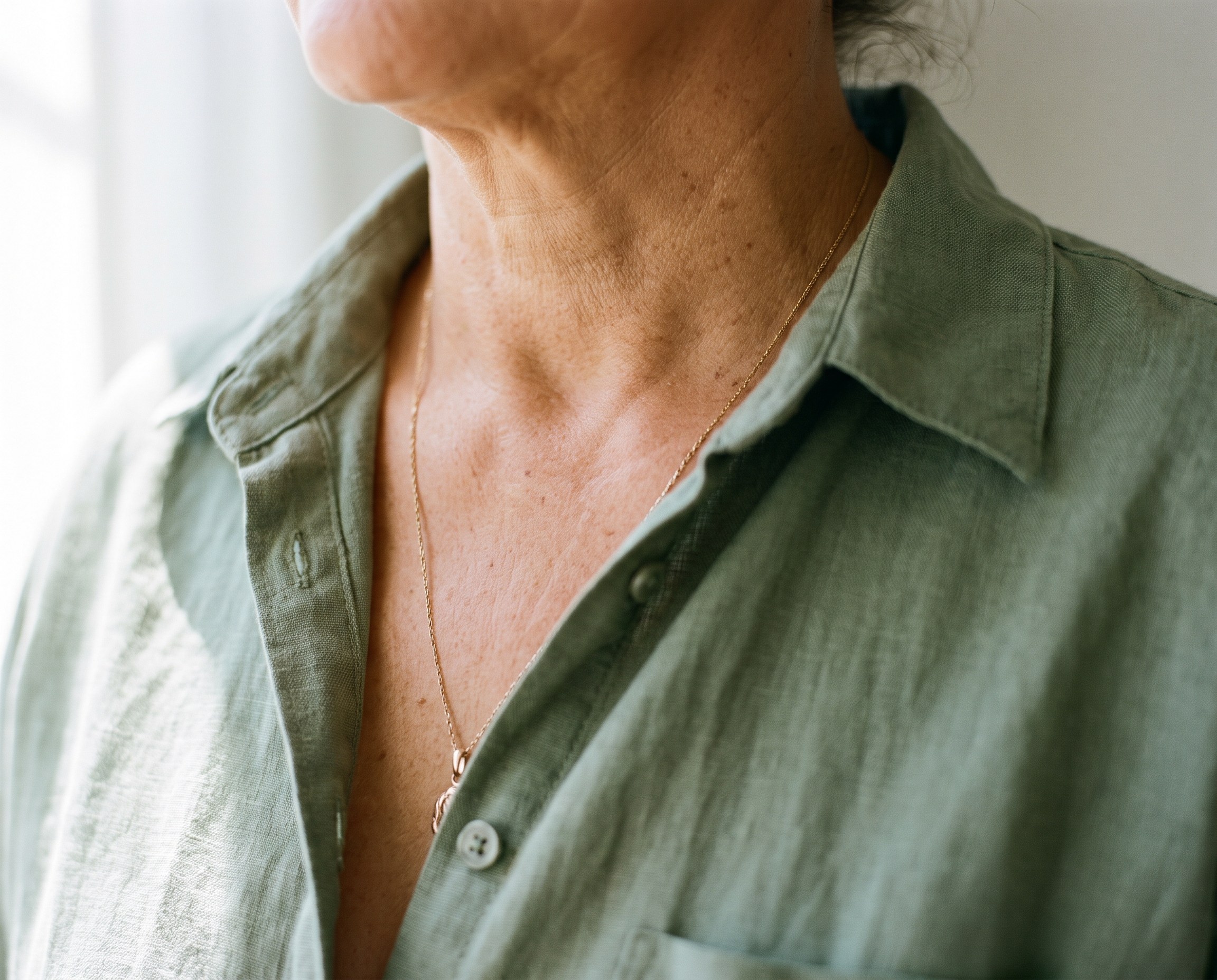
Genetics and hormones set the pace of intrinsic aging – the kind that happens regardless of what you do. But UV radiation can dramatically speed that process up. Dermatologists estimate that UV exposure accounts for approximately 80 percent of visible facial aging signs. Source: https://drwhitneybowebeauty.com/blogs/derm-scribbles/aging-overnight-dermatologist-insight-on-collagen-loss-and-what-you-can-do-about-it-at-home The mechanism is direct: UV light, particularly UVA rays, penetrates through the epidermis into the dermis, where it triggers enzymes called matrix metalloproteinases – MMPs for short. MMPs degrade collagen and elastin fibers as part of the inflammatory response to UV exposure. The skin does partially repair this damage, but repeated exposure over decades leads to a net deficit – more degradation than repair – and the skin gradually loses its density and firmness as a result.
Photoaged skin shows a specific pattern called elastosis, where elastin accumulates in an abnormal, disorganized mass in the upper dermis rather than forming the neat parallel fibers seen in protected skin. This disorganized elastin is non-functional – it does not recoil, it simply takes up space – and the skin above it looks rough, yellowed, and crepey in a way that is distinct from intrinsically aged skin. The inside of your arm, if it has been well-protected from the sun throughout your life, will look noticeably younger than the outer forearm that catches UV light whenever you are outside. That contrast illustrates exactly how much cumulative UV damage compounds the natural aging process. Every decade of unprotected sun exposure leaves a measurable mark on the dermis.
What Happens Under the Skin That Makes It Look So Thin?
Skin does not exist in isolation. Beneath the dermis lies a layer of subcutaneous fat – organized into discrete fat pads that cushion and support the skin above. These fat pads shrink with age and redistribute as hormone levels change. On the face, they deflate, causing the cheeks to flatten and the skin to hang more loosely. On the arms, neck, and abdomen, the fat layer thins and the skin above it loses its underlying support, which makes it look less anchored and more prone to crinkling. This volume loss is a separate process from collagen loss, but the two happen simultaneously and their effects are additive – skin that has lost both its internal structure and its underlying padding has nowhere to go but down.
The epidermis also thins with age. Cell turnover in the outermost layer slows – a young adult replaces their epidermis roughly every 28 days, while the same process takes 45 to 60 days in someone over 50 – which means surface cells are older on average and the skin below them has less structural support. Slower turnover also affects how well the skin barrier functions: it loses moisture more readily, feels more sensitive, and looks duller than younger skin with its faster refresh rate. And because the barrier is less efficient, even well-hydrated skin can look and feel drier than it should, adding to the appearance of crepiness. All of these changes converge in the 50s, which is why that decade tends to feel like a tipping point.
What Can Women Over 50 Do to Improve Crepey Skin?

No topical product rebuilds collagen the way a young fibroblast does – but several ingredients are well-supported by clinical evidence for improving the appearance of crepey skin over time. Retinol, a vitamin A derivative, has the strongest evidence base of any over-the-counter option. Applied consistently over months, retinol increases cell turnover in the epidermis, signals fibroblasts to produce more collagen, and reduces the activity of the MMPs that degrade existing structural fibers. It is particularly effective on fine surface texture and early crepiness, though results are slower on body skin than on the face and typically take three to six months to become visible. Women with sensitive skin often find that starting with a low concentration – 0.025 to 0.05 percent – three times a week and building gradually helps them tolerate it without irritation.
Peptides are a strong complement to retinol. These short chains of amino acids signal to fibroblasts that collagen has been broken down and that more should be produced. Clinical trials have shown measurable improvements in skin firmness and elasticity with consistent use over four to six weeks. Hyaluronic acid in topical form works differently – it does not rebuild structure, but it draws moisture into the skin and provides an immediate improvement in plumpness and surface texture. What matters is using a product that contains multiple molecular weights of hyaluronic acid, since smaller molecules penetrate deeper into the dermis while larger ones work at the surface. Niacinamide rounds out a solid routine by supporting the skin barrier, reducing water loss, and improving overall tone.
Sun protection is not optional for anyone working to improve crepey skin after 50. Daily broad-spectrum SPF 30 or higher prevents the ongoing MMP-mediated destruction of collagen that UV exposure causes – and because cumulative UV damage continues to accelerate crepiness well into the 50s and 60s, stopping new damage matters as much as repairing what has already happened. Using SPF on the arms, hands, neck, and décolletage – not just the face – extends protection to the areas where crepey skin is often most visible. Reapplying after two hours of sun exposure makes a real difference in how much damage accumulates over a lifetime. Many women are consistent about facial sunscreen but forget that the skin on their arms and neck is aging at the same rate.
In-office procedures can go further than topicals. Laser treatments, radiofrequency, and microneedling all stimulate collagen remodeling by creating controlled damage in the dermis, triggering a wound-healing response that deposits new, organized collagen. The results are more pronounced than what over-the-counter products can achieve, though they also carry more cost and some downtime. For women who are bothered by significant crepiness on the upper arms or thighs – areas that topicals are slow to address – these procedures offer a more aggressive path to improvement. A board-certified dermatologist can advise on which approach fits the degree of change and the skin’s tolerance level.
FAQs
What is the main cause of crepey skin after 50?
The main driver is the combined loss of collagen, elastin, and hyaluronic acid in the dermis – a process that accelerates sharply around menopause when estrogen levels drop. By the first five years post-menopause, women may lose roughly 30 percent of their skin collagen. UV damage, which accounts for about 80 percent of visible facial aging, compounds the effect by activating enzymes that break down the remaining structural fibers.
Can crepey skin be reversed?
Fully reversed – no. The structural losses that cause crepey skin cannot be completely undone with topical products. But the appearance can be improved meaningfully. Consistent use of retinol, peptides, and broad-spectrum sunscreen over several months produces visible changes in surface texture and firmness. Professional procedures like radiofrequency and laser treatments go further, stimulating new collagen growth in the dermis. The goal is improvement, not a return to how skin looked at 30.
At what age does skin start to become crepey?
Most people notice the earliest signs in their late 40s, but for many women the change feels more significant in the early to mid-50s, which coincides with the hormonal shifts of perimenopause and menopause. The process has been building for decades before then – collagen loss starts in the mid-20s – but the menopause-related acceleration is what makes the change visible and noticeable for most women.
Does weight loss cause crepey skin?
Rapid or significant weight loss can contribute to crepey skin by reducing the fat padding beneath the dermis, which leaves the skin with less support. The skin does not always contract to match the reduced volume below, especially in adults whose skin has already lost some elasticity. Losing weight slowly and maintaining muscle mass both reduce – though do not eliminate – the crepiness that can follow significant fat loss.
Does drinking more water help crepey skin?
Staying well-hydrated helps the skin look better overall, but it does not address the underlying structural losses that cause crepey skin. Dehydration makes skin look drier and more finely lined, so keeping hydrated prevents that from making things worse. For meaningful improvement, topical ingredients that work on the dermis – retinol, peptides, hyaluronic acid – are more directly effective than changes to water intake alone.

Skin does not become crepey because of anything that can be fixed with a simple swap or an overnight remedy. The changes are structural – they accumulate across decades, accelerate with hormonal shifts, and deepen with every hour of unprotected sun exposure. Knowing the science behind what is actually happening in the dermis makes it easier to choose the right approach: a long game of consistent sun protection, targeted actives that support collagen and hydration, and realistic expectations about what can be improved over time. The goal is not to stop the clock – it is to give your skin what it needs to hold up well through the years ahead.
Related Posts