
Oct
Skincare, Trends & Opinions, Wellness
How To Get a Teenager To Wear Sunscreen
If you click on links we provide, we may receive compensation.
Only 10 percent of American teenagers always wear sunscreen when spending time outdoors – and the other 90 percent are accumulating damage they won’t see for another two or three decades. A survey from Gallup found that nearly seven in ten teens were not very or not at all concerned about developing skin cancer in their lifetimes (https://news.gallup.com/poll/12931/most-teens-soak-sun-unprotected.aspx). The skin doesn’t keep score in real time, which is part of the problem. Every summer of unprotected sun exposure looks and feels fine for years – until, suddenly, it doesn’t. Knowing that gap between risk and perception exists is the first step toward actually closing it.
Why Do Teenagers Refuse To Wear Sunscreen?
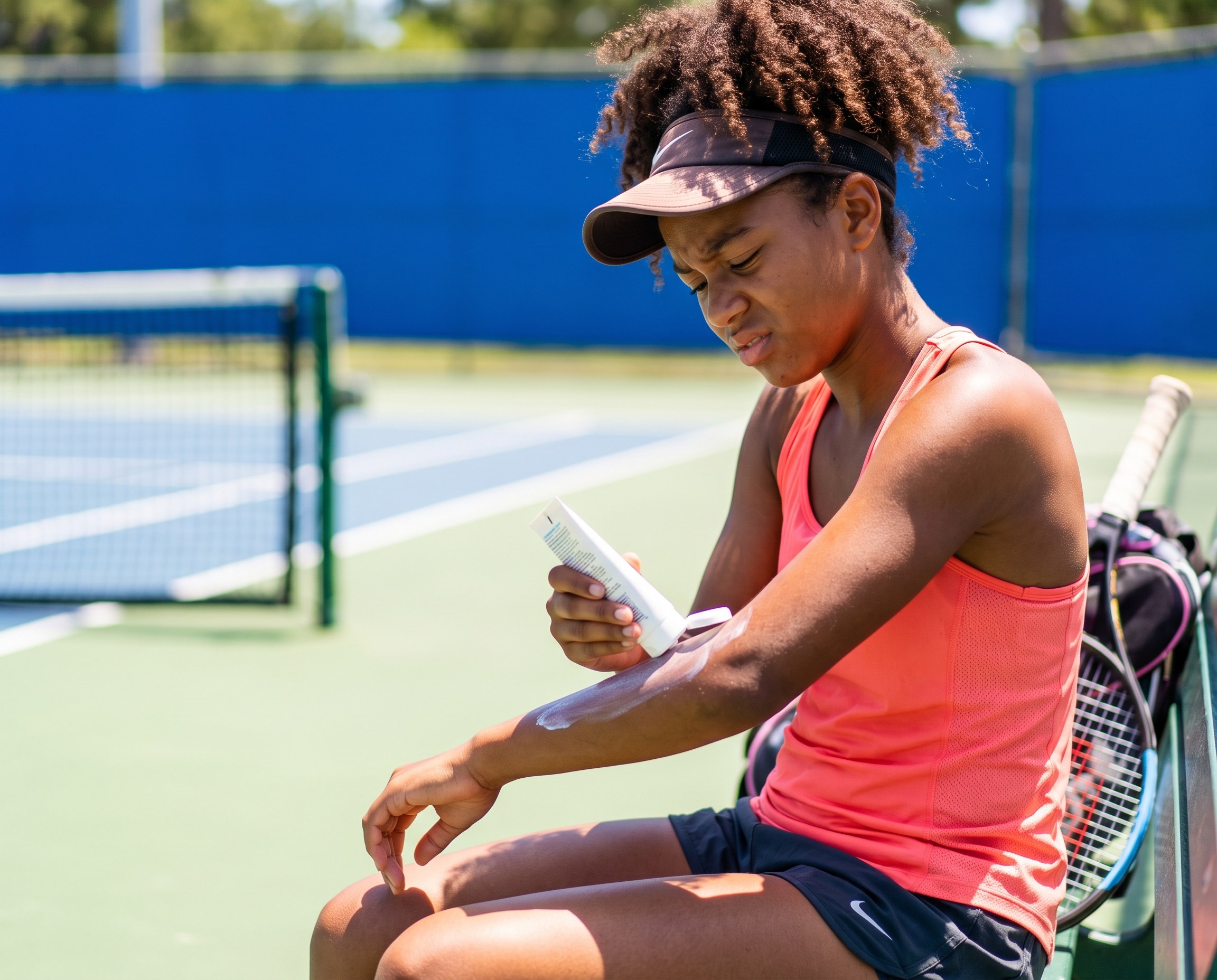
The refusal has a name in developmental psychology: the personal fable. This is the normal adolescent belief that bad things happen to other people, not to them specifically. Teenagers know abstractly that UV damage is real – they’ve heard it from parents, doctors, and health classes. But knowing a fact and feeling its weight as a genuine personal threat are two different things, and adolescent brain development keeps those two things far apart. A 2019 study published in Preventive Medicine Reports found that sun protective behaviors actually declined with age as children became more independent, spending more time outside of parental influence and peer environments that normalized sun protection (https://www.sciencedirect.com/science/article/pii/S2211335519301597).
Beyond psychology, there are simple practical barriers that parents shouldn’t underestimate. A 2026 study reported by News-Medical found that the primary reason teenagers give for skipping sunscreen is that they find it inconvenient and time-consuming (https://www.news-medical.net/news/20260424/Teens-skip-sunscreen-because-they-see-it-as-inconvenient.aspx). Many teenagers have only ever tried thick white lotions that leave a cast, feel greasy, smell clinical, or break them out – and one bad experience with sunscreen in childhood can plant a lasting aversion. There’s a social dimension too: in many peer cultures, a tan is still coded as attractive and confident, while SPF can feel like opting out of that norm. Research tracking sunscreen use among high schoolers found that usage actually dropped from 67.7 percent in 2001 to 56.1 percent in 2011, suggesting the habit is not improving on its own (https://www.ncbi.nlm.nih.gov/pmc/articles/PMC4149322/).
Does The Health Argument Work On Teenagers?

The honest answer is: not very well. Telling a teenager they might get skin cancer in their fifties carries about as much emotional urgency as telling them their joints might ache someday. The abstract future simply doesn’t move most adolescents, and a lecture about long-term health risk can activate exactly the kind of defensive shutdown that makes the conversation worse. Adolescence is, neurologically speaking, a period of heightened reward-seeking and reduced sensitivity to delayed consequences – applying sunscreen for a cancer risk thirty years away is a genuinely hard sell at 16. The more you push this angle, the more likely your teenager is to nod politely and ignore everything you’ve said.
What does work is reframing the argument around something teenagers care about right now: how they look. Research published in the Journal of Drugs in Dermatology found that appearance-based messaging – specifically, showing young people the cosmetic effects of UV damage on their skin over time – was more effective than health-based messaging at actually changing behavior (https://jddonline.com/articles/news-views-and-reviews-carrots-before-sticks-appealing-to-vanity-promotes-sun-protection-S1545961613P0952X/). A study highlighted by Harvard Health took this further, giving high school students access to an app that showed them a simulated photo of their face aged by UV exposure – and found it drove measurable increases in sunscreen use compared to control groups who received only health information (https://www.health.harvard.edu/blog/can-appealing-to-teenagers-vanity-improve-sun-protective-behaviors-2020073020668). The same teenager who tunes out cancer statistics may pay close attention when you show them what unprotected summers do to the skin by their mid-thirties. That shift in framing is worth more than a dozen earnest conversations about melanoma.
What Does Sun Damage Actually Do To Teenage Skin Over Time?
Research estimates that somewhere between 25 and 50 percent of a person’s total lifetime UV exposure occurs before the age of 60 – and children receive roughly three times the annual UV dose that adults do (https://pmc.ncbi.nlm.nih.gov/articles/PMC5036351/). Each sunburn in the teenage years is not merely an uncomfortable weekend experience. A review published in PMC found that a history of six or more severe sunburns before age 25 was associated with an odds ratio of 2.7 for melanoma, compared to those who had never burned badly (https://pmc.ncbi.nlm.nih.gov/articles/PMC10453427/). Blistering burns during adolescence are particularly risky because young skin cells are rapidly dividing, which makes UV-induced DNA damage more likely to accumulate and persist. Every blistering burn dismissed as a rite of summer is, biologically speaking, a cumulative event the skin will carry forward.
Premature aging is the consequence that tends to arrive far earlier than teenagers expect. UV radiation systematically breaks down the collagen and elastin fibers that keep skin firm, plump, and smooth – and that process is silent and invisible for years before it becomes visible on the surface. A clinician at Dartmouth-Hitchcock Medical Center has noted that skin cancers showing up on patients today are often traceable to sun damage from ten to fifteen years prior (https://www.dartmouth-hitchcock.org/stories/article/3-ways-minimize-effects-aging-your-skin). Wrinkles, pigment spots, uneven skin tone, and the rough precancerous patches called actinic keratoses are not random signs of aging – they’re the accumulated record of unprotected time in the sun. For a teenager who thinks of their thirties as a manageable destination, framing it this way – you will look significantly older than your friends by your mid-thirties if you skip SPF – carries more weight than the distant word cancer ever could.
Which Sunscreen Formats Actually Work For Reluctant Teenagers?

Product selection is one of the most underrated parts of this conversation. Many teenagers who claim to hate sunscreen have only ever encountered one or two products – often the thick, heavily scented lotion from childhood that leaves a white cast and clogs pores. The modern sunscreen market looks nothing like that. Lightweight fluid formulas designed for daily facial use absorb quickly and leave no residue. Tinted formulas add subtle, even coverage that actually improves the look of skin. Stick formats require no rubbing and leave no mess on hands or clothes, making them easy to reapply anywhere without a mirror. Sunscreen-infused moisturizers and SPF-containing primers fold into a skincare routine without adding an extra step – which matters enormously when a teenager’s patience for morning routines is limited.
The practical recommendation from most dermatologists is to buy a few different formats and let the teenager try them until something clicks (https://drbaileyskincare.com/blogs/blog/sunscreen-for-teens-how-do-you-get-teens-to-wear-sunscreen). Mineral formulas with zinc oxide are generally better tolerated on acne-prone skin because they sit on the skin’s surface rather than absorbing into it – this matters for teenagers who have already had bad experiences with sunscreen-triggered breakouts. SPF 30 is the minimum recommended by the American Academy of Dermatology for daily use; SPF 50 is the better choice for extended outdoor exposure, sports, and beach days. Water-resistant formulas are worth keeping in a sports bag or car. US Dermatology Partners suggests keeping sunscreen visible and accessible wherever the teenager already spends time in the morning, so reaching for it becomes the path of least resistance (https://www.usdermatologypartners.com/blog/best-sunscreen-tips-for-kids/).
Can You Make Sun Protection Part of How Teenagers See Themselves?
The most durable behavior change happens when someone chooses a habit for themselves, not when it’s enforced on them from outside. For teenagers who already have an interest in skincare – and Gen Z has a notably high engagement with skincare culture – sunscreen is most effectively introduced as a core element of a routine they’re building for themselves, not an add-on their parent insisted on. Dermatologists frequently note that the expensive serums, antioxidants, and treatments teenagers invest in are considerably less effective when not paired with daily SPF, because UV damage actively undermines the results those products aim to produce. That argument speaks directly to the teenager’s existing investment and can land without any parenting energy at all. It’s not a lecture; it’s just information that makes the routine they already care about work better.
The Skin Cancer Foundation recommends introducing sun protection early and framing it as a habitual part of the morning routine so that reaching for SPF becomes as automatic as brushing teeth (https://www.skincancer.org/blog/teach-your-kids-about-sun-protection/). Sanova Dermatology suggests packaging sunscreen alongside the other products the teenager already uses – a face wash, a moisturizer, a serum – so it’s integrated into a ritual rather than presented as a separate medical obligation (https://sanovadermatology.com/blog/3-tips-to-get-your-teen-to-use-sunscreen). This approach takes patience, particularly if the resistance is already established. But habits built from genuine personal interest stick far better than ones imposed through argument, and a teenager who chooses sunscreen is one who will still be using it at 30.
What Women Over 50 Wish They Could Tell Their Teenage Selves

For mothers and grandmothers who came of age in the era of baby oil and reflective sun mats, the evidence of decades of unprotected sun exposure is often directly visible – on their hands, their chest, their face. That firsthand story, told plainly and without drama, is one of the most powerful tools available in this conversation. Several women writing publicly about their skin in later life have made the same observation: the damage that became visible at 55 or 60 was built one summer at a time between the ages of 12 and 25, and the entire process was invisible as it happened (https://ellemuse.com/the-best-rated-sunscreen-lotions-for-aging-skin/). A grandmother showing a teenager the dark spots on her hands – or the small scar from a basal cell removal – and saying ‘this is from the summers I didn’t think it mattered’ is offering something no dermatologist’s pamphlet can replicate.
The conversation works best when it’s honest rather than alarming, and when it comes from a place of connection rather than correction. Some women have found that taking their teenager to a routine skin check appointment – not as a scare tactic but as a normal part of family life – does more than a year of verbal reminders. Showing a teenager what actinic keratoses look like, or what a mole biopsy involves, grounds the abstract in the real in a way that resonates. Women who have had a skin cancer diagnosis often report that sharing that experience with the teenager in their life changed the teen’s behavior more than anything else they’d tried. The key is to offer the experience as information, not as pressure – ‘I want you to know what I know now, so you can make a different choice’ lands far better than ‘you need to listen to me about this.’
Women 50 and older are also navigating the real skin effects of decades of accumulated UV exposure – and continuing to protect their skin now matters as much as ever. The Skin Cancer Foundation has noted that seniors remain significantly at risk and need consistent protection alongside regular skin checks (https://www.skincancer.org/blog/the-sun-keeps-rising-why-seniors-cant-skip-uv-protection/). For older women who became serious about sun protection later in life, the visual contrast between well-protected and sun-exposed skin over time is often striking, and sharing that observation with a teenager gives it a kind of authority that parenting books can’t provide. The message that it’s never too late to start also carries a quiet mirror message: the earlier you start, the more you have to protect. That is a gift worth passing on, and most teenagers, when they hear it from someone they love and trust, do hear it.
FAQs
At what SPF should teenagers use sunscreen?
The American Academy of Dermatology recommends SPF 30 as the minimum for daily use, with SPF 50 preferred for extended outdoor activities. Broad-spectrum protection covering both UVA and UVB rays matters as much as the number itself – SPF alone does not indicate UVA coverage. Water-resistant formulas are important for sports and swimming. Consistent daily use is the variable that matters most: even SPF 30, applied every morning and reapplied after heavy sweating, will do far more than a higher SPF used inconsistently.
Does sunscreen cause acne breakouts in teenagers?
Some formulas do – particularly heavy cream-based products or those with occlusive ingredients that trap oil in pores. Oil-free, non-comedogenic formulas are designed for acne-prone skin and are widely available. Mineral sunscreens with zinc oxide are often well tolerated and can have a mildly calming effect on inflamed skin. One bad experience with a pore-clogging formula shouldn’t end the sunscreen conversation – it should start the search for a better one. Acne-prone teenagers who find the right mineral formula often discover it actually improves their skin clarity over time.
How often should a teenager reapply sunscreen?
Every two hours during extended outdoor exposure, and immediately after swimming or sweating heavily. Applying once in the morning and treating the rest of the day as protected is one of the most common sunscreen mistakes. A long sports practice, a beach afternoon, or several hours outdoors all require reapplication. Spray and stick formats make reapplication faster and considerably more likely to actually happen, which is why carrying a portable format in a sports bag or car matters.
What if my teenager refuses sunscreen on their face?
Start with lower-barrier options. A tinted moisturizer or BB cream with SPF 30 built in requires no additional step and doesn’t feel like applying sunscreen. Dedicated facial sunscreens formulated to feel like skincare – lightweight, fast-absorbing, fragrance-free – can also reduce resistance significantly. US Dermatology Partners suggests experimenting across several formats until you find one the teenager will actually use consistently (https://www.usdermatologypartners.com/blog/best-sunscreen-tips-for-kids/). Partial compliance – some SPF, some of the time – is still far better than none.
Can a single bad sunburn in the teenage years cause lasting damage?
Yes, it matters. Research published in PMC found that a history of severe sunburns before age 25 was significantly linked to elevated melanoma risk, with an odds ratio of 2.7 for those who had experienced six or more severe burns (https://pmc.ncbi.nlm.nih.gov/articles/PMC10453427/). No single burn seals any fate, but each one adds to a cumulative load of UV-induced DNA damage that the skin carries forward. This is exactly why building a consistent sunscreen habit now – even imperfectly – is worth considerably more than waiting for perfect compliance.
The arguments about cancer risk don’t move most teenagers, and repeated nagging rarely helps. What tends to work is meeting teens where they actually are – appealing to their genuine interest in their appearance, giving them formulas they’ll use without complaint, and letting someone they love share, honestly, what they wish they had known at that age. Sun protection is not a hard sell when the conversation is framed right. A teenager who sees SPF as part of why their skin looks good – not as a medical obligation dreamed up by anxious adults – is one who will keep reaching for it long after they leave home. And that’s the habit worth building.
Related Posts