
Nov
If you click on links we provide, we may receive compensation.
You switch face washes because the old one ran out, and within a week your cheeks feel tight by mid-morning. Nothing else has changed. Same moisturizer, same weather, same routine. It’s easy to blame the new bottle and move on, and sometimes that’s the right call. But there’s often a quieter story underneath, and it involves a number most of us haven’t thought about since high school chemistry. Your skin’s surface is slightly acidic on purpose, and that acidity runs more of the show than you’d guess. After 50, the system that keeps it acidic gets a little slower, and I think that’s worth knowing about.
What is the acid mantle, really?
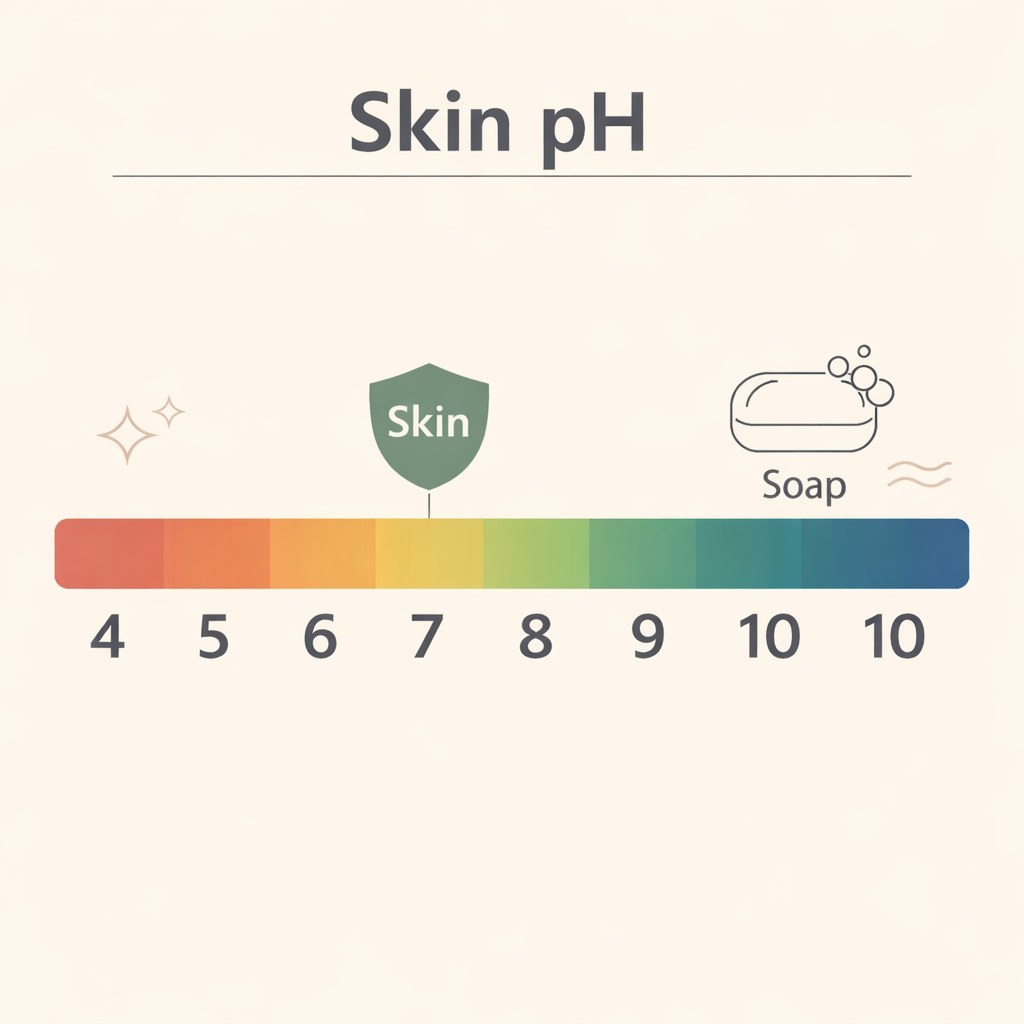
The pH scale runs from 0 to 14. Seven is neutral, lower is acidic, and higher is alkaline. Each step is a tenfold change, so pH 5 is ten times more acidic than pH 6. Healthy adult skin usually sits somewhere between 4 and 6 on its surface. A multicenter study of 330 people found an average forearm pH of 5.12 under normal washing habits, which dropped to 4.93 after 24 hours without showering or products. From that drop, the researchers estimated the skin’s natural resting pH at about 4.7 (https://pubmed.ncbi.nlm.nih.gov/18489300/).
That slightly acidic layer is what people call the acid mantle. The name makes it sound like a separate coating, but it isn’t. It’s the chemistry of the stratum corneum, the outer layer of dead, flattened cells and the fats between them. Several sources keep it acidic. Free fatty acids come from sebum. Sweat brings lactic acid and amino acids. The breakdown of a protein called filaggrin produces acidic molecules like urocanic acid and pyrrolidone carboxylic acid. And a small pump in the cell membrane, known as NHE1, pushes acid out toward the surface.
Here’s the part that surprises people. The living skin just a fraction of a millimeter below the surface sits near a neutral pH of about 7. So there’s a steep drop of two to three pH units across a layer thinner than a sheet of paper (https://medicaljournals.se/acta/content/html/10.2340/00015555-1531). That gradient isn’t an accident. Different jobs happen at different depths, and each one needs the right level of acidity to work.
Why do skin enzymes care so much about pH?
Most of the work in your outer skin is done by enzymes, and enzymes are fussy. Each has a pH range where it works best, and outside that range it slows down or stops. Two of the most important ones in the barrier are beta-glucocerebrosidase and acid sphingomyelinase. Their job is to turn raw lipid ingredients into ceramides, the fats that seal the gaps between skin cells. Both work best at a pH of about 5 (https://pmc.ncbi.nlm.nih.gov/articles/PMC7138575/).
Researchers tested what happens when you take that acidity away. In a 1998 study, damaged skin that was bathed in acidic solutions repaired its barrier normally. When the same damaged skin was exposed to neutral or alkaline solutions, the repair stalled, and the lipid processing was the step that broke down (https://pubmed.ncbi.nlm.nih.gov/9617442/). In plain terms, the skin had the raw materials but couldn’t assemble them. It’s a bit like a kitchen where the cooks have the groceries but the oven won’t heat.
There’s a second set of enzymes pulling the other way. Serine proteases, especially kallikrein 5 and kallikrein 7, break down the protein rivets that hold dead skin cells together. That’s how skin sheds normally. But these enzymes prefer a neutral pH. When the surface becomes less acidic, they speed up and cut those rivets too early, so the outer layer loses its cohesion and flakes unevenly (https://pmc.ncbi.nlm.nih.gov/articles/PMC4552322/). They can also degrade the lipid-making enzymes themselves. Aged skin also shows higher activity of alkaline ceramidase, an enzyme with a pH optimum around 9 that breaks ceramides down.
Advertisement
How does pH shape the bacteria living on your skin?
Your skin hosts a large community of bacteria, and most of them are helpful or harmless. Acidity helps decide who thrives. Common troublemakers like Staphylococcus aureus and Streptococcus pyogenes grow poorly at an acidic pH, while friendlier residents such as coagulase-negative staphylococci and corynebacteria do fine there (https://pmc.ncbi.nlm.nih.gov/articles/PMC3535073/). The same 330-person study found that a pH of 4 to 4.5 kept resident bacteria attached to the skin, while a more neutral surface encouraged them to let go. That matters because a settled, stable community leaves less room for opportunists.
Washing habits can shift this balance over time. In a 1991 study, people washed for weeks with either a pH 5.5 or a pH 8.5 cleanser. The alkaline group ended up with higher skin pH on both forehead and forearm, along with measurable changes in their propionibacteria counts (https://library.scconline.org/v042n03/14). More recent lab work found that pyrrolidone carboxylic acid, one of the skin’s own acidic moisturizing molecules, slowed the growth of Staph aureus by roughly 25 percent (https://pmc.ncbi.nlm.nih.gov/articles/PMC10292209/). The skin’s acidity and its moisture system turn out to be the same machinery.
I should add one honest complication. A 2024 study in Nature Communications imaged the stratum corneum in living mice, cell by cell, and found it isn’t simply acidic from top to bottom. The very top layer was closer to neutral, with the most acidic zone sitting in the middle (https://pubmed.ncbi.nlm.nih.gov/38750035/). That doesn’t overturn decades of work on acidity and barrier repair. But it does mean the textbook picture of a single acid film is too simple, and anyone who sells you certainty about one magic number is ahead of the science.
How are skin pH and barrier function connected?

Think of the skin barrier as a brick wall. The dead skin cells are the bricks, and the lipids between them are the mortar. Acidity controls both how the mortar gets made and how long the bricks stay attached. A 2024 review in the Annals of Dermatology described healthy barrier function as resting on three things working together: lipids, natural moisturizing factors, and an acidic surface pH. When pH rises, the review notes, you get more infections, weaker lipid production, slower repair, and a looser outer layer (https://pmc.ncbi.nlm.nih.gov/articles/PMC10861303/).
The trouble is that this can become a loop. A damaged barrier loses moisture and acidic molecules, so its pH creeps up. The higher pH then slows repair and speeds up those rivet-cutting enzymes, which damages the barrier further. That’s one reason irritation sometimes seems to snowball after a harsh product or a week of hot showers. Breaking the loop usually means removing the irritant and giving the skin what it needs to get its acidity back. Most of the time, healthy skin does this on its own within hours.
What changes in your skin’s pH after 50?

This is where I want to be careful, because the research isn’t as tidy as many product labels suggest. A 1991 study comparing young adults with people averaging 70 found no significant pH difference on most body sites. The only measure that clearly changed with age was water loss through the skin (https://pubmed.ncbi.nlm.nih.gov/1845280/). Later studies with better tools found a shift, but a modest one. A German study of 97 women aged 20 to 97 found that surface pH rises slightly with age on the forehead, temple and forearm (https://pubmed.ncbi.nlm.nih.gov/22433511/). A large Chinese study found forehead pH was higher in people over 70 than in younger groups.
So the resting number moves a little. The bigger change is how aged skin handles a push. In a classic study, older adults’ barriers broke down after an average of 18 tape strips, compared with 31 in younger people. After damage, young skin had recovered about 50 percent of its barrier within 24 hours, while older skin had recovered only about 15 percent (https://pmc.ncbi.nlm.nih.gov/articles/PMC295841/). Under calm conditions, aged skin can look fine on paper. The difference shows up after it’s challenged by soap, hot water, wind or a strong active.
Several things drive this. Older skin has less activity in the NHE1 acid pump, produces less sebum, and sweats less, so it has fewer sources of acidity to draw on. Filaggrin and other structural proteins decline with age, which means fewer of the acidic moisturizing molecules that come from them. For women, the drop in estrogen around menopause cuts sebum output further. A 2020 review noted that from about age 50, skin problems linked to aging become more common, alongside weaker barrier function, lower hydration and a higher surface pH (https://pmc.ncbi.nlm.nih.gov/articles/PMC7138575/).
What does that look like in daily life? Shins that flake and itch every winter. Hands that crack after a few days of extra washing. A cleanser that felt fine at 40 and now leaves your face tight. Retinol that suddenly stings. None of these are proof of a pH problem on their own. But they’re all signs of a barrier that takes longer to bounce back, and pH is one of the levers that controls that recovery.
Do pH-balanced cleansers make a real difference?
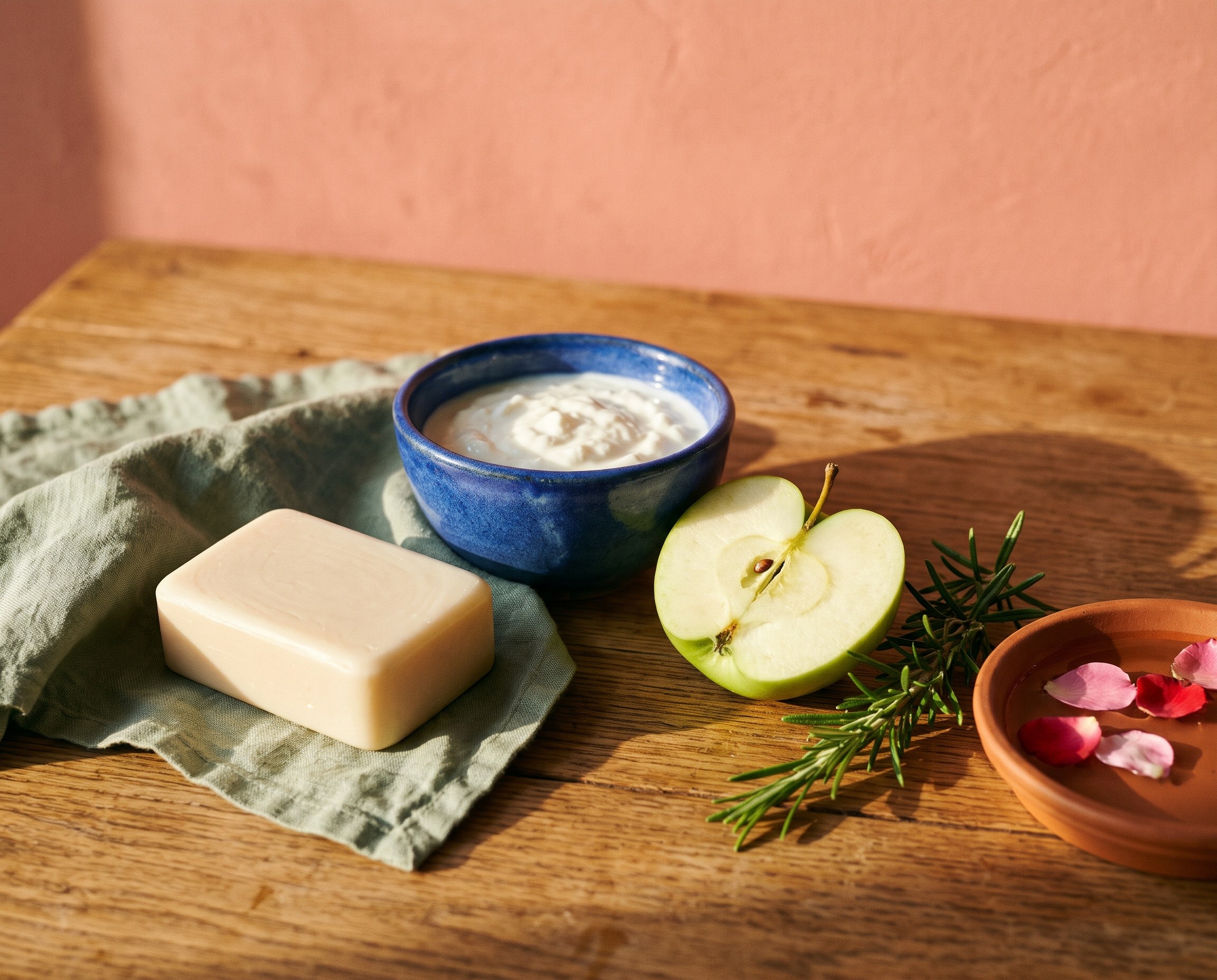
Cleansing is the biggest daily pH event your skin goes through, so it’s the right place to start. Traditional bar soap is strongly alkaline. A 2024 study of 33 hand-wash products found that soap bars averaged a pH of 10.3, while liquid soaps averaged 5.9 and syndet products averaged 6.0 (https://pmc.ncbi.nlm.nih.gov/articles/PMC10931849/). In a forearm study, alkaline soap raised skin pH at every time point measured, increased water loss and caused more redness than the gentler options (https://pubmed.ncbi.nlm.nih.gov/34741581/). For dry, older skin, that’s a real argument for leaving true soap behind.
But here’s the part the marketing tends to skip. A cleanser’s pH isn’t the main thing that decides whether it’s gentle. The type of surfactant matters more. A 2024 review in the Journal of Cosmetic Science pointed to tests where a sodium laureth sulfate cleanser made at skin pH was harsher than the same formula at neutral pH (https://library.scconline.org/v075n05/76). The reason is chemistry. Lowering the pH creates more positively charged spots on skin proteins, and common cleansing agents carry a negative charge, so they grab on harder. A label that says pH 5.5 tells you very little if the cleansing agent underneath is a harsh one.
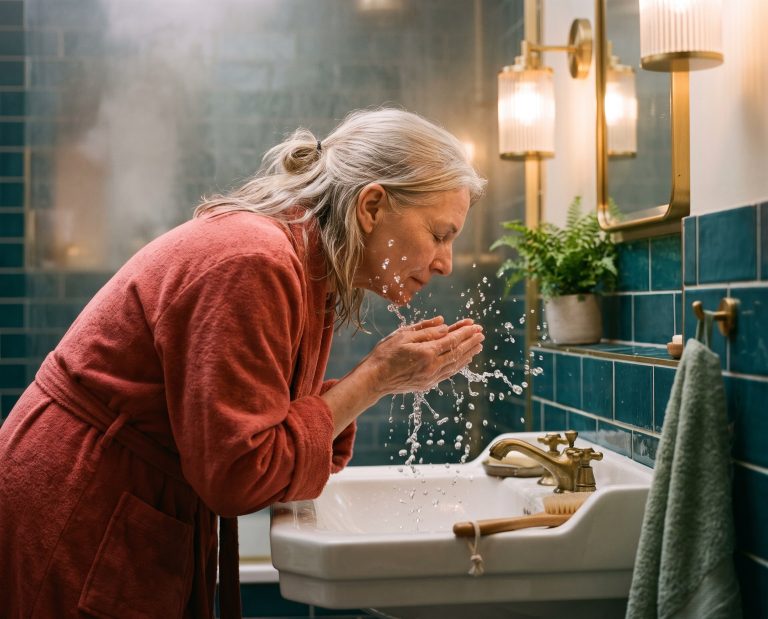
So my advice is to look past the pH claim. A good cleanser for skin over 50 is non-soap, uses milder cleansing agents such as glucosides, isethionates or amphoteric surfactants, and leaves your skin feeling comfortable rather than squeaky. Lukewarm water helps, and so does keeping the wash short. Even plain tap water nudges skin pH upward for a while, so washing your face twice a day with water alone isn’t neutral either. If your skin feels tight within 15 minutes of washing, that’s your signal, whatever the bottle says.
Can acidic moisturizers help aging skin?
Leave-on products are where the evidence for pH gets more interesting, because they stay on the skin for hours. A team in Germany has run several trials in older adults comparing identical creams at different pH levels. In a long-term study of nursing home residents, products at pH 4.0 led to a significant improvement in barrier function compared with the same products at pH 6.0. In a randomized four-week study of 20 older adults, a pH 4 cream lowered skin pH, improved hydration and produced better-organized lipid layers than a pH 5.8 version (https://pubmed.ncbi.nlm.nih.gov/31106905/). When the researchers then irritated the skin on purpose, the area treated with the pH 4 cream had the smallest rise in pH.
These are promising results, and the biology lines up with the lab work on lipid enzymes. Still, they deserve some caution. The studies are small, and much of this research comes from one group with ties to a skin care manufacturer, which the authors disclosed (https://medicalxpress.com/news/2016-10-acidic-skin-product-beneficial-older.pdf). That doesn’t make the findings wrong. It does mean they need independent replication before anyone treats pH 4 as a settled standard. Most products also don’t list their pH, so you can’t easily shop by the number anyway.
What you can look for are gentle acidifying ingredients. Lactic acid is part of the skin’s own moisturizing system, and low concentrations in a body lotion can help with rough, flaky shins. Polyhydroxy acids like gluconolactone and lactobionic acid are milder still, and in animal studies they improved barrier repair by boosting the ceramide-making enzymes (https://pmc.ncbi.nlm.nih.gov/articles/PMC2844116/). This is different from a strong exfoliating peel, which can irritate fragile skin and set the loop going in the wrong direction. Pairing a mild acid with ceramides, cholesterol and fatty acids gives the barrier both the right conditions and the raw materials.
What does a pH-smart routine look like after 60?

It’s simpler than you might expect, and it doesn’t require a pH meter. Start by replacing any true soap bar with a syndet bar or a creamy non-soap cleanser, especially for your body. Wash your face once a day with a cleanser and rinse with water in the morning if your skin is dry. Apply moisturizer while your skin is still a little damp, and choose one with barrier lipids and perhaps a gentle acid like lactic acid or gluconolactone. Keep showers warm and brief, and moisturize your shins and hands right after.
Then watch how your skin responds over two or three weeks. Less tightness, less itching and fewer flaky patches are the real measures of success. If a product stings every time, stop it, even if it’s sold as pH-balanced. If you have eczema, diabetes, or skin that cracks and doesn’t heal, talk with a dermatologist, because those conditions often come with a higher skin pH and need more than an over-the-counter fix. And remember that sunscreen still does more for aging skin than any pH tweak ever will.
FAQs
Is pH 5.5 the ideal number for skin care products?
Not exactly. The figure of 5.5 became popular decades ago, but studies of unwashed skin suggest its natural resting pH is often below 5. For cleansers, the type of surfactant matters more than hitting a specific number. For leave-on products, a few small trials in older adults favored pH 4 over 5.8, but that research still needs independent confirmation.
Does plain water change my skin’s pH?
Yes, briefly. Tap water is usually close to neutral or slightly alkaline, so it raises surface pH for a while after washing. Healthy skin brings it back down within a few hours. Older or damaged skin tends to take longer, which is one reason long, hot showers leave mature skin feeling dry.
Are all bar cleansers bad for mature skin?
No. True soap bars are alkaline and can be drying, but syndet bars are made with synthetic cleansing agents and sit closer to neutral. Some of the mildest cleansers on the market come in bar form. Check the ingredient list for soap terms like sodium tallowate or sodium palmate if you want to avoid true soap.
Can I fix my skin’s pH with apple cider vinegar?
I wouldn’t. The strength of vinegar varies from bottle to bottle, and it’s easy to apply something far more acidic than your skin needs. That can cause stinging and irritation, which damages the barrier you’re trying to help. A well-formulated moisturizer with a gentle acid is a safer way to support your skin’s acidity.
Should I test my skin’s pH at home?
There’s little reason to. Home test strips aren’t designed for skin and give unreliable readings, and pH changes throughout the day with washing, sweating and products. How your skin feels is a better guide. Tightness after washing, persistent itch and flaking are signs your barrier needs gentler care.
Skin pH isn’t a trend or a marketing number. It’s one of the quiet controls behind how your skin repairs itself, which bacteria settle on it, and how well the outer layer holds together. After 50, the resting number shifts only slightly, but your skin’s ability to recover from a push slows down a lot, and that’s where acidity earns its keep. The most useful changes are modest ones. Trade harsh soap for a mild non-soap cleanser, choose moisturizers that support the barrier, and judge every product by how your skin feels a few weeks in rather than by what the label promises.
Related Posts
 Your Bentonite Clay Has a Hometown and That Actually Matters for Your Skin
 Sebaceous Glands: Your Skin Has Its Own Oil Factory and Here Is Why That Matters
 What Rubbing Minerals on Your Skin Actually Does
 The Tiny Layer That Controls Everything Your Skin Does
 Skincare Products for Mature Skin That Are Actually Worth Your Money
 Skincare Brands That Actually Understand Skin Over 60
 Beauty Breakthroughs That Actually Matter: What Innovation Looks Like Beyond the Label
 Beauty Labels Decoded: How to Actually Understand What You’re Putting on Your Skin
 What Your Skin Needs at Night After 50 and Why Bedtime Is Your Best Window
 Why Your Hair Is Changing Right Along With Your Skin
 Your Skin at 35 Needs Less Than You Think
 Why Your Skin Makes Dark Spots and the Ingredients Proven to Fade Them
