

Nov
If you click on links we provide, we may receive compensation.
You’ve probably heard some version of it at a dinner party or seen it scroll past on your phone. Your skin is your largest organ, so whatever you rub on it ends up in your bloodstream. That’s an unsettling thought when you look at the bottles lined up on your bathroom counter. It’s also a hopeful one when you’re holding a jar of collagen cream that cost more than your shoes. Both reactions rest on the same idea, that skin works like a sponge. I half-believed it myself for years! The real story is more interesting, and once you know how it works, you’ll read labels very differently.
Is your skin a sponge or a wall?
Your skin is built to keep things out. The outermost layer, the stratum corneum, is made of flattened dead cells stacked in a fatty mortar, and on most of the body it’s thinner than a sheet of paper. Dermatologists often compare it to a brick wall. Its main job is to hold water in and keep the outside world where it belongs. If skin soaked up everything that touched it, a long bath would leave you waterlogged and a day at the beach would be a medical event. You may have seen the claim that skin absorbs 60% of what you put on it, but I couldn’t find a study that supports that number, and the researchers who measure this get very different answers for different ingredients.
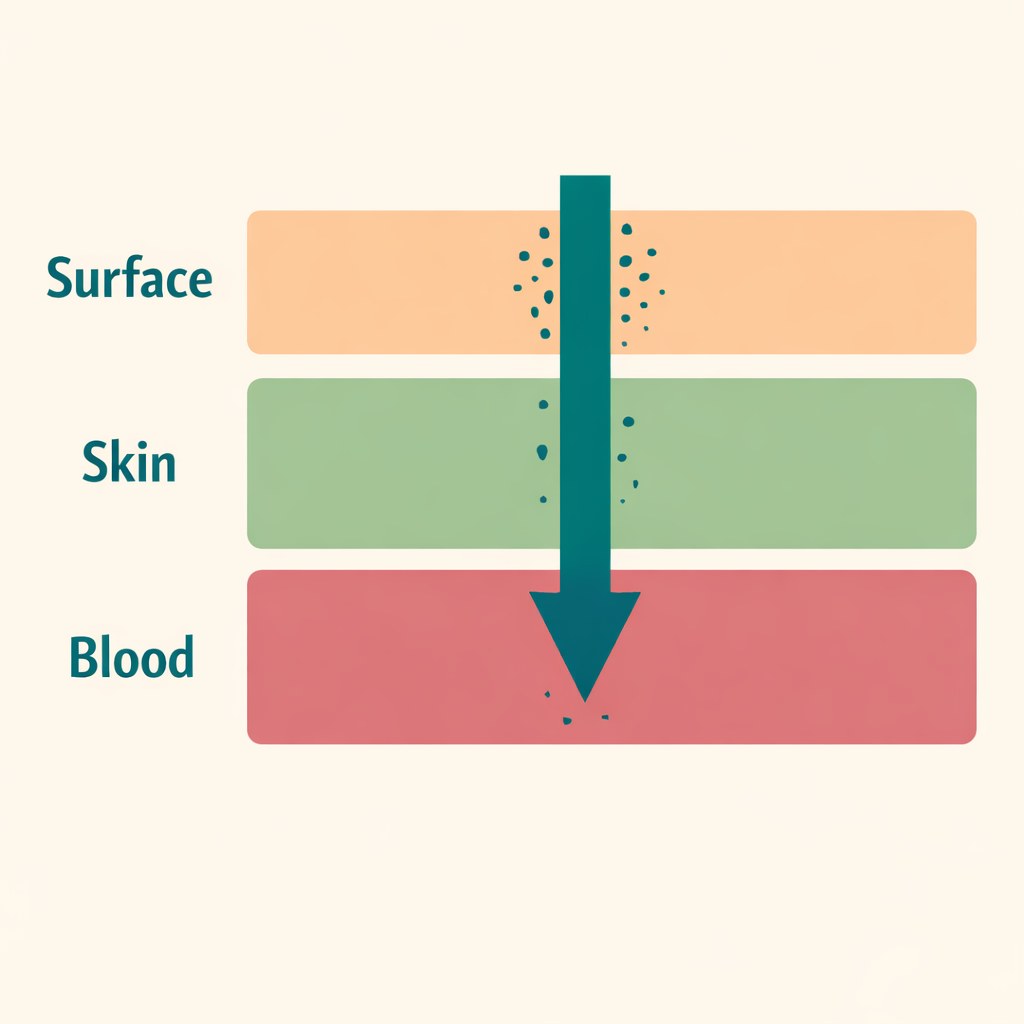
So a better question is where an ingredient goes after you apply it. There are three broad destinations. Some ingredients stay on the surface or in the top few cell layers. Some move deeper into the living layers of skin and do their work there. And a few pass all the way through and get picked up by tiny blood vessels, which is what scientists mean by systemic absorption. Most skincare is designed for the first two, while medicated patches are designed for the third. Which path a given ingredient takes depends on four things: the molecule itself, the formula around it, how much of it you use, and the condition of the skin it lands on.
What does surface deposition mean?
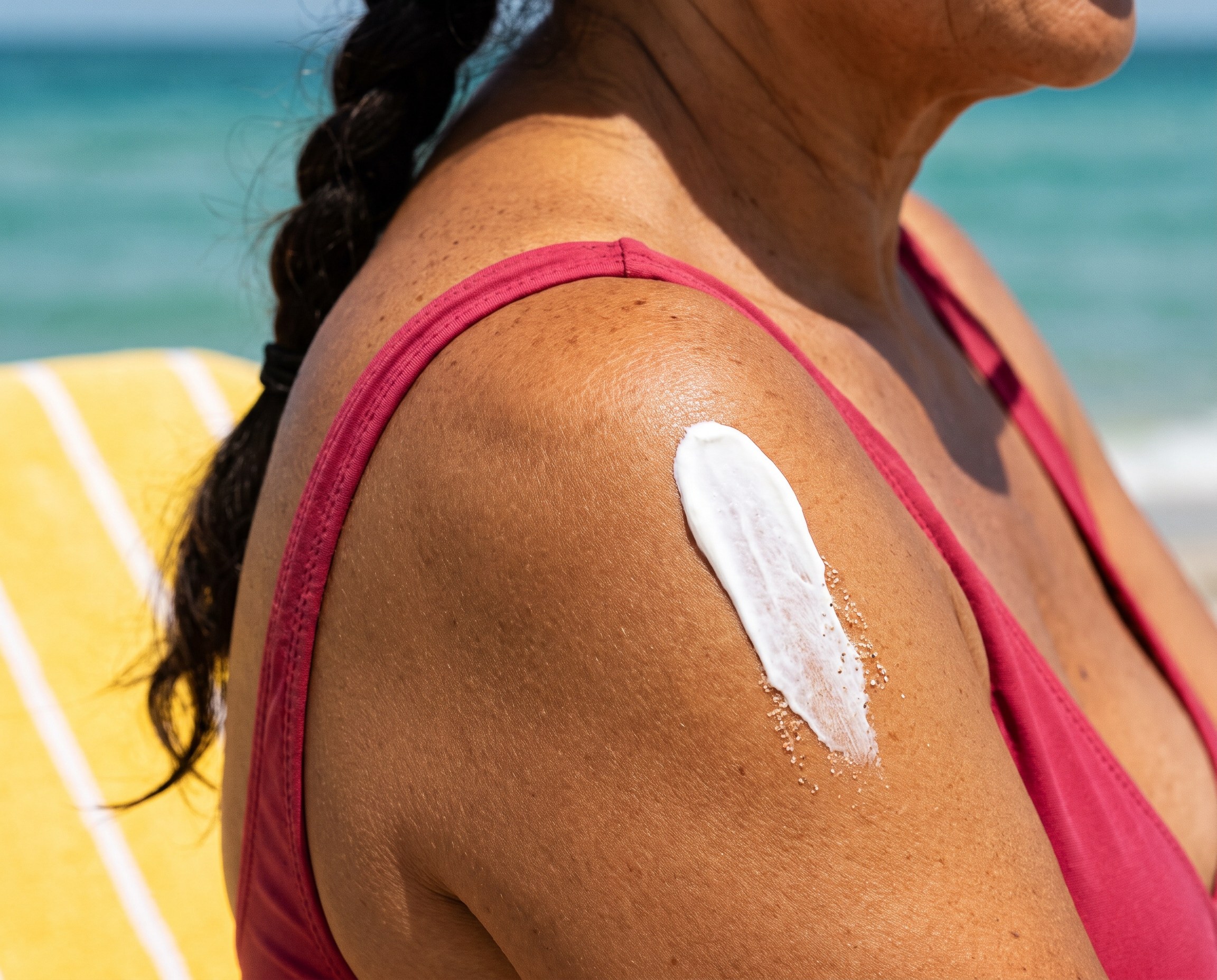
Surface deposition means an ingredient stays on top of the skin or in the upper part of the stratum corneum. That isn’t a failure. For a lot of products, it’s the whole point. Mineral sunscreens made with zinc oxide or titanium dioxide are meant to sit on the surface and block UV light there. Occlusives like petrolatum and dimethicone form a thin film that slows water loss. Makeup, primers and many moisturizers are also surface products, and they’re gone when you wash or when the outer cells shed, a cycle that takes about two weeks.
Hyaluronic acid is a good example of how size decides the job. In a study that tracked hyaluronic acid in human skin with Raman spectroscopy, smaller forms between 20 and 300 kilodaltons passed into the stratum corneum, while large forms of 1,000 to 1,400 kilodaltons didn’t get through (https://pubmed.ncbi.nlm.nih.gov/25877232/). Most hyaluronic acid serums lean on the large form. That doesn’t make them useless, because big hyaluronic acid holds water at the surface and can make fine lines look softer for hours. But it’s surface hydration, not a rebuild of the deeper skin. A label that says plumping is usually describing that temporary effect.
How far do ingredients get into the skin layers?
Penetration means an ingredient moves past the surface into the stratum corneum, the living epidermis and sometimes the dermis below it, without reaching the bloodstream in amounts that matter. This is the target zone for most active ingredients. Retinoids act on cells in the epidermis and dermis. Vitamin C needs to reach living cells to work as an antioxidant. Exfoliating acids mostly work in the upper layers, where they loosen the bonds between dead cells. Each of these has to get in far enough to do something, and ideally not much farther.
Ingredients take a few routes to get there. The main one winds between the dead cells through the fatty mortar, a slow and twisting path. Some molecules pass straight through the cells themselves. And some slip down hair follicles and sweat ducts, which act as shortcuts past the toughest part of the barrier. The skin also isn’t a passive tube. It contains enzymes that can break down or change some ingredients on the way in, which is one reason a product can behave differently on skin than it does in a lab dish.
Advertisement
When does something reach your bloodstream?

The dermis has a dense network of tiny blood vessels, so anything that gets that far can be carried away into the body. Transdermal patches prove it works. Nicotine, estrogen and motion sickness patches all deliver medicine through intact skin. But look at how they’re built. They use small molecules at high concentration, sealed under a patch that keeps them in contact with the skin for hours or days. That’s a very different situation from a thin layer of face cream you rinse off the next morning.
Still, everyday products aren’t completely kept out. In a 2020 FDA study published in JAMA, all six chemical sunscreen filters tested were absorbed into the bloodstream, and their levels passed the agency’s 0.5 nanogram per milliliter threshold after a single application on the first day (https://pubmed.ncbi.nlm.nih.gov/31961417/). That threshold isn’t a danger line. It’s the point where the FDA says more safety testing is needed, and the agency stressed that people shouldn’t stop using sunscreen (https://www.fda.gov/news-events/fda-brief/fda-brief-fda-announces-results-second-sunscreen-absorption-study). The study used large amounts over most of the body, several times a day, which pushes absorption up. The lesson is that absorbed doesn’t mean harmful, and it doesn’t mean all of it.
Why does molecule size matter so much?
In 2000, two dermatologists in Amsterdam proposed what’s now called the 500 Dalton rule. They argued that a compound needs a molecular weight under 500 Daltons to get through the stratum corneum, and that larger molecules can’t pass the outer layer (https://pubmed.ncbi.nlm.nih.gov/10839713/). They pointed out that nearly all common contact allergens and topical drugs fall under that line. For a sense of scale, caffeine is about 194 Daltons, vitamin C about 176 and retinol about 286. Collagen is in a different league entirely, with a single molecule weighing roughly 300,000 Daltons.
That’s why a collagen cream can’t top up the collagen in your dermis. The molecule is simply too big to get through, so it sits on the surface and works as a moisturizer. Small peptides are a different story, since many of them weigh only a few hundred Daltons and can get in. The 500 Dalton rule is a rule of thumb, not a law. Some larger drugs, like the eczema treatment tacrolimus, do penetrate, especially through skin that’s already inflamed. But when a product promises that a giant molecule will travel deep into your skin, it’s fair to ask how.
Does it matter whether an ingredient loves oil or water?
Size is only half the picture. Because the barrier’s mortar is made of fats, an ingredient needs some oil-friendliness to dissolve into it. But the living skin underneath is mostly water, so it also needs some water-friendliness to move out of the mortar and keep going. The ingredients that penetrate best sit in the middle. Very water-loving molecules struggle to enter, and very oil-loving ones tend to get stuck in the outer layer, where they can build up a reservoir. Molecules with an electrical charge have an even harder time, because charged particles don’t move well through fat.
Vitamin C shows how much this matters. Pure L-ascorbic acid is water-loving and often carries a charge. In research led by Sheldon Pinnell at Duke, L-ascorbic acid only entered the skin when it was formulated at a pH below 3.5, where more of it stays uncharged (https://pubmed.ncbi.nlm.nih.gov/11207686/). The same study found that popular derivatives like magnesium ascorbyl phosphate and ascorbyl palmitate didn’t raise skin levels of vitamin C. That’s why good vitamin C serums are so acidic, and why they often tingle. The chemistry decides the delivery.
How does the formula change where an ingredient goes?
Formulators call the cream, gel or oil that carries an ingredient the vehicle, and it can matter as much as the active itself. Occlusion is one big lever. Ointments, wraps and patches trap water in the outer layer, which swells it and lets more through. That’s why doctors sometimes cover a steroid cream with plastic wrap, and why the same cream penetrates differently under a heavy balm than on bare skin. Some ingredients, including alcohol, propylene glycol and certain fatty acids, loosen the barrier’s lipids and act as penetration enhancers. Encapsulation in tiny lipid spheres is another approach, meant to protect fragile actives and release them gradually.
An ingredient also has to want to leave the product. If the formula holds it too comfortably, it stays in the film on your skin. Formulators sometimes push an ingredient to the edge of what the vehicle can dissolve, which gives it more of a push into the skin. And as water or alcohol evaporates after you apply something, the leftover film gets more concentrated, which changes the push again. So two products with the same ingredient at the same percentage can deliver very different amounts. That’s frustrating for shoppers, but it’s also why a well-made formula is worth more than a long ingredient list.
Does a higher concentration mean more gets in?
Up to a point, yes. Most ingredients move through skin by passive diffusion, so a stronger concentration on the surface pushes more molecules inward. Studies by Howard Maibach’s group in both people and rhesus monkeys found that the total amount absorbed rose as the applied dose went up (https://library.scconline.org/v030n05/45). But the share that gets in often drops as the dose climbs. Once the outer layer is saturated, extra product mostly sits on top. How long it stays on, how large an area you cover and how often you reapply all change the total as well.
There’s also a ceiling. In the Duke vitamin C research, skin levels peaked when the serum contained 20% L-ascorbic acid, and stronger serums didn’t deliver more. Meanwhile, irritation keeps climbing as strength goes up. That’s a pattern you see with retinoids and exfoliating acids too. A 30% serum may just give you a 30% sting with no extra benefit. When it comes to concentration, more often means more on the surface, not more where you want it.
How much does the condition of your skin change things?

A lot. Anything that damages the barrier lets more through. Researchers have long known that skin diseases with a weak outer layer increase absorption, and that stripping the barrier with tape boosts absorption of almost any substance (https://library.scconline.org/v022n10/18). In daily life, that means eczema patches, sunburn, cuts, freshly shaved skin and over-exfoliated skin all let ingredients in faster. Damp skin is more permeable than dry skin, which is why a serum on a just-washed face can sting more. Heat raises blood flow near the surface, and that can speed uptake too.
Where you put a product matters as well. In classic work on hydrocortisone, absorption was greater on follicle-rich areas like the forehead and scalp, and lower where the stratum corneum is thick, like the soles of the feet (https://library.scconline.org/v022n10/19). Eyelid skin is very thin, while the skin on your shins and palms is tougher. So the same cream can behave differently on your cheek than on your forearm. It can also behave differently on a calm day than on the morning after a chemical peel. This is why dermatologists sometimes tell you to wait a while before applying a retinoid after washing.
What changes for mature skin?

Many people assume older skin absorbs more because it’s thinner. The research doesn’t support that simple picture. A study by Roskos, Maibach and Guy compared younger and older adults and found that hydrocortisone, benzoic acid, aspirin and caffeine all passed through aged skin significantly less, while the more oil-loving hormones testosterone and estradiol got through at about the same rate (https://researchportal.bath.ac.uk/en/publications/the-effect-of-aging-on-percutaneous-absorption-in-man/). The researchers pointed to two causes. Older skin has fewer surface lipids to dissolve ingredients into, and its outer layer is usually drier. Other research has found that aged stratum corneum holds more than 30% less lipid than young skin (https://pmc.ncbi.nlm.nih.gov/articles/PMC7138575/).
So after 60, water-loving ingredients may have a harder time getting in, while the barrier is also slower to repair once it’s disrupted. That’s an awkward mix. Your vitamin C serum might deliver a bit less than it did at 40, but a harsh exfoliant or a strong retinol can still leave you raw for days. A few habits help. Keep the outer layer hydrated with a moisturizer that has humectants and ceramides, since a well-hydrated barrier handles actives better. Be careful about sealing a strong active under a heavy occlusive, because more penetration plus slower repair can mean more irritation. And if you use medicated creams, gels or hormone patches, follow the label closely and ask before putting heat, like a heating pad, near a patch, since heat can raise absorption.
So should you worry about what you put on your skin?
Mostly, I’d shift the worry. The fear that every ingredient floods your bloodstream doesn’t hold up, since most cosmetic ingredients reach the body in tiny amounts, if at all. Safety assessors already factor in how much of an ingredient crosses the skin when they set limits. Sunscreen is a good example, because some filters do get absorbed, yet the FDA’s own advice is to keep using it. If that still bothers you, mineral sunscreens are an easy swap. Paying attention matters most with large amounts on large areas, on broken skin, and with products that are meant to deliver drugs.
Where I’d point your skepticism instead is at the promises. Collagen that rebuilds your dermis, deep-penetrating hyaluronic acid and vitamin C derivatives that outperform the real thing all run into the same chemistry. Ask what the ingredient is supposed to do, where it needs to go to do it, and whether its size, charge and formula give it a fair shot at getting there. If the brand can’t answer that, the price tag is paying for the story. That one question will save you more money than any coupon.
FAQs
Does collagen cream add collagen to my skin?
No. Collagen molecules are hundreds of times too large to pass through the outer layer, so they stay on the surface and act as a moisturizer. Your skin makes its own collagen, and ingredients like retinoids and vitamin C can encourage that process. Sunscreen protects the collagen you already have.
Is it better to apply products to damp skin?
Damp skin is more permeable, so humectants and moisturizers often work better on slightly damp skin. But strong actives like retinoids and acids can also sting more. Apply hydrating products to damp skin and give your face a few minutes to dry before stronger ones.
Does fast absorbing on a label mean it goes deep?
Not usually. Fast absorbing describes how quickly a product disappears from the surface, which often comes down to water or alcohol evaporating. It says little about how far the active ingredients travel. A light gel can feel gone in seconds and still leave most of its contents in the top layer.
Do mineral sunscreens get into the bloodstream?
Zinc oxide and titanium dioxide are designed to sit on the surface, and the FDA has proposed recognizing both as safe and effective. They’re a good option if you’d rather avoid chemical filters. Look for a formula you like enough to apply generously.
Can essential oils get into my body through my skin?
Some of their components are small, oily molecules, so a portion can pass through, especially from large amounts on large areas. That’s one reason to dilute them well. They’re also a common cause of skin allergies, so patch test first.
Your skin isn’t a sponge, and it isn’t a sealed vault either. It’s a smart, selective barrier that lets some things in, holds others at the surface, and passes a small share of a few ingredients all the way through. Size, chemistry, formula, strength and the state of your skin decide which path each one takes. Once you think in those terms, the scary headlines get less scary and the miracle claims get less convincing. And you get better at choosing products that put the right ingredient in the right place. That’s a pretty good return for a little chemistry!
Related Posts
 The Tiny Layer That Controls Everything Your Skin Does
 What Your Skin Needs at Night After 50 and Why Bedtime Is Your Best Window
 Why Your Hair Is Changing Right Along With Your Skin
 Your Skin at 35 Needs Less Than You Think
 Sebaceous Glands: Your Skin Has Its Own Oil Factory and Here Is Why That Matters
 Why Your Skin Makes Dark Spots and the Ingredients Proven to Fade Them
 What Your Bath Bomb Is Really Doing to Your Skin
 Your Bentonite Clay Has a Hometown and That Actually Matters for Your Skin
 Your Skin Wants Pumpkin This Fall and Here Is Why It Works
 The Exfoliation Secret Older Skin Has Been Waiting For
 Everything I Wish I Had Known About Skincare in My Twenties
 The Fall Skin Reset You Need Before the Season Turns
