

Nov
If you click on links we provide, we may receive compensation.
You put your foundation on the same way you have for years. Same brush, same shade, same routine you could do half asleep. Then around lunchtime you catch your face in the car’s rearview mirror and there it is – a thin line of product sitting in the crease under your eye, and another tracing the fold beside your mouth. It wasn’t there last year. I’ll be honest, the first time it happens it feels a little unfair, like the rules changed and nobody sent a memo. But nothing’s wrong with you, and you probably haven’t lost your touch. Your skin changed, and the makeup that worked on the old version of it now behaves differently on a different surface.
The good news is that settling has clear causes. Some live in your skin – texture, water content, elasticity and the way your face moves all day. Others live in the bottle, in how you put the product on, and in what you do to your skin before makeup ever touches it. Once you see how those pieces fit together, the fixes stop feeling like guesswork. Most of them are small, and a few cost nothing at all.
What actually happens when makeup settles?
Foundation and concealer are mostly pigment suspended in a mix of water, oils, silicones and film formers. When you apply them, the liquid parts start to evaporate or sink in, and the pigment is left behind in a thin film. On smooth, springy skin that film lies flat and stays put. On skin with more texture, the film has somewhere to go. Every time your face moves, the skin folds, and product gets pushed from the high points into the low points. Over a few hours that adds up, and the pigment collects in the creases where it looks darker and denser than the skin around it. That’s why settling often looks worse at 3 p.m. than it did at 8 a.m. The line was there all along, and the makeup found it over the course of the day.
It helps to separate two problems that often get lumped together. Creasing is product gathering into lines. Caking is product sitting on top of dry patches and looking thick or powdery. They often show up together, and they share some causes, but the fixes lean in different directions. Creasing is mostly about movement and how much product sits on the areas that move. Caking is mostly about dryness and texture under the makeup. If you know which one you’re looking at, you’ll know where to start.
Why does skin texture change after 40?
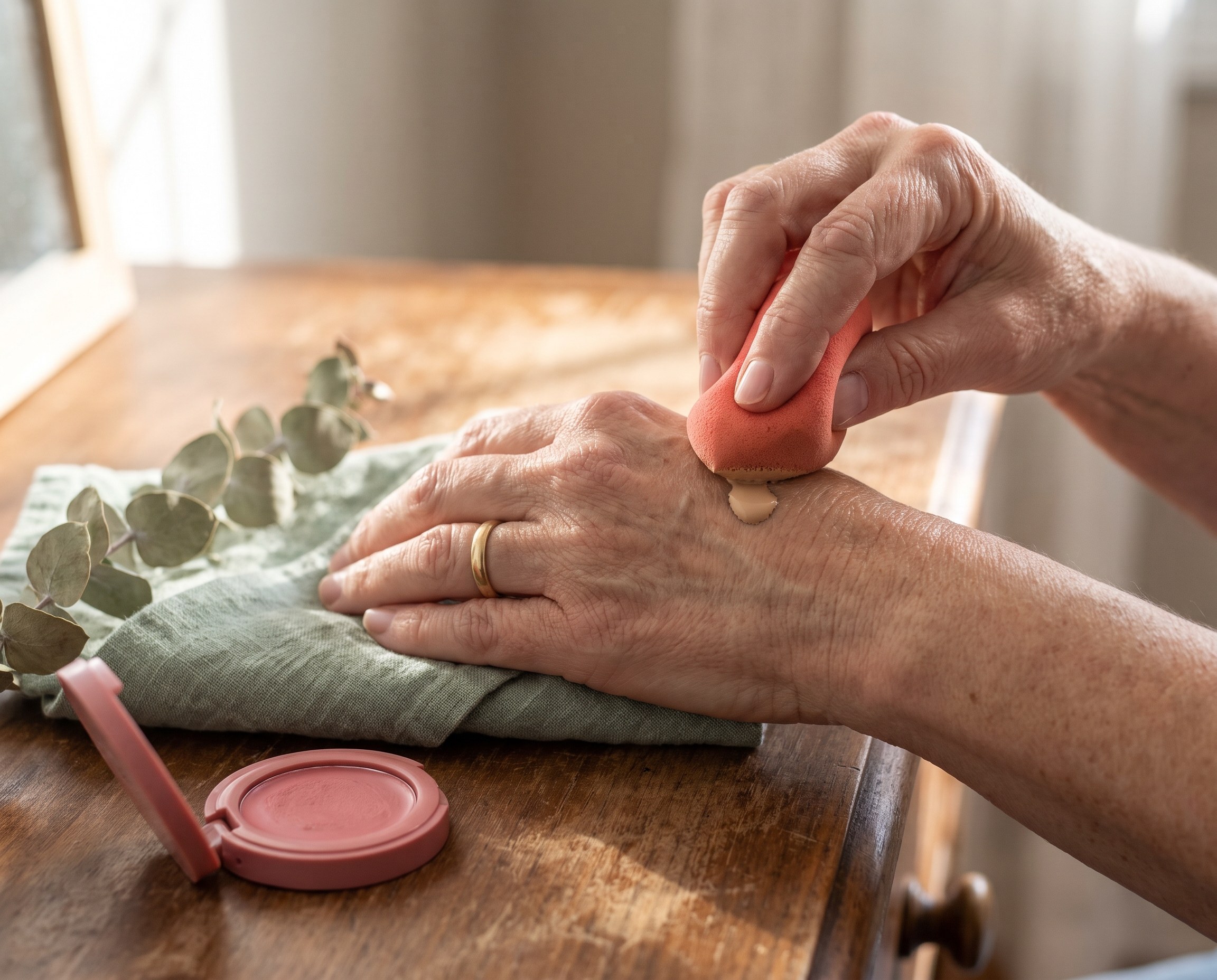
Texture depends a lot on what’s going on under the surface. The dermis, the layer below the outer skin, is packed with collagen and elastin that give skin its thickness and bounce. That support thins over time, and for women it drops faster around menopause. A 2025 clinical review in EMJ Dermatology notes that women lose about 30% of their skin’s collagen in the first five years after menopause (https://emjreviews.com/dermatology/article/managing-menopausal-skin-a-clinicians-review). Less collagen means thinner skin with less internal scaffolding. The surface starts to show fine crisscross lines that weren’t visible before, and pores can look larger because the skin around them has less support.
Cell turnover slows down too. Younger skin sheds its outer layer of dead cells on a fairly quick cycle, which keeps the surface smooth and even. As that process slows, dead cells linger and build up into a rougher layer. Makeup grabs onto those flakes and sits unevenly on them. You might notice foundation looks patchy around the nose or chin even when you’ve blended well. That’s texture, and it’s one of the main reasons a product that used to look seamless now looks like it’s sitting on top of your face.
How does lost hydration change the way foundation wears?
Water in the outer skin layer is a big part of how smooth skin looks. Plump, hydrated skin cells sit close together and reflect light evenly. When they dry out, they shrink and lift slightly at the edges, and tiny dehydration lines appear. Those lines are shallow, but makeup finds them anyway. The skin’s own oils help hold that water in place, and they fall off sharply with age. A study in Acta Dermato-Venereologica reports that sebum production in women drops by about 40% during their 50s (https://www.medicaljournals.se/acta/content/html/10.2340/00015555-2572).
Less oil changes how makeup wears in a second way. Many foundations rely on a little natural oil to stay flexible on the skin through the day. Without it, the film dries out faster and gets stiffer. A stiff film cracks when your face moves instead of bending with it. Dry skin also pulls moisture out of liquid foundation while you apply it, so the product sets before you’re done blending. Then you go back in with more to fix the patchiness, and that extra layer is exactly what ends up in the creases. A 2007 review in Menopause International found that 36.2% of postmenopausal women aged 40 and over had dry skin (https://www.um.edu.mt/library/oar/bitstream/123456789/6405/1/Jean%20Calleja-Agius%20-%20Skin%20ageing.pdf), so if this sounds familiar, you’re in good company.
Why does elasticity matter so much for concealer?
Elasticity is the skin’s ability to snap back after it stretches or folds. Young skin folds when you smile and flattens out the moment you stop. Older skin folds in the same places but takes longer to recover, and some folds start to stay. The same Menopause International review notes that skin elasticity declines by about 0.55% a year after menopause. That sounds small, but it adds up over a decade, and the effect shows first in the areas that move most. A line that holds its shape for even a few seconds longer gives makeup time to slide in and settle.
Advertisement
Concealer takes the worst of this because of where it goes. The under-eye area has some of the thinnest skin on the face, very few oil glands, and it moves constantly. Concealers are also built to cover, which usually means more pigment and less slip than foundation. Put a thick, high-coverage product on thin, dry, mobile skin and it has nowhere to go but into the folds. This is why so many people find their foundation still looks fine while their under-eye concealer has collapsed into lines by midmorning. The concealer is being asked to do a hard job on difficult ground.
How much does facial movement contribute?

More than most of us think! Your face is almost never still. You talk, chew, squint at screens, raise your eyebrows and smile at people all day. You also blink, and most people blink around 15 to 20 times a minute, according to Healthline (https://www.healthline.com/health/how-many-times-do-you-blink-a-day). Each blink folds the skin around the eye, and that adds up to thousands of folds over a working day. Every fold presses a little makeup into the crease and lifts a little off the skin on either side.
Expression lines also form in predictable spots. The lines between the brows, the crow’s feet at the outer eyes, the folds running from nose to mouth and the small lines above the upper lip all come from repeated movement. In younger skin these are dynamic lines that vanish when the face relaxes. Over time some become static lines that are there even at rest. Makeup treats both kinds as channels. Once you know where your face moves most, you also know where to use less product.
Is your foundation formula working against you?
Formulas that look great on younger or oilier skin can be a poor match after 40. Long-wear and matte foundations are a common example. They’re built to set into a firm film that resists oil and sweat, which is useful on an oily T-zone. On drier, thinner skin that firm film doesn’t flex, and it shows every line once your face starts moving. Heavy, full-coverage formulas have a similar problem because there’s simply more pigment available to collect in creases. Many people reach for more coverage as they get older to even out spots and redness, and that instinct often makes settling worse.
Look instead for formulas described as hydrating, satin or skin-like in finish. These usually contain more humectants and emollients, like glycerin, hyaluronic acid or squalane, that keep the film flexible longer. Lighter textures such as serum foundations, skin tints and tinted moisturizers lay down less pigment per layer. You can build coverage only where you need it and leave the rest of the face sheer. Water-based formulas tend to feel lighter, while those with a bit of oil or silicone give more slip and blur. There’s no single right answer, so test a formula through a full day before you decide.
Powder deserves its own mention. A heavy layer of setting powder can lock foundation in place, but on dry skin it can also soak up what moisture is left and settle into lines as a dry, grayish film. Finely milled translucent powders are easier to work with than heavier tinted ones. Most people over 40 do best using powder only where they need it, usually the sides of the nose, the center of the forehead and a light touch under the eyes. Pressing it in with a puff works better than sweeping it on with a big brush. And plenty of people find they don’t need it at all.
Do primers help or make it worse?
Primers can help, but it depends on which kind you use. Silicone-based smoothing primers fill in fine lines and pores with a soft, flexible film, giving foundation a flatter surface to sit on. That can work well on the cheeks and forehead. Used under the eyes or around the mouth, though, a thick layer can make concealer slide around and pool. Hydrating primers act more like a light extra moisturizer and help on skin that drinks up foundation. For many people the best approach is a small amount, only in the areas that need it, with a minute to settle before makeup goes on.
Pay attention to how your primer, moisturizer and foundation work together, too. Water-based and silicone-heavy products don’t always layer well, and mixing them can cause pilling or patchy wear. If your foundation balls up or separates by midday, try pairing products with similar bases. Read the first few ingredients on each label. If one starts with water and the other leads with something ending in “-cone” or “-siloxane,” that pairing might be the problem. It’s a small detail, but it explains a lot of makeup that seems to break down for no reason.
Does the way you apply makeup make a difference?
Technique matters as much as formula, and maybe more. The biggest single change most people can make is to use less product. Start with a small amount in the center of the face, where redness and uneven tone usually sit, and blend outward. By the time you reach the outer cheeks, jaw and the area around the eyes, there’s only a thin veil left. That’s where your face moves most, so that’s where you want the least. You can always go back and add a second thin layer to a spot that needs it.
Tools change the finish too. A damp makeup sponge pressed into the skin gives a thin, even layer and picks up excess product as it goes. Fingers warm the product slightly and help it melt into the skin, which works well with cream and liquid formulas. Dense brushes can leave streaks and push more product onto the surface than you need. Whatever you use, press and roll rather than wipe. Wiping drags product across texture and leaves more of it sitting in the dips.
With concealer, placement is everything. Many people sweep a big triangle under the eye, right up to the lash line, which puts product on the thinnest and most mobile skin. Try putting a small amount only where the shadow is darkest, usually the inner corner and the hollow just below it, and tap it out with your ring finger. Keep it away from the outer corner, where crow’s feet fold with every smile. Wait a minute, then look up, smile and blink a few times. If anything has gathered in a line, tap over it once with your finger or a damp sponge before you set it.
How should you prep your skin before makeup?

Most settling problems start before the foundation comes out. Makeup sits on whatever surface you give it, so the condition of that surface sets the tone for the whole day. Start with a gentle cleanser that doesn’t leave your skin feeling tight. Follow with a moisturizer suited to your skin, and give it a few minutes to absorb before you apply anything else. Skipping that wait is one of the most common reasons makeup slides or pills.
Exfoliation helps with the texture problem, but more isn’t better. Gentle chemical exfoliants like lactic acid or polyhydroxy acids loosen dead skin cells without scrubbing. Once or twice a week is plenty for most mature skin. Over-exfoliating weakens the skin barrier, and a weakened barrier loses water faster and looks rougher, which is the opposite of what you want. If your skin stings when you put on moisturizer, cut back.
Longer term, a few ingredients can improve the surface your makeup sits on. Retinoids are well studied for supporting collagen and smoothing fine lines over months of steady use. Peptides and niacinamide support the skin barrier. Humectants such as hyaluronic acid and glycerin pull water into the outer layer. Daily sunscreen is the step that protects everything else, since UV exposure breaks down collagen faster. None of this works overnight, but after a few months makeup tends to go on more smoothly and stay put longer.
What changes for mature skin in your 60s and beyond?

After 60, the shifts we’ve talked about keep going, and a few new ones join them. Skin is thinner and drier, oil output is lower, and folds that once relaxed now tend to stay. Fat pads in the face also lose volume and shift lower, which creates hollows under the eyes and deepens the folds near the mouth. Makeup reads differently on that kind of surface. Very dewy, reflective finishes that look lovely on smooth skin can catch the light on texture, so a soft satin finish is often the better middle ground.
Many women in their 60s and 70s find that less makeup looks better than more. A tinted moisturizer or skin tint with targeted concealer, a little cream blush and a defined brow often looks fresher than full foundation and powder. Cream products move with the skin instead of sitting on top of it. Powder blush and powder eyeshadow can cling to dry patches and crepey lids, so creams are often the easier choice. The goal is makeup that looks like skin, on skin that has changed.
Your skincare routine might need a firmer hand at this stage too. Richer moisturizers, fewer foaming cleansers and a gentler approach to strong actives can all help the skin hold water through the day. Lips need attention as well, since the fine vertical lines above the upper lip can pull lipstick outward. A lip liner close to your natural lip color, paired with a creamy rather than matte lipstick, keeps color where you put it. Small changes like these tend to add up to more than any single product swap.
FAQs
Why does my foundation look fine in the morning but settle by afternoon?
Most settling happens over hours, not minutes. Each time your face moves, a little product shifts into the creases, and the effect builds through the day. Dry skin also absorbs moisture from the foundation, which stiffens the film and makes it crack along lines. Using less product in the areas that move and pressing a damp sponge over creases at midday can help.
Should I stop using powder after 40?
Not necessarily. Many people do well with a small amount of finely milled translucent powder pressed into the areas that get shiny. The problem is usually too much powder, or a heavy powder applied all over dry skin. Try using less and placing it only where you need it.
Can skincare actually stop makeup from creasing?
It can make a real difference over time. Well-hydrated skin with a healthy barrier gives makeup a smoother, more flexible surface. Ingredients like retinoids, hyaluronic acid and niacinamide improve texture over weeks to months. Skincare won’t erase deep lines, but it often reduces how much product gathers in the finer ones.
Is concealer or foundation more likely to settle?
Concealer, in most cases. It’s thicker and more pigmented, and it usually goes on the thinnest, driest and most mobile skin on the face. A lighter, more hydrating concealer placed only where the shadow is darkest makes a big difference.
Do I need to buy all new makeup?
Probably not. Start by changing how much you use and how you apply it, and spend a little more time on skin prep. If a product still settles after that, a lighter or more hydrating formula is the next thing to try.
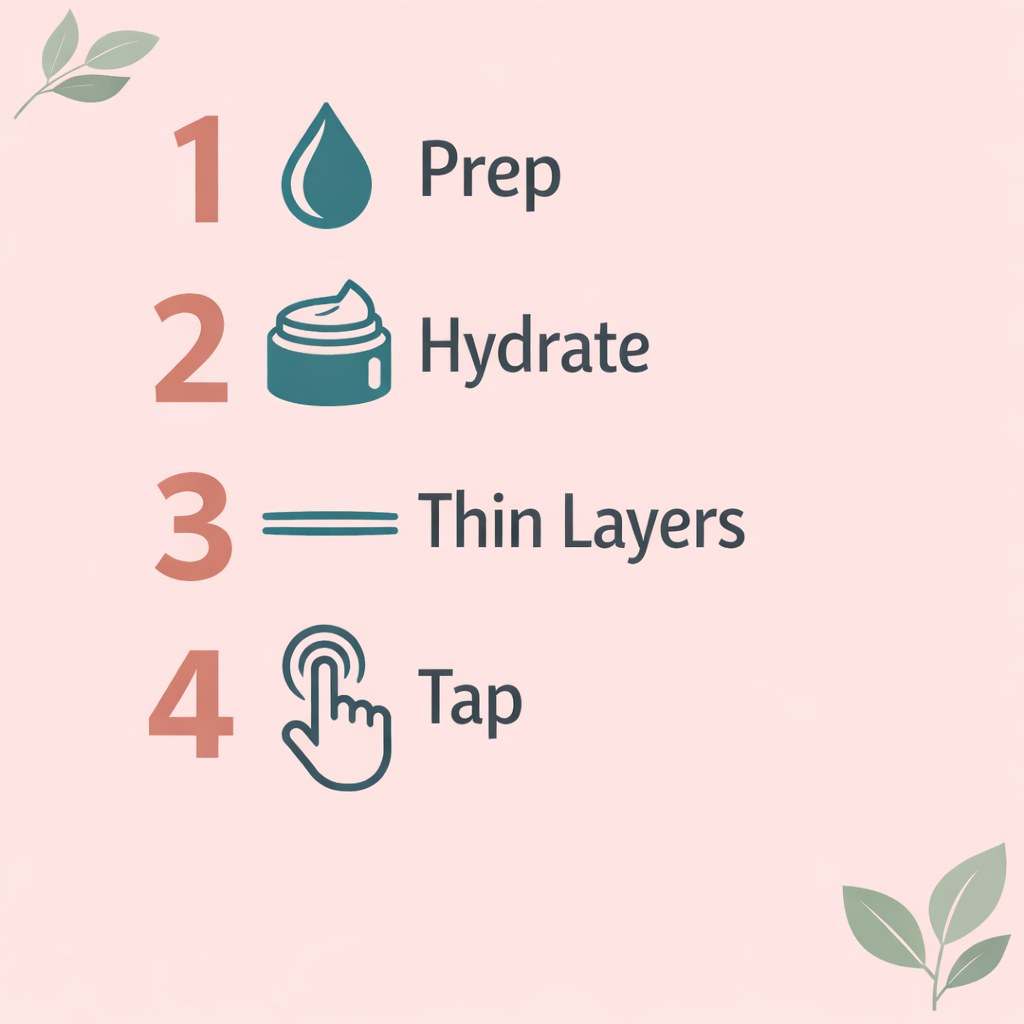
When makeup starts settling into lines, it usually means your skin has changed and your routine hasn’t caught up yet. Thinner skin, less oil, slower bounce-back and a face that moves all day all play a part. The fixes are mostly simple. Prep the skin well, choose formulas that stay flexible, use less where your face moves most, and take a minute to check your work before you leave the house. Give a few of these changes a couple of weeks, and I think you’ll be surprised how much better your usual products start to look.
Related Posts
 Can Glitter Eye Makeup Hurt Your Eyes? Here’s the Honest Answer
 What Your Eye Cream Can Fix and What It Never Will
 Why Your Skincare Dupe Isn’t a Twin Even When the Ingredients Match
 What You’re Paying For in a $150 Moisturizer
 Why Your Hair Is Changing Right Along With Your Skin
 Preservative Free Sounds Safer Until You Open the Jar
 Why Your Conditioner Stopped Working and What a Hair Mask Can Do About It
 Should You Use Dandruff Shampoo Every Day? Here’s What Your Scalp Really Wants
 The Cosmetics Law You Probably Missed Is Already Sitting in Your Bathroom Cabinet
 The Good, the Bad, and the Ugly Truth About Cheap and Pricey Shampoo
 Your Skin at 35 Needs Less Than You Think
 Who Has the Best Pimple Patch in 2026
