Sep
If you click on links we provide, we may receive compensation.
Dermatologists who track skin barrier function across seasons have found that transepidermal water loss – the invisible seepage of moisture through the skin’s outer layer – climbs measurably as autumn deepens into winter. TEWL is measured in grams of water per square meter of skin per hour, and in cold, dry conditions the gradient between your skin and the surrounding air sharpens, pulling moisture outward faster than your cells can replenish it. A systematic review published in the journal Skin Pharmacology and Physiology confirmed that cold weather, low ambient humidity, and wind all increase outward water diffusion and worsen TEWL (https://pmc.ncbi.nlm.nih.gov/articles/PMC9168018/). For anyone over 60, the situation is compounded: ceramide production declines naturally with age, leaving the outer barrier thinner and more permeable than it was twenty years ago. The holiday season does not just bring cold weather – it layers on cortisol from travel schedules, disrupted sleep, and the particular low-grade pressure of getting everything done before year’s end. Starting a targeted skin wellness ritual now, before you feel the damage, means your skin has weeks to build reserves rather than weeks to burn through them.
Most people approach holiday skincare reactively. They reach for heavier creams when their face already feels tight, or buy a vitamin C serum in late November and wonder why they are not glowing by the office party. But skin does not turn around overnight. The keratinocytes that form the outer layer take roughly 28 days to travel from the deeper epidermis to the surface; after 40 that cycle slows further, meaning changes you make now will not show up as visible improvement for three to six weeks. Building a seasonal ritual in early fall means your freshest, best-prepared skin cells are arriving at the surface just as the holiday calendar fills up. The timing is not incidental. And the steps involved are simpler than most people expect – the benefit comes from consistency and choosing the right ingredients for the season’s specific stressors, not from stacking a dozen products.
Why Does the Holiday Season Hit Skin So Hard?

Cold outdoor air and heated indoor spaces are often treated as one problem, but they are actually two separate mechanisms working in the same direction. Outside, cold temperatures and low humidity create a harsh vapor gradient that pulls water from the skin surface, and wind accelerates evaporation further. Inside, central heating systems warm the air without adding humidity to it, often dropping indoor relative humidity to 20 to 30 percent – a level that actively desiccates skin tissue. Moving repeatedly between these two environments across a single day means the barrier never gets a stable equilibrium to work from. That constant adjustment taxes the tight junctions between skin cells, the lipid lamellae that hold them together, and the natural moisturizing factors that keep the outermost layer supple. By November those repeated transitions have already accumulated into measurable damage.
Stress compounds all of this. Cortisol – the body’s primary stress hormone – has a well-documented suppressive effect on skin structure. Research published in PMC found that at higher cortisol concentrations, LOXL1 mRNA expression dropped by 27 percent, which corresponds to a predicted impairment of the skin’s elastin network (https://pmc.ncbi.nlm.nih.gov/articles/PMC11743297/). Collagen type I and type III were also significantly downregulated. These are not abstract biochemical measurements – they translate into skin that looks less firm, feels less resilient, and heals more slowly when the air dries it out. Holiday stress does not strike all at once but builds over weeks, meaning the skin is usually already compromised before the most demanding social events arrive. Getting your ritual in place now means the barrier has time to rebuild before the cortisol load peaks.
Diet also shifts during the holiday period in ways that affect the skin. More alcohol, more sugar, and more processed food generate more systemic inflammation, and inflammation accelerates the enzymatic breakdown of collagen and elastin. Glycation – the process by which sugar molecules attach to collagen fibers and make them stiff and brittle – is worth knowing about for anyone in their 60s or 70s, because the body’s capacity to recycle damaged collagen declines with age. The point is not to avoid celebrating. It is to understand that what goes in has visible effects on the surface, and that supporting your skin from the outside with the right topicals gives your body’s repair systems a better starting point when internal inputs are less than perfect.
What Should Your Morning Routine Look Like Right Now?
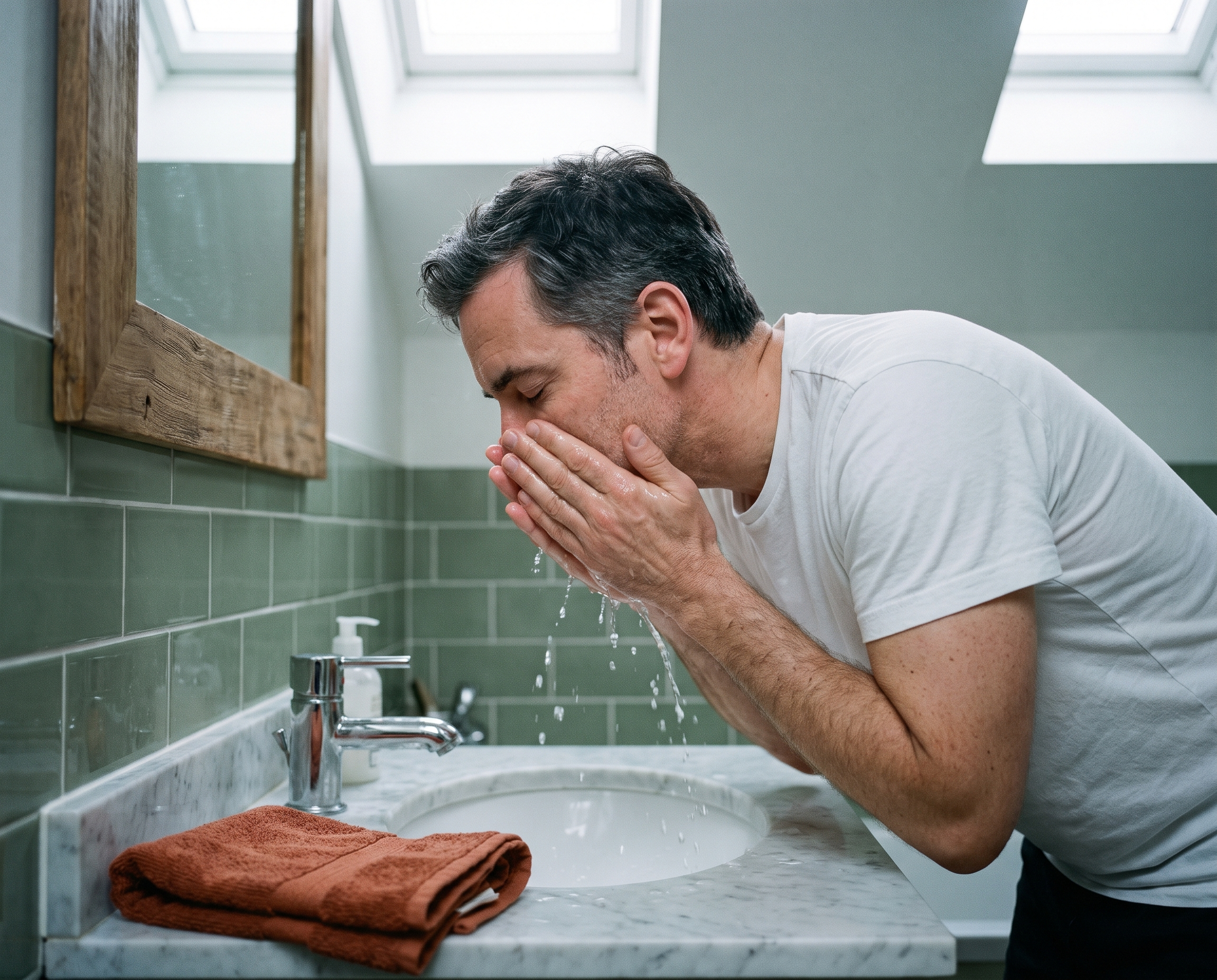
The morning routine for autumn and holiday prep has three pillars: antioxidant protection, hydration, and SPF. Most people already know these in theory, but execution is where it usually falls apart. The antioxidant step – typically a vitamin C serum – needs to be applied to clean, dry skin before any moisturizer so that the active ingredient can actually penetrate rather than sit on top of an emollient layer. Vitamin C at L-ascorbic acid concentrations of 10 to 20 percent has decades of peer-reviewed support for reducing oxidative stress, brightening post-inflammatory pigmentation, and supporting collagen production. In autumn it matters additionally because indoor heating systems can degrade indoor air quality in ways that increase free radicals at the skin surface, making antioxidants double their value.
Hydration comes next. A hyaluronic acid serum applied to slightly damp skin draws water toward the outer layers and temporarily increases their volume and plumpness, which softens the visible depth of fine lines. But hyaluronic acid can work against you in very low-humidity environments: if there is no moisture in the air to draw from, it will pull from the deeper skin layers instead. The fix is to seal it immediately with a moisturizer that contains either an occlusive ingredient like squalane or shea butter, or a combination of humectant and emollient so the water has somewhere to come from and something to keep it from leaving. Skipping this sealing step is one of the most common reasons people say their hydrating serums are not working. SPF follows regardless of season – UV radiation still penetrates clouds, glass, and the flat winter light that does not feel warm enough to cause damage.
What Happens to Mature Skin When Cold Weather Arrives?

Mature skin responds to cold weather differently than younger skin does, and the differences are significant enough that they change what a good winter ritual actually looks like. After 60, the epidermis is typically thinner, sebaceous glands produce less oil, and the skin’s natural ceramide content is lower than it was at 40 – which means the lipid barrier is already running a deficit before any environmental stress is added. When TEWL increases in cold air, mature skin loses moisture faster and recovers it more slowly, because the cellular machinery that rebuilds the barrier – the enzymes that synthesize ceramides, fatty acids, and cholesterol in the outer layer – becomes less efficient with age. The result is that mature skin experiences winter dryness earlier in the season and more severely than younger skin, even in people who have maintained a careful routine throughout the year.
The skin’s collagen matrix also changes with age in ways that make winter damage more visible. Collagen density in the dermis declines at roughly one percent per year from around age 25, and what remains in mature skin is more cross-linked and less elastic. When the epidermis above becomes dehydrated and tight, the appearance of lines and creases is amplified – not because new wrinkles have formed, but because dehydration removes the water content that normally cushions the surface and softens light reflection. This is why many women in their 60s notice their skin looks noticeably older in winter than in spring or autumn. The dehydration effect exaggerates every existing line. Addressing it is largely about water content rather than new actives, which is why a ceramide-rich moisturizer becomes more important this season than any other product in the routine.
Advertisement
A 2025 consensus study involving 62 dermatologists at 43 centers rated ceramides as the second most recommended ingredient for dry skin, with 82.1 percent consensus – just behind petrolatum (source: https://dessna.com/how-cold-weather-compromises-your-skins-natural-defense-system/). That consensus carries weight. Ceramides are the lipids that form the lamellar structure of the skin barrier, and topically applied ceramides have been shown in multiple studies to integrate into that structure and reduce TEWL measurably. For mature skin where endogenous ceramide production is already low, they are genuinely restorative rather than just supportive. A ceramide-rich moisturizer applied morning and evening during the autumn-to-winter transition gives the barrier a tangible repair scaffold.
Gentle cleansing is another area where mature skin needs particular care during this season. Foaming cleansers that strip sebum may have been appropriate for oily skin in summer, but in winter on older skin they remove the lipid protection that the barrier works hard to produce. A cream or oil-based cleanser that lifts makeup and environmental debris without dissolving the skin’s own oils is the better choice from October through March. If skin feels dry or tight within 10 minutes of cleansing, that is a clear signal the cleanser is too stripping. Switching it out will have a faster effect on overall skin comfort than adding more products on top.
How Do You Protect Your Skin Against Holiday Stress?
Addressing holiday stress on the skin means working on the skin itself and, to some degree, the inputs that drive cortisol production – though the latter is a whole-life project rather than a skincare step. From the topical side, ingredients that support barrier integrity and reduce surface inflammation give the skin better resilience when cortisol is elevated. Niacinamide – vitamin B3 at concentrations of 4 to 10 percent – has solid clinical evidence for reducing transepidermal water loss, calming redness, and improving the appearance of enlarged pores and uneven tone. It is also unusually compatible: it does not conflict with retinoids or vitamin C at most concentrations, and it carries essentially no sensitization risk for most skin types. Adding niacinamide to a morning or evening routine is one of the simpler decisions a person can make heading into autumn.
Sleep disruption, which peaks for many people during the holiday travel season, shows up on the skin because most of the skin’s repair processes – collagen synthesis, cell turnover, barrier rebuilding – happen primarily at night under the influence of growth hormone and other nocturnal signals. A single bad night does not register dramatically, but two or three weeks of fragmented sleep adds up into visible dullness, puffiness, and slower recovery from whatever the environment is doing to the skin during the day. A concentrated overnight mask or sleeping cream on nights when rest is limited gives the skin’s repair systems additional raw materials to work with. Look for formulas that combine peptides – which signal fibroblasts to increase collagen production – with occlusives that seal moisture in while you sleep. It does not replace sleep, but it narrows the gap.
What Should Your Evening Routine Add This Season?
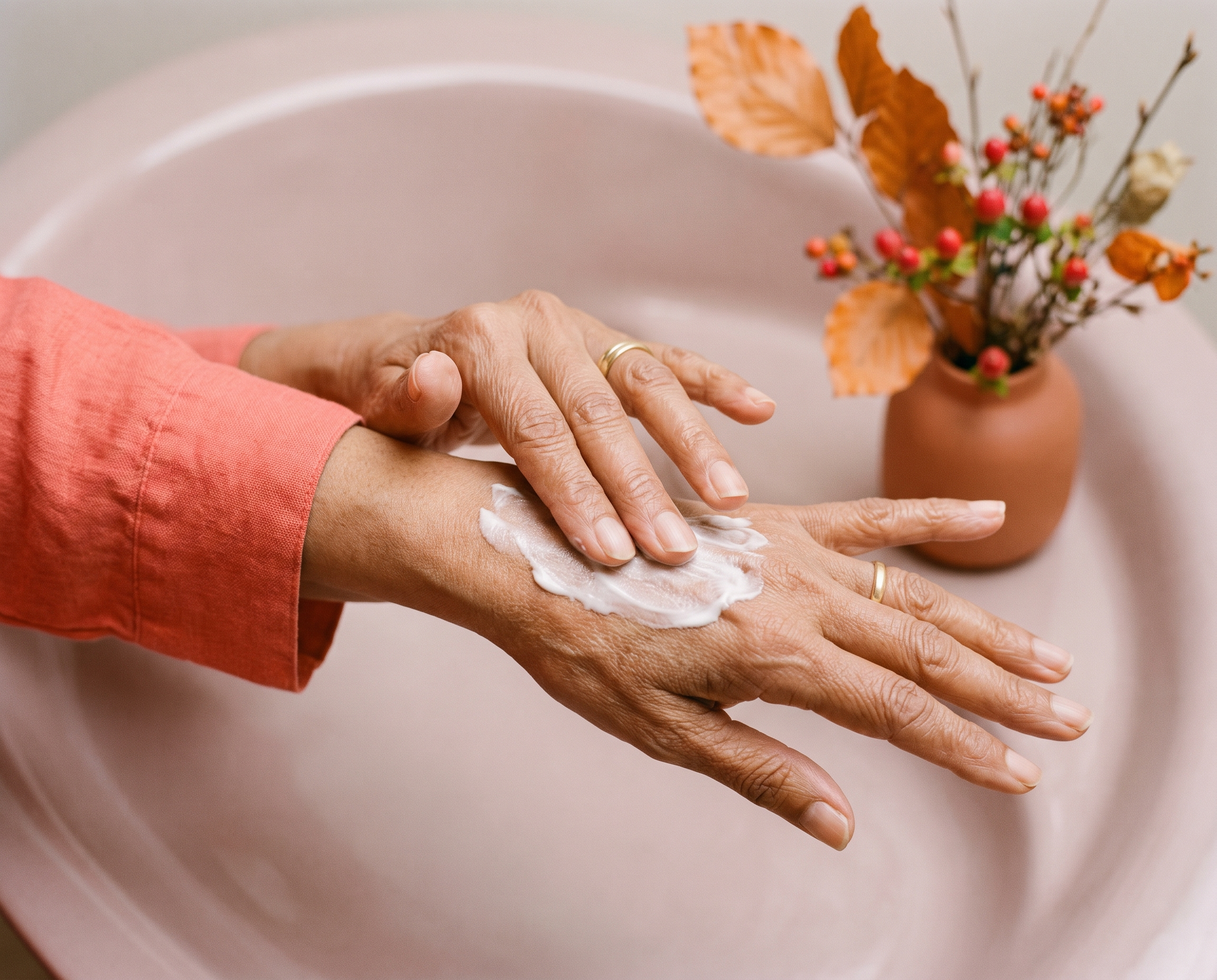
Evening is when the most active ingredients belong. Retinoids – vitamin A derivatives that include both over-the-counter retinol and prescription-strength tretinoin – are the most evidence-backed actives for collagen loss, cell turnover, and visible signs of chronological aging. They work by binding to nuclear receptors in fibroblasts and keratinocytes, increasing the transcription of procollagen genes and speeding up epidermal cell renewal. The difficulty in winter is that retinoids can increase TEWL and make skin more sensitive to drying environmental conditions – not a reason to stop them, but a reason to buffer them. Applying a thin layer of ceramide moisturizer before retinol – the sandwich method – reduces irritation while preserving efficacy. Beginning at a lower frequency, two or three nights per week, and building up as the skin acclimates is a practical approach for anyone new to winter retinoid use.
Peptides are worth adding to the evening routine during colder months. Unlike retinoids, they carry essentially no irritation risk, they can be layered with almost anything, and they signal cells to produce more of the structural proteins – collagen, elastin, and hyaluronic acid – that aging skin produces less of on its own. Matrixyl 3000, argireline, and copper peptides each work through different mechanisms and are available across a range of price points. There is no single best peptide, but the evidence base for several of them is genuinely solid. Incorporating a peptide serum under an occlusive moisturizer at night adds meaningful support for skin repair during the hours when that repair is most biologically active.
Do You Need to Swap Out Any Products Already in Your Routine?
The transition into the holiday season is a good time to audit what is already in the routine for seasonal fit. Products that worked well in summer may work less well now – not because they have gone off, but because the skin’s needs have shifted. A lightweight gel moisturizer that felt ideal in July may not have enough occlusive weight to keep skin comfortable in November when indoor heat is running. A cleanser that felt refreshing in warm weather may feel stripping now. The test is simple: if skin feels tight anywhere within 10 to 15 minutes of completing the routine, something is not providing enough barrier coverage for the current conditions. That is worth addressing early rather than waiting until the skin is visibly irritated or flaking.
Exfoliation deserves specific attention in the seasonal swap. In summer, higher humidity and faster cell turnover often justify more frequent use of AHAs or BHAs. In autumn and winter, the barrier is already under more pressure from environmental conditions, and aggressive exfoliation can tip it from a manageable challenge into genuine impairment. That does not mean stopping exfoliation – the buildup of dead cells in winter makes skin look dull and blocks the penetration of active ingredients. But reducing frequency from every other day to twice a week, and switching to a gentler acid like lactic instead of glycolic, gives the barrier less to cope with while still maintaining the turnover needed for clear, receptive skin. Physical scrubs should generally be avoided on mature skin in this season; the micro-tears they can cause are harder to heal when the barrier is already under stress.
FAQs
Is it too early to start a winter skincare routine in September or October?
No – starting early is an advantage, not a waste of effort. The skin’s cell cycle takes four to six weeks in mature skin, meaning beneficial changes you introduce now will show up as surface improvements in November and December, just when you want them. Waiting until you feel the cold weather’s effect means you are already playing catch-up.
Can I use retinol in winter if I already have dry skin?
Yes, with adjustments. Apply a thin layer of a ceramide or peptide moisturizer before your retinol to buffer contact and reduce irritation. Start with a lower concentration – 0.25 to 0.5 percent – two or three nights per week, and build frequency as your skin adjusts. If skin is significantly dry or flaky, spend a week or two focusing only on ceramide-based repair before introducing retinol.
Do I still need SPF in winter?
Yes. UVA rays – the ones most responsible for collagen degradation and photoaging – maintain roughly consistent levels year-round. They penetrate cloud cover and glass, meaning time spent near windows on grey winter days still carries UV exposure. A broad-spectrum SPF 30 or higher belongs in the morning routine through January and beyond.
What is the single most important change for mature skin heading into the holiday season?
Switching to a ceramide-rich moisturizer and applying it consistently twice a day. Ceramides are the lipids that form the skin’s barrier, their production declines with age, and cold weather depletes them further. Every other active in the routine works better when the barrier is intact – ceramides lay the foundation everything else builds on.
Does what I eat over the holidays actually show up on my skin?
Over time, yes. Excess alcohol dehydrates the skin systemically; sugar drives glycation which stiffens collagen; heavily processed foods elevate systemic inflammation. None of this means one holiday dinner creates visible damage, but consistent excess over a six-week period accumulates. Balancing richer occasions with good hydration and antioxidant-rich foods like leafy greens, berries, and fatty fish helps offset the load on the skin’s repair systems.
The holiday season is a real environmental event for your skin. Cold air, indoor heat, stress, disrupted sleep, and dietary changes all push in the same direction – toward a depleted barrier, accelerated moisture loss, and the kind of tired skin that shows up in photographs taken at parties you were glad to attend. Starting a targeted ritual now means those forces meet a barrier that has been deliberately reinforced, a collagen network supported with the right actives, and a skin surface that has been kept clear enough to benefit from what you are using. None of this requires an elaborate shelf of products. A vitamin C serum in the morning, a ceramide moisturizer applied twice daily, SPF every day, retinol or peptides in the evening a few nights a week, and a gentler cleanser – that is a complete protocol for the season. The work is in starting now and keeping it consistent, not in finding something more complicated. Your December skin will reflect what you did in October.
Related Posts