

Nov
If you click on links we provide, we may receive compensation.
You wash your face before bed, smooth on whatever cream is closest and turn out the light. Then you wake up and your cheeks feel tight before your feet even hit the floor. Maybe there’s a dry patch beside your nose that wasn’t there last week. I hear some version of this all the time, and it’s frustrating, because you did take care of your skin. You just took care of it the way that worked ten or fifteen years ago. After 50, the night shift asks for something different, and the good news is that it isn’t complicated.
This piece is the other half of our morning skincare routine for dry mature skin. The morning routine is about defense, with sunscreen, antioxidants and enough moisture to carry you through the day. Night is where repair happens, and it runs on three ideas I’ll walk through here. When you use a retinoid matters as much as which one you use. Your night cream needs to be richer than your day cream. And the last thing you put on should help hold everything in until morning.
Why does your skin behave differently at night?

Your skin keeps its own clock. Researchers have tracked water loss, temperature and surface pH around the clock and found that each one rises and falls on a daily rhythm. A study in the Journal of Investigative Dermatology found that transepidermal water loss, the water that evaporates up through your skin, was higher in the evening and at night than in the morning (https://pubmed.ncbi.nlm.nih.gov/9424081/). The same researchers concluded that skin is more permeable at night. That cuts both ways. Ingredients you put on at night get in more easily, but water also gets out more easily. So a good night routine does two jobs at once. It delivers the active ingredients while the door is open, and it closes the door before you lose the moisture you started with.
Repair work also picks up while you sleep. Cell division in the outer skin and DNA repair activity tend to run higher overnight, which is part of why dermatologists move repair ingredients to the evening. For eight hours your skin isn’t dealing with UV, pollution or a wool scarf rubbing your chin. That quiet stretch is a good time to hand it building materials. It’s also why a bad week of sleep shows up on your face. Short sleep has been linked to drier skin and higher water loss, so the routine and the rest go together.
Why does skin over 50 struggle more overnight?
Here’s the part nobody mentions when you turn 50. Your barrier can look fine on a quiet day and still fall apart faster under stress. In a well-known study in the Journal of Clinical Investigation, researchers compared people over 80 with people in their 20s. The older skin broke down after about 18 rounds of tape stripping, compared with about 31 for the younger group, and it took much longer to recover (https://www.jci.org/articles/view/117919). The team traced the problem to lower lipid production and fewer of the layered fat structures that hold skin cells together. That study looked at people well past 50, but the slide starts much earlier, and it speeds up after menopause.
In everyday terms, your barrier has less margin for error. A harsh cleanser, a hot shower, a dry bedroom or a new retinoid can push it over the edge, and it takes days instead of hours to recover. Falling estrogen adds to it, because estrogen helps keep oil glands and collagen production going. This is why so many women in their 50s and 60s suddenly react to products they’ve used for years. Nothing is wrong with the product, and nothing is wrong with you. The skin just needs more support around the active steps, which we cover in more depth in why your skin takes so much longer to bounce back after 50.
How should you take off the day without stripping your skin?
Night cleansing matters more than morning cleansing. You’re removing sunscreen, makeup, oil and whatever the day left on your face, and leftover sunscreen can keep the next steps from absorbing evenly. But the goal is clean, not squeaky. Use lukewarm water, never hot, and a cream or lotion cleanser that leaves skin soft. If you wear long-wear foundation or water-resistant sunscreen, a cleansing balm first and a gentle cleanser second is worth the extra minute. Then pat your face dry with a soft towel and stop there.
Advertisement

I like La Roche-Posay Toleriane Hydrating Gentle Cleanser for this step. It’s a milky, fragrance-free cleanser with ceramides, niacinamide and glycerin, and it rinses clean without that tight feeling afterward. It suits skin that’s using a retinoid because it doesn’t add irritation of its own. A small amount covers the whole face. And if your skin still feels tight five minutes after washing, the cleanser is too strong for you, whatever the label says.
When should a retinoid go on, and how often?

Retinoids are the most studied ingredient for aging skin, and they belong at night. Light breaks down many forms of vitamin A, and retinoids can make skin more sensitive to the sun. So they go on in the evening, on clean skin, after your face is fully dry. Many dermatologists suggest waiting 10 to 20 minutes after washing, because damp skin takes in more of the retinoid and gets more irritated. Use a pea-sized amount for the whole face. More doesn’t work better, it just stings more.
And it’s not too late to start! A University of Michigan study published in the Archives of Dermatology tested 0.4 percent retinol lotion on people with an average age of 87. After 24 weeks, the treated skin had significantly fewer fine wrinkles than the untreated side, and biopsies showed more collagen-building activity (https://pubmed.ncbi.nlm.nih.gov/17515510/). That’s a reassuring result if you’ve ever wondered whether your skin is past helping. It isn’t. But results like that come from months of steady use, not a couple of weeks.
Timing across the week matters as much as timing within the night. Start with two or three nights a week, on nights that aren’t back to back. After two weeks with no peeling or stinging, add another night. Most people over 50 do well settling at every other night, and some never need more. Keep the retinoid away from the corners of your nose, the creases beside your mouth and the thin skin right under your eyes, where it tends to pool and irritate. And don’t use it on the same night as an exfoliating acid. If you exfoliate, give it a night of its own.

If your skin is very dry, try the sandwich method. Apply a thin layer of moisturizer, then the retinoid, then more moisturizer on top. It softens the dose a little, but a retinoid you can tolerate four nights a week beats a stronger one you quit after ten days. A good place to start is Olay Regenerist Retinol 24 Night Moisturizer in the fragrance-free version, which puts retinol into a hydrating cream base with niacinamide. Because it’s already a cream, it does double duty on retinoid nights. If you want something stronger down the road, ask a dermatologist about prescription tretinoin.
What goes on the nights you skip the retinoid?
Off nights are recovery nights, and they matter just as much. This is where hydrating ingredients do their best work. Apply a humectant serum to slightly damp skin right after cleansing. Hyaluronic acid, glycerin and panthenol pull water into the outer layer of skin and plump it from the surface. Then seal it in with your night cream so that water doesn’t evaporate back out overnight.

Neutrogena Hydro Boost Hydrating Hyaluronic Acid Serum is an easy, inexpensive option. It’s light and layers well under heavier creams. A small amount covers your face and neck. On retinoid nights you can skip it, or move it to the morning, as we cover in the morning routine. Just don’t let a hyaluronic serum be your last step in a dry bedroom. Without a cream on top, it can leave skin feeling drier by morning than when you started.
Why does your night cream need to be richer than your day cream?

Your day cream has to sit under sunscreen and makeup. Your night cream doesn’t, so it can be heavier, and after 50 it usually should be. What aging skin runs short of is lipids, mainly ceramides, cholesterol and fatty acids. These are the fats that fill the gaps between skin cells and keep water in. Creams that supply them help the barrier rebuild while you sleep.
Cholesterol deserves extra attention. A study in the Journal of the American Academy of Dermatology found that aged skin repaired its barrier faster with a lipid mix weighted toward cholesterol, while a mix heavy in fatty acids slowed recovery in aged skin in lab tests (https://pubmed.ncbi.nlm.nih.gov/9308554/). Older skin makes less cholesterol on its own, so giving some back seems to help. You won’t see ratios on a label. But it’s worth checking the ingredient list for cholesterol alongside ceramides, not ceramides alone.

CeraVe Skin Renewing Night Cream is a solid, affordable pick. It combines ceramides with niacinamide, peptides and hyaluronic acid in a thick cream that doesn’t feel greasy. It works on its own on off nights and over a retinoid on the rest. Use enough to cover your face, your neck and the tops of your ears, which dry out more than people expect. If your skin still feels tight in the morning, the cream isn’t the problem. You probably need the next step.
Is slugging worth trying after 50?
Slugging means putting a thin layer of petrolatum over your night routine to seal it in. It got popular on social media, but it rests on old, solid dermatology. Petrolatum reduces water loss through the skin by about 98 percent, while other oil-based moisturizers reduce it by only 20 to 30 percent, according to a review in the journal Cutis (https://cdn.mdedge.com/files/s3fs-public/CT110004175.pdf). It doesn’t add moisture by itself. It keeps the moisture you just applied from leaving.
For dry mature skin, that can make a real difference by morning. Use very little, about a pea-sized amount for the whole face, and press it on rather than rubbing it in. You don’t have to cover everything. Many people do just the cheeks, the area around the mouth and any flaky patches, and skip the nose and chin if they break out there. Change your pillowcase often, since some of it ends up on the fabric.

One caution. Don’t seal over a retinoid when you’re just starting one. Occlusion pushes more of it into the skin, which can turn mild irritation into raw, peeling skin. Wait until your skin has handled the retinoid for a month, and even then save slugging for off nights at first. Aquaphor Healing Ointment is my pick here. It’s 41 percent petrolatum with glycerin and panthenol, it’s fragrance-free, and one jar lasts for months. If you’re sensitive to lanolin, plain petroleum jelly is the better choice.
What does the full night routine look like from start to finish?

Here’s how it fits together. Take off sunscreen and makeup with a gentle cream cleanser and lukewarm water, then pat dry. On retinoid nights, wait until your skin is fully dry, apply a pea-sized amount and follow with your night cream. On off nights, press a hydrating serum into damp skin and follow with the same cream. Finish with a thin layer of ointment on the driest areas when your skin needs it.
That’s three or four steps most nights. Not eight. The order matters more than the number of products, because each step sets up the next one. Lightest to heaviest is the simple rule to remember. Water-based serums go first, creams go next, and anything greasy goes last.
Your bedroom is part of the routine too. Indoor heat in winter can drop the humidity low enough to dry out even well-cared-for skin, and a humidifier near the bed helps. Keep the room on the cool side, since heat raises water loss. A silk or satin pillowcase creates less friction than cotton, which helps if you sleep on one side. And give yourself enough sleep, because your skin does its repair work on your body’s schedule and can’t do it if you’re up until one.
How do you know when to adjust your night routine?
Your skin tells you pretty quickly. Stinging, redness that lasts into the morning or peeling around the mouth means the retinoid needs fewer nights or a gentler formula. Tightness when you wake up means you need more occlusion. Small bumps or clogged pores after starting an ointment mean you should use less of it or keep it off those areas. The seasons matter too, and most people need a heavier routine from November through March than they do in humid summer months.
If you’ve followed a gentle routine for six to eight weeks and your skin is still flaking, itching or cracking, see a dermatologist. Persistent dryness after 50 can point to eczema, a thyroid problem or a reaction to a medication. That’s not something a night cream can fix. A dermatologist can also help you step up to a prescription retinoid when you’re ready. It’s one of the most useful appointments you can make in your 50s and 60s.
FAQs
Can I use retinol every night after 50?
You can if your skin tolerates it, but you don’t have to. Many people over 50 get good results at three or four nights a week. Start slow, build up and back off if you see peeling or stinging. Steady use over months matters more than nightly use.
Should my retinoid go on before or after moisturizer?
For most people, the retinoid goes on first, on dry skin, followed by moisturizer. If your skin is very dry or reactive, put a thin layer of moisturizer on first as a buffer. That lowers irritation a little and still lets the retinoid work.
Will petrolatum clog my pores?
Petrolatum itself is considered non-comedogenic because it sits on top of the skin. But it can trap oil and other products underneath, which bothers some people who are prone to breakouts. If that’s you, use a thin layer and keep it off oily areas.
Do I really need a separate night cream?
Not strictly. But a day cream has to work under sunscreen and makeup, and a night cream doesn’t. Most dry mature skin does better with a heavier cream at night than it could comfortably wear during the day.
Is eye cream necessary at night?
Not always. A fragrance-free night cream is usually fine around the eyes. Just keep retinoids a little away from the lower lid unless the product is made for that area.
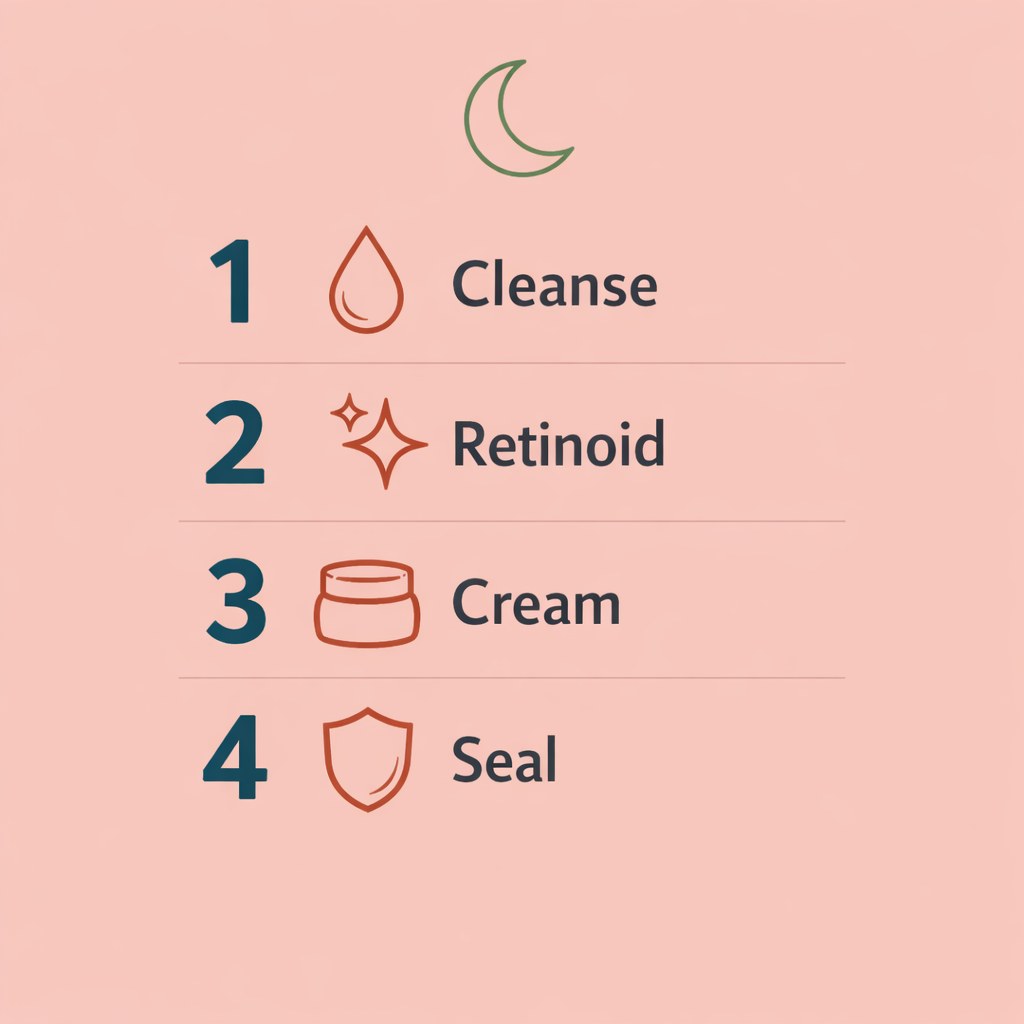
Night is when your skin does the slow work of repair, and after 50 it needs more help doing it. Clean gently, give your retinoid its own quiet time, feed the barrier the fats it’s running short of and seal it all in before the lights go out. Pair that with the morning routine and your skin gets protection by day and repair by night. Then give it a few months. That’s how long real change takes, and it’s worth the wait.
Related Posts
 Your Skin at 35 Needs Less Than You Think
 Why Your Face Can Look Older in the Morning Than It Did Last Night
 Why Your Hair Is Changing Right Along With Your Skin
 Sebaceous Glands: Your Skin Has Its Own Oil Factory and Here Is Why That Matters
 Why Your Skin Makes Dark Spots and the Ingredients Proven to Fade Them
 What Your Bath Bomb Is Really Doing to Your Skin
 Your Bentonite Clay Has a Hometown and That Actually Matters for Your Skin
 Your Skin Wants Pumpkin This Fall and Here Is Why It Works
 The Exfoliation Secret Older Skin Has Been Waiting For
 Your Scalp Needs a Seasonal Reset and Here Is Exactly How to Give It One
 The Fall Skin Reset You Need Before the Season Turns
 Start Your Holiday Skin Wellness Ritual Now and See the Difference by December
