

Oct
If you click on links we provide, we may receive compensation.
An estimated 88 million American adults have prediabetes – a condition almost entirely driven by insulin resistance – and the Centers for Disease Control reports that more than 80 percent of them have no idea. That number is striking enough on its own. After menopause, the risk does not just hold steady – it climbs. Estrogen has long been quietly protecting your cells’ ability to respond to insulin, and when levels fall during perimenopause and beyond, the metabolic shift can show up as stubborn weight gain around the middle, energy crashes after meals, and a slow drift toward more serious health problems. Insulin resistance is not a verdict, though. It responds – sometimes dramatically – to lifestyle changes, and those changes work best when paired with whatever your doctor has prescribed. This article is informational, not a substitute for medical advice. Please work with your healthcare provider before making changes to your diet, exercise routine, or supplement regimen.
How Does Insulin Actually Work?
Every time you eat – a piece of toast, a bowl of lentil soup, even a handful of almonds – your body breaks the carbohydrates down into glucose and releases it into your bloodstream. Your pancreas senses that glucose rise and responds by secreting insulin, a hormone whose job is to act like a key. Insulin travels through the blood and docks onto receptors on the surface of cells – muscle cells, fat cells, liver cells – and that signal tells those cells to open up and absorb the glucose. The glucose then gets used as immediate fuel or stored for later. Under normal circumstances this process runs smoothly and quietly, keeping blood sugar within a healthy range within an hour or two of eating. Most people never think about it, which is exactly how it should work.
What Happens When Your Cells Stop Responding to Insulin?
Insulin resistance means the key still fits the lock, but the lock no longer turns properly. Cells have become less sensitive to insulin’s signal, so they do not absorb glucose as efficiently. The pancreas, sensing that blood sugar is still elevated, compensates by producing more insulin. For a while this works – blood sugar stays in the normal range, but insulin levels are chronically high. Over time, that hyperinsulinemia causes its own problems: it promotes fat storage, drives low-grade inflammation, and suppresses the production of sex hormone binding globulin, a liver protein that regulates how much testosterone and estrogen are biologically active in the bloodstream. Eventually, if the pancreas cannot keep up with the extra demand, blood sugar begins to rise. That is when prediabetes or type 2 diabetes can develop.
Insulin resistance does not arrive alone. It is a core feature of metabolic syndrome – a cluster of conditions including high blood pressure, elevated triglycerides, low HDL cholesterol, high fasting glucose, and excess abdominal fat – and it is the defining characteristic of polycystic ovary syndrome, where up to 70 percent of women with PCOS have insulin resistance regardless of their body weight. Source: https://pubmed.ncbi.nlm.nih.gov/41103651/ The day-to-day experience can include energy crashes in the afternoon, strong sugar cravings, difficulty losing weight despite reasonable effort, brain fog, and a general sense that your metabolism is working against you. None of that is imaginary. It is a physiological response to cells that are no longer receiving insulin’s signal clearly.
Why Does Menopause Make Insulin Resistance Worse?

Estrogen – specifically 17-beta estradiol, the form most active during the reproductive years – plays a direct role in how cells handle glucose. It supports the function of pancreatic beta cells, which produce insulin. It also influences the presence of GLUT4, the glucose transporter protein that lives in muscle cells and pulls glucose out of the bloodstream. When estrogen is plentiful, this system runs efficiently. When estrogen declines during perimenopause and menopause, insulin sensitivity tends to fall with it – beyond what can be explained by aging alone. Research published in Inside Precision Medicine covered a 2024 meta-analysis of more than 29,000 participants and found that hormone therapy significantly reduced insulin resistance in healthy postmenopausal women without metabolic disease, which gives some sense of how directly estrogen drives the mechanism. Source: https://www.insideprecisionmedicine.com/topics/patient-care/hrt-reduces-insulin-resistance-after-menopause-according-to-meta-analysis
The mechanism runs deeper than estrogen withdrawal alone. Falling estrogen also reduces sex hormone binding globulin levels, which allows more free testosterone to circulate. Higher androgen activity in women is independently associated with insulin resistance – the same dynamic seen in PCOS now appearing in midlife. At the same time, fat distribution shifts: fat migrates from the hips and thighs toward the abdomen, and visceral fat – the kind that wraps around internal organs – is metabolically active in ways that subcutaneous fat is not. It releases inflammatory signals that directly impair insulin signaling at the cellular level. This combination of estrogen loss, rising free androgens, and shifting fat distribution explains why a woman who has had no blood sugar issues in her forties may find that her numbers start creeping upward in her fifties, even without obvious changes in her diet or lifestyle.
What Can Diet Do for Insulin Sensitivity?

Diet is one of the most direct levers available, and the first place to look is what drives blood sugar highest and fastest. Refined carbohydrates – white bread, white rice, pasta, crackers, sweetened cereals, anything made with processed white flour – digest quickly and send glucose into the bloodstream at a pace that strains the insulin response. Added sugar, particularly in sweetened beverages, does the same without any nutritional offset. Swapping these for whole-food alternatives that deliver energy more slowly keeps glucose levels considerably steadier throughout the day.
Fiber is particularly useful. Soluble fiber – found in oats, beans, lentils, apples, and flaxseed – slows the absorption of glucose by forming a gel-like substance in the digestive tract, blunting the spike that would otherwise follow a carbohydrate-heavy meal. Including a protein source with every meal has a similar stabilizing effect: protein slows gastric emptying and reduces the glucose peak from carbohydrates eaten at the same time. The Mediterranean style of eating – centered on olive oil, vegetables, legumes, fish, and whole grains, with limited red meat and added sugar – has strong evidence behind it specifically for women. A large Women’s Health Study analysis found that markers tied to insulin resistance were the single biggest contributor to why Mediterranean diet followers had lower diabetes risk. Source: https://www.ncbi.nlm.nih.gov/pmc/articles/PMC7677766/
Fermented foods and vinegar deserve a mention. Apple cider vinegar taken before a starchy meal has been shown in small studies to blunt the postmeal glucose rise, possibly by slowing gastric emptying and improving insulin sensitivity acutely. Fermented foods – yogurt, kefir, kimchi, sauerkraut – support a diverse gut microbiome, and emerging research suggests the gut microbiome plays a meaningful role in glucose metabolism. None of these are standalone solutions, but together they add up to a dietary pattern that keeps blood sugar measurably more stable.
Why Is Exercise One of the Most Effective Natural Strategies?

Skeletal muscle is the body’s primary site of glucose disposal. When muscle cells contract during exercise, they can absorb glucose directly – bypassing the need for insulin entirely – through a separate pathway that stays active even in insulin-resistant tissue. This is why a 20-minute walk after dinner can noticeably flatten the blood sugar spike that would otherwise follow a meal. Resistance training – lifting weights, using resistance bands, doing body-weight exercises like squats and lunges – does something even more valuable over the long term. Building and preserving muscle mass increases the total amount of glucose-absorbing tissue available around the clock, not just during the workout itself.
A systematic review published in the Journal of Diabetes Research found that resistance training improves glycemic control, reduces insulin resistance, and enhances body composition in ways that complement aerobic exercise and dietary changes. Source: https://doaj.org/article/beb6099337da44e68e83c38c3f0a25c4 This is particularly important for women after menopause, because the natural loss of muscle mass that comes with aging – sarcopenia – accelerates after estrogen levels drop. Every pound of muscle lost is a pound less of the body’s most efficient glucose storage tissue. Even two sessions per week of progressive resistance training has been shown to reduce abdominal fat and improve insulin sensitivity in older adults with type 2 diabetes. If you can only make one lifestyle change, the research consistently points here.
How Much Does Sleep Affect Blood Sugar?
The connection between sleep and blood sugar is one of the most consistent findings in metabolic research, and still one of the most underappreciated. Studies have found that insulin sensitivity can diminish by nearly 40 percent in people who sleep fewer hours compared to those who get adequate sleep – a dramatic number, comparable to what a high-sugar diet might produce. Source: https://pmc.ncbi.nlm.nih.gov/articles/PMC4399283 The mechanism centers on cortisol. Poor sleep raises nighttime cortisol levels, and cortisol directly counteracts insulin’s effects, signaling the liver to release stored glucose even when none is needed from food. Blood sugar rises without a single bite.
Sleep deprivation also disrupts ghrelin and leptin, the hormones that regulate hunger and fullness. When you are underslept, ghrelin rises and leptin falls – you become hungrier, harder to satisfy, and more likely to reach for quick energy in the form of sugar and refined carbs. Poor sleep also elevates inflammatory molecules like interleukin-6 and tumor necrosis factor, and chronic low-grade inflammation is a direct upstream driver of cellular insulin resistance. Seven to nine hours of quality sleep is not a wellness luxury. It is a metabolic intervention with real, measurable effects on glucose regulation and insulin sensitivity.
Can Chronic Stress Be Raising Your Blood Sugar?
Yes, and the mechanism is direct. Cortisol is designed for acute stress – a threat, a sprint, an emergency – and it responds by rapidly raising blood glucose so muscles have fuel to react. In the short term, this is adaptive. With chronic, ongoing stress, the same mechanism becomes a problem. Elevated cortisol over weeks and months keeps blood sugar chronically higher than it should be, directly impairs cells’ ability to respond to insulin, and promotes the accumulation of visceral abdominal fat, the type most strongly linked to metabolic dysfunction. A study published in the Journal of Diabetes Science and Technology found that psychological stress significantly increased blood glucose levels in patients with type 2 diabetes, confirming what the physiology would predict.
The stress-blood sugar connection is particularly relevant for women navigating perimenopause and menopause, because this stage of life often coincides with significant caregiving responsibilities, career pressures, and major life transitions – all at the same time that hormonal changes are already stressing the metabolic system. Sleep disruption, a hallmark of perimenopause, compounds the cortisol picture further. Practices like yoga, mindfulness meditation, walking in nature, and consistent social connection have measurable effects on cortisol levels and, by extension, on blood sugar regulation. Even 10 minutes of deliberate slow breathing can lower acute cortisol. The goal is not to eliminate stress but to interrupt the chronic activation that keeps the body in a low-grade alarm state that it was never designed to sustain.
Is Intermittent Fasting Worth Trying for Insulin Resistance?
Time-restricted eating – consuming all your meals within a set window of 8 to 10 hours and fasting for the rest of the day – has attracted serious research attention for its effects on metabolic health. The underlying logic is that an extended fasting period allows insulin levels to fall fully, rather than staying chronically elevated from continuous eating across a 14- or 16-hour day. Studies have shown improvements in fasting glucose, insulin sensitivity, and triglycerides in people who practice time-restricted eating consistently. Some of the benefit may also come from a natural reduction in overall calories that happens when the eating window is smaller, without requiring calorie counting.
That said, intermittent fasting is not for everyone, and women – especially those in menopause – may respond differently than men. Some research suggests that certain fasting protocols can elevate cortisol in women, potentially offsetting some of the metabolic benefit. Others find it very manageable and see real results. A simpler starting point is to stop eating two to three hours before bed, which allows insulin to settle before sleep and tends to improve fasting blood sugar readings the next morning. If you take medications that require food, or that affect blood sugar directly, talk to your doctor before changing your eating schedule. Fasting combined with blood sugar medication can cause glucose to drop too low.
Which Supplements Have Actual Evidence Behind Them?

A clear note before this section: every supplement mentioned here should be discussed with your doctor before you start, especially if you are already taking medications for blood sugar, blood pressure, or cholesterol. Some of these compounds have meaningful interactions with prescription drugs, and adding something that affects insulin pathways to an existing medication regimen can cause blood sugar to fall too low. The following is a summary of what the research shows – not a prescription, and absolutely not a reason to stop or reduce any medication your doctor has prescribed.

Berberine is the most studied compound in this category. It activates AMP-activated protein kinase – the same cellular pathway that the diabetes drug metformin targets – and a meta-analysis of 14 randomized controlled trials found that berberine reduced HbA1c by 0.9 percent and fasting glucose by a clinically meaningful margin, with effects that researchers found comparable to metformin. Source: https://www.ncbi.nlm.nih.gov/pmc/articles/PMC6736273/ Magnesium is another well-supported option. Insulin receptor signaling depends on magnesium as a cofactor in over 300 enzymatic reactions, and deficiency is common in people eating a Western diet low in leafy greens and legumes. A systematic review found that magnesium supplementation significantly improves fasting glucose and insulin resistance scores in people with metabolic issues.

Myo-inositol is particularly relevant for women. It functions as a second messenger in insulin signaling pathways, and research specifically in postmenopausal women found that it improved insulin sensitivity and favorably affected markers of metabolic syndrome, especially when combined with alpha-lipoic acid. Source: https://www.ncbi.nlm.nih.gov/pmc/articles/PMC3765513/ Alpha-lipoic acid is a potent antioxidant that also appears to improve insulin-mediated glucose disposal and has been evaluated in multiple clinical trials for glycemic control, referenced at https://clinicaltrials.gov/study/NCT00845156 and https://pmc.ncbi.nlm.nih.gov/articles/PMC9395822 These supplements are promising, but the evidence base is considerably thinner than for prescription medications. They work best as part of a broad lifestyle approach and should always be discussed with your doctor before starting, particularly if you are already on metformin, GLP-1 agonists, or any insulin therapy.
What Does Insulin Resistance Do to Your Skin?
The skin reflects metabolic health in ways that are easy to miss. Chronically high insulin levels – the hallmark of insulin resistance – directly stimulate androgen production, which is why some women notice new or worsening breakouts in perimenopause even without a history of acne in younger years. High insulin also promotes the overproduction of keratinocytes, the skin cells that can block pores, and it reduces sex hormone binding globulin, further raising the androgen load at the skin level. If your skin is suddenly behaving like it did at 17, this hormonal pattern is worth discussing with your doctor.
There are more visible markers, too. Skin tags – small, soft growths that appear around the neck, armpits, and under the breasts – are strongly associated with insulin resistance and high circulating insulin. Acanthosis nigricans, the velvety darkening of skin in creases like the back of the neck and armpits, is a direct cutaneous sign of hyperinsulinemia. And then there is glycation – when excess glucose in the bloodstream bonds to collagen and elastin proteins through a process called advanced glycation end-product formation. Glycated collagen becomes stiff and brittle, losing its ability to spring back, which accelerates the visible loss of skin firmness and the appearance of lines. Managing insulin resistance is, in this sense, also a skin-health strategy – one that works from the inside out in ways that no topical product can replicate.
FAQs
Can insulin resistance be reversed?
Insulin resistance is not a one-way door. Many people see significant improvement – and sometimes full normalization of fasting insulin and glucose – with sustained lifestyle changes including diet, resistance training, better sleep, and stress management. How far it can be reversed depends on how long it has been present, genetic factors, and whether the pancreas’s beta cell function is still intact. Earlier intervention tends to leave more room for improvement. Work with your doctor to track your progress with fasting insulin, fasting glucose, and HOMA-IR over time.
How do I know if I have insulin resistance?
The most common lab measures are fasting insulin, fasting glucose, and a calculation called HOMA-IR (homeostatic model assessment of insulin resistance). An elevated fasting insulin level alongside a normal fasting glucose is an early sign that the pancreas is overcompensating. HbA1c, which reflects average blood sugar over the past two to three months, is another useful marker. If you have symptoms – fatigue after meals, strong sugar cravings, difficulty losing weight despite reasonable effort, or new weight gain around the abdomen – ask your doctor for a full metabolic panel, including fasting insulin.
Should I take berberine instead of metformin?
No – this is a decision for your doctor. Berberine has promising evidence, but it is a supplement, not a regulated pharmaceutical, and its quality, dosing, and purity vary considerably between products. If your doctor has prescribed metformin or another medication, continue taking it. Berberine might be considered as an adjunct – something discussed with your doctor and added alongside, not instead of, medication – because combining berberine with metformin can amplify the glucose-lowering effect in ways that need monitoring to prevent hypoglycemia.
Does stress really raise blood sugar that much?
Yes, and the effect is measurable. Cortisol signals the liver to release stored glucose even when you have not eaten anything. For people with insulin resistance, cells are already slower to clear that extra glucose, which amplifies the effect. Chronic low-grade stress – the kind that hums along in the background for months – can be a surprisingly significant driver of blood sugar variability and poor overnight readings.
What is the most effective single lifestyle change for insulin resistance?
Research consistently points to resistance training as having the largest effect per unit of effort, because it builds the muscle mass that absorbs glucose most efficiently around the clock. Diet, sleep, and stress management each contribute independently, and the combined effect of addressing all four is greater than any one strategy alone. If you can only make one change to start, begin lifting weights – even twice a week makes a measurable difference.
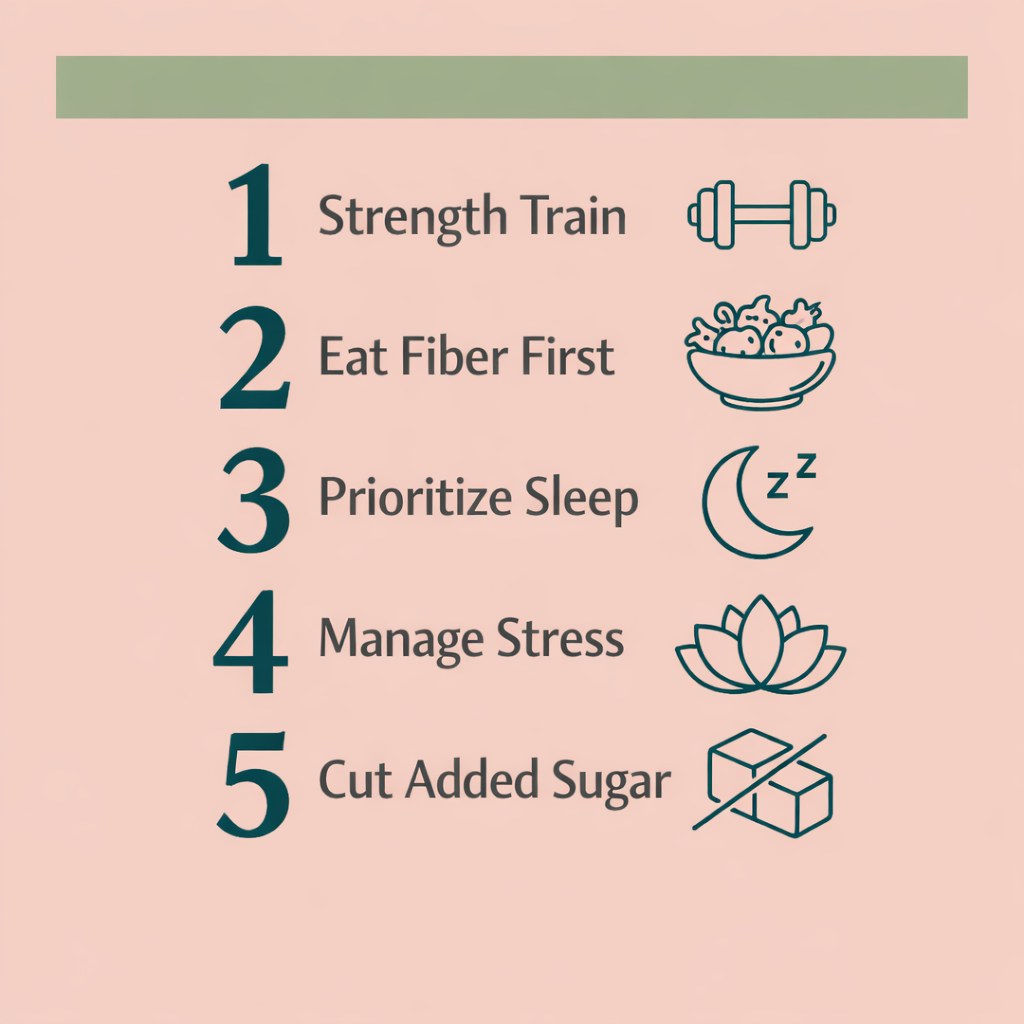
Insulin resistance is not an inevitable outcome of aging or menopause, even though the hormonal changes of midlife do tilt the odds. The same strategies that improve insulin sensitivity – building muscle, eating in ways that keep blood sugar steady, sleeping well, managing stress – also protect bone density, support cognitive health, and slow the skin changes that come from glycation and chronic inflammation. The most useful first step is finding out where you actually stand. A fasting insulin test, an HbA1c, and a full metabolic panel give you a clear baseline to work from. From there, every change you make – however small to start – counts toward a body that functions better across the board, now and in the decades ahead.
Related Posts