Oct
Skincare
Why Your Skin Falls Apart Every November
If you click on links we provide, we may receive compensation.
Take outdoor air at 30 degrees and 70 percent humidity, warm it to 70 degrees inside your house, and its relative humidity falls to about 15 percent. Nothing was taken out of that air. Warm air simply holds far more water than cold air, so the same moisture now fills a much smaller share of what the air could hold. The U.S. Environmental Protection Agency recommends keeping indoor humidity between 30 and 50 percent (https://www.epa.gov/mold/brief-guide-mold-moisture-and-your-home). Plenty of heated homes dip well below that floor once the furnace runs for good, and they can stay there for months. That is the air your face lives in from now until spring.
November is when it all lines up. The heat comes on for the season. The wind picks up. The clocks fall back, the days get short, and you spend more hours indoors breathing furnace air. And most of us are still using the same cleanser, serum, and light lotion we used in August. I see it every year! The routine stays on summer settings while the climate flips to winter, and by Thanksgiving skin feels tight, looks flaky, and stings at products it handled fine a month earlier.
What happens to your skin when the heat comes on?
Your outermost layer of skin, the stratum corneum, is thin. It is made of flattened cells held together by fats, mostly ceramides, cholesterol, and fatty acids. Water moves from the deeper layers outward and escapes into the air, a process dermatologists call transepidermal water loss. The drier the air around you, the faster that water leaves. In humid summer air the pull is gentle. In 15 percent indoor air it is strong, and it runs all day and all night.
When the outer layer loses too much water, it stiffens. Cells that should shed quietly start to curl and lift, which is the flaking you see around the nose, brows, and chin. The fats between those cells don’t work as well when they dry out, so small gaps open up. Those gaps let more water out and let irritants in. That is why a toner or acid that felt fine in September can sting in November. Your product did not change. Your barrier did.
The American Academy of Dermatology notes that cold, dry air makes it harder for skin to hold moisture and can make fine lines and wrinkles more noticeable (https://www.aad.org/news/cold-weather-and-your-skin). That second point matters to a lot of readers. Many people see new lines in late fall and assume they aged overnight. Usually it is dehydration. Dry skin creases more easily and reflects light unevenly, and those lines often soften once water content comes back up. That is a fixable problem, which is good news.
Why does cold wind make it worse?

Wind does its damage through speed. Moving air strips away the thin layer of humid air that normally sits right against your skin. Without that buffer, water evaporates faster, even outdoors where the humidity may be higher than in your living room. Cold also slows oil production, so your skin makes less of its own protection right when it needs more. Add a 20-minute walk on a raw November morning and you can come home with red, stinging cheeks. People call it windburn. It is closer to a chapped barrier than a burn, but it hurts either way.
The bigger trouble is the swing. You go from 35 degrees and wind outdoors to 70 degrees and dry heat indoors, sometimes a dozen times a day. Blood vessels in the face tighten in the cold and open up in the warmth. For people prone to flushing or rosacea, that cycle can mean more redness. For everyone else, it means skin never settles into one environment long enough to adjust. Then the evening shower adds one more swing on top.
And November is when showers get longer and hotter. It feels wonderful, I know. But hot water dissolves the fats that hold your barrier together, and long soaks pull out even more. The AAD recommends keeping showers and baths to about 5 to 10 minutes in warm water, not hot, and patting dry instead of rubbing (https://www.aad.org/public/everyday-care/skin-care-basics/dry/dry-skin-relief). Then moisturize while your skin is still damp. That short window after the shower is the best moment of the day to trap water in.
Why do most people wait until the damage shows?
Because the damage is slow at first. The barrier does not fail on the first cold day. It wears down over a week or two of dry heat, hot showers, and wind. By the time you see flakes or feel stinging, the problem has been building for a while. And habits are sticky. If a routine worked all summer, there is no obvious reason to change it on November 1.
Then the fix people reach for often makes things worse. Flakes look like dead skin, so the instinct is a scrub or a stronger acid to clear them away. That removes the flakes for a day and thins the barrier further. Others pile on several new products at once, hoping one of them works, and end up more irritated without knowing which product caused it. I’ve done both. The better move is quieter: switch to gentler steps and richer moisture before trouble starts.
That is why I think mid-to-late October is the right time to adjust, not December. Make the change when you turn the heat on, not when your face starts complaining. A stressed barrier often takes two to four weeks to rebuild, so getting ahead by a few weeks spares you most of the misery. Think of it like putting snow tires on before the first storm. Nobody wants to do that job in a parking lot during the blizzard.
How should you change your routine for November?

Start with the cleanser, because it does the most quiet damage. Foaming cleansers that leave skin squeaky remove oils your barrier needs, and in dry air those oils can’t be replaced fast enough. Swap to a cream, milk, or gentle lotion cleanser for the season. Many people with dry or mature skin can skip the morning cleanse altogether and just rinse with lukewarm water. Tightness after washing is a sign you stripped too much, not a sign you got clean.
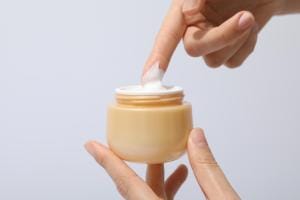
Next, move to a heavier moisturizer. The AAD advises choosing a cream or ointment over a lotion for dry skin, since thicker formulas hold more water in place. Look for a mix of three things. Humectants such as glycerin and hyaluronic acid pull water into the skin. Barrier fats such as ceramides, cholesterol, and fatty acids patch the gaps. And a sealing layer such as shea butter, squalane, dimethicone, or petrolatum slows water from leaving. A cream with all three does more in November than a light gel with one.
A word on hyaluronic acid serums. They are popular, and they help. But a humectant pulls water from wherever it can find it. When the air holds very little water, more of that pull comes from deeper in your skin, so a hyaluronic serum used alone in dry heat can leave you feeling tighter, not softer. Always seal it with a cream on top. Apply it to damp skin, too, so there is water on the surface for it to grab first.
Should you cut back on acids and retinoids?
For most people, yes, at least for a while. AAD dermatologist Elizabeth Kiracofe recommends cutting back on alpha and beta hydroxy acid products in winter because they can irritate skin in cold, dry conditions. That doesn’t mean throwing them out. If you use a glycolic toner every night, drop to once or twice a week, or switch to lactic acid or a polyhydroxy acid, which are gentler. If you have stinging, redness, or raw patches, stop exfoliating completely until your skin calms down. The acid can always come back in a few weeks.
Retinoids need a similar adjustment, not an exit. They are among the best-studied ingredients for lines and texture, and the payoff comes from years of use, not any single month. So protect the habit. Drop from nightly to every other night, or every third night. Put moisturizer on first and the retinoid over it, which softens the effect. And if you’ve never used one, I’d hold off on starting until your skin has settled into the heating season.
Do humidifiers really help your skin?

They help with the root cause, which most products can’t touch. Your moisturizer slows water loss. A humidifier weakens the pull in the first place. The AAD suggests running a humidifier in the bedroom while you sleep, and Dr. Kiracofe recommends a filtered, cool-mist model. Aim for the EPA’s 30 to 50 percent range. A cheap hygrometer from the hardware store will tell you where your room really sits, and the number surprises a lot of people.
Keep it clean. A humidifier with standing water can grow mold and bacteria, then spray them into the room. Empty, rinse, and dry the tank often, and follow the maker’s cleaning schedule. Don’t overshoot either, since humidity above 60 percent invites mold on windows and walls. The bedroom is the best place to start because you spend seven or eight hours there every night. And the AAD suggests dressing warmly indoors rather than turning the thermostat way up, which keeps the air from drying out as much.
Why does sunscreen still matter in November?
Because UV doesn’t take the winter off. The burning UVB rays drop in late fall, but UVA, the wavelength most tied to skin aging, stays much steadier through the year and passes through clouds and window glass. The Skin Cancer Foundation notes that snow can reflect up to 80 percent of UV light, so on a bright winter day you get hit from above and below (https://www.skincancer.org/press/the-skin-cancer-foundation-shares-winter-sun-protection-tips). A dry, damaged barrier doesn’t defend you any better against that. The good news is that one product can do two jobs. The foundation suggests a moisturizing sunscreen with glycerin or lanolin for winter skin, and the AAD recommends broad-spectrum SPF 30 or higher.
Why does mature skin take the biggest hit?

Everything above hits harder after 50, and harder still after 70. In a well-known study in the Journal of Clinical Investigation, researchers compared barrier repair in adults aged 20 to 30 with adults over 80 (https://www.jci.org/articles/view/117919). After the barrier was disrupted, younger skin got back about 50 percent of its function within 24 hours. Older skin got back only about 15 percent in the same time, and kept lagging for days. The older skin also broke down more easily to begin with. The researchers linked both problems to a shortage of the fats the barrier is built from.
Put that next to November and the math is rough. Mature skin makes less oil, and after menopause oil production drops further. It holds less water, and it repairs itself more slowly when something goes wrong. So a week of furnace air and hot showers that leaves a 30-year-old a little tight can leave a 65-year-old cracked, itchy, and red, with a much longer road back. Flaky shins, rough hands, and sudden stinging from a favorite product are all part of the same story.
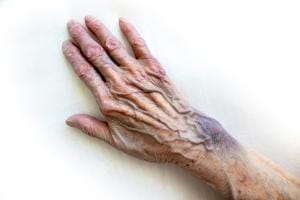
If you’re in this group, make the switch earlier and go heavier. Use a cream rich in ceramides and cholesterol morning and night, not just at bedtime. Don’t forget your neck, chest, and the backs of your hands, which have thin skin and show dryness fast. Moisturize your body within a few minutes of every shower, and keep hand cream by every sink, since the AAD recommends applying it after each handwash. And if itching keeps you up at night, or skin cracks and bleeds, see a dermatologist. Dry skin in older adults can tip into eczema, and that is easier to treat early.
What about lips, hands, and the rest of your body?
Lips have no oil glands, so they are usually the first thing to crack. Use a plain balm or petroleum jelly, and skip balms with menthol, camphor, or heavy flavoring, which can irritate. Hands take a beating from cold air, hot water, and sanitizer all season long. Wear gloves outdoors and when you wash dishes, which the AAD also recommends. On the body, fabric matters more than people think. Wool and polyester against bare skin can make itching worse, so a soft cotton or silk layer underneath helps a lot.
FAQs
Is November really worse for skin than January?
Not in raw numbers. January and February are often colder and drier in much of the country. But November is the switch. Skin hasn’t adapted, routines haven’t changed, and the first stretch of steady indoor heat lands all at once, so it is often when damage first shows.
Can I keep using my vitamin C serum?
Usually, yes. Strong L-ascorbic acid formulas are acidic and can sting a stressed barrier. If that happens, use it every other day, apply it after a light moisturizer, or switch to a gentler form such as ascorbyl glucoside until your skin settles.
Should I add a face oil?
It can help, but oil seals water in rather than adding it. Press a few drops over your moisturizer or mix them into your cream. Applied alone on dry skin, an oil won’t fix dehydration.
How long until my skin recovers?
Mild tightness often eases within days of switching to a richer cream and gentler cleanser. A stressed barrier commonly takes two to four weeks to rebuild, and older skin can take longer. If it isn’t improving after a month, see a dermatologist.
Will drinking more water fix dry skin?
Staying hydrated matters for your health, but extra water alone won’t undo what dry indoor air does to the surface of your skin. Moisturizer, gentler cleansing, shorter showers, and a humidifier make the bigger difference.
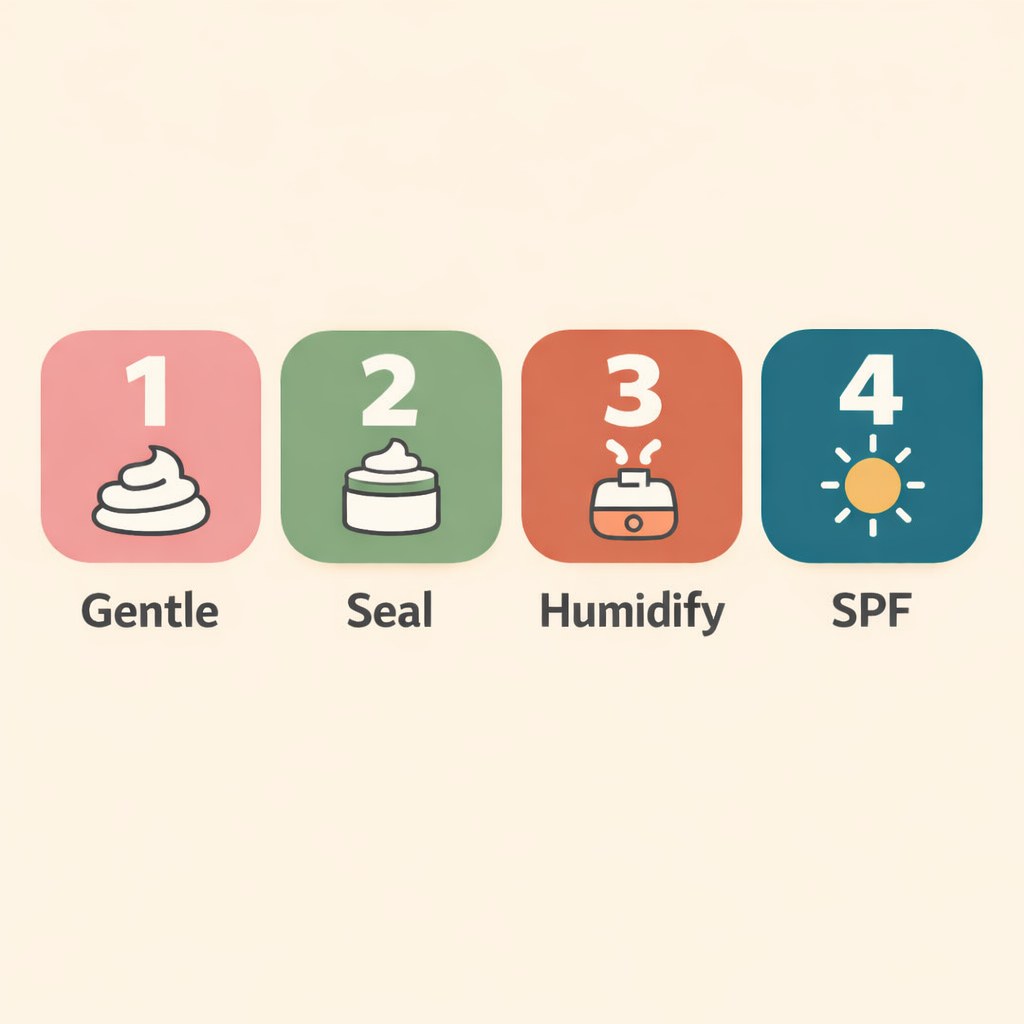
November skin trouble is predictable, and that is the useful part. The heat comes on, the wind picks up, the showers get hotter, and the barrier wears down a little more each day. You don’t need a new ten-step routine to fight it. You need a gentler cleanser, a heavier cream, fewer acids, a humidifier, and sunscreen that keeps going after Labor Day. Make those changes when you turn the thermostat up, and most of the flaking and stinging never shows up at all.
Related Posts