
Oct
Wellness
Hurt Your Shoulder? How to Rehab It at Home and Spot the Signs You Need a Doctor
If you click on links we provide, we may receive compensation.
You reach into the back seat for your bag, and something in your shoulder catches. Or you wake up with an ache you can’t explain, and the only suspect is the way you slept. Maybe it was the third game of pickleball, or a slip on wet leaves that you caught with an outstretched hand. However it starts, a sore shoulder gets into everything, from pulling on a coat to reaching for a coffee mug. And after 30, it’s not always clear how much damage is there.
One Japanese study scanned the shoulders of 664 adults and found that about two-thirds of rotator cuff tears in people over 60 caused no symptoms at all.
Source: https://pmc.ncbi.nlm.nih.gov/articles/PMC3768248/
That tells you something about shoulders after 30. They change quietly. Tendons lose some of their blood supply and get less elastic, and the cartilage in the joint thins. Then one day you reach for a box on a high shelf, slip on wet leaves, or wake up after sleeping on your arm, and a shoulder that never complained suddenly hurts. Most of these injuries are minor and heal with time, rest, and simple movement. Some are not. This piece walks through how to tell the difference, what you can safely do at home, and the signs that mean you should stop guessing and see a doctor.
Why does the shoulder get hurt so easily?

The shoulder is the most mobile joint in the body, and that mobility is the trade-off. The ball of the upper arm bone sits on a shallow socket, a little like a golf ball on a tee, and it relies on soft tissue to stay in place. Four small muscles and their tendons, together called the rotator cuff, wrap around the ball and keep it centered while bigger muscles do the lifting. A ring of cartilage called the labrum deepens the socket. A fluid-filled sac called the bursa lets the tendons glide without friction. When any one of those parts gets irritated, torn, or inflamed, the whole joint feels it.
Most adult shoulder problems fall into a handful of groups. Strains and tendon irritation come from overuse, like a weekend of painting a ceiling or a new pickleball habit. Impingement and bursitis happen when the tendons get pinched under the bony roof of the shoulder during overhead motion. Tears of the rotator cuff or labrum can come from one hard event or from years of wear. Dislocations and fractures usually come from falls or collisions. And frozen shoulder, a slow tightening of the joint capsule, often shows up with no clear injury at all.
Can you really hurt your shoulder by sleeping wrong?
Yes, and it’s one of the most common ways people describe how their shoulder pain started. Side sleepers put steady pressure on the bottom shoulder for hours. That squeezes the tendons and bursa against bone and can leave them sore by morning. Sleeping with an arm stretched overhead can irritate the top of the joint in a similar way. Sometimes the pain isn’t from the shoulder at all. A stiff neck from an awkward pillow can send pain into the top of the shoulder and down toward the shoulder blade, and it feels just like a shoulder problem.
Morning pain from sleep position usually eases as you move around during the day. It tends to feel like a dull ache or stiffness rather than a sharp, specific pain. If that’s your pattern, small changes help. Try sleeping on your back or on the other side, and hug a pillow so the top arm doesn’t drop forward across your body. A pillow that keeps your neck level, neither propped up nor sagging, takes strain off both the neck and the shoulder. But if pain wakes you every night, or you can’t lie on that side at all for weeks, that’s a different situation, and the sections below cover it.
What are the signs a shoulder injury is serious?
Some symptoms need attention the same day. If the shoulder looks deformed, sits lower than the other side, or has a new bump, you may have a dislocation or a fracture. If you felt a pop and then couldn’t lift your arm at all, a tendon may have torn. If the shoulder is hot, red, and swollen and you have a fever, an infection in the joint is possible, and that needs fast treatment. Numbness, tingling, or a cold, pale hand after an injury can mean a nerve or blood vessel is involved. Don’t wait on any of these. Go to urgent care or the emergency room.
There’s one more warning sign that has nothing to do with the joint. Pain in the shoulder, arm, or jaw can be a sign of a heart attack, especially when it comes with chest pressure, shortness of breath, sweating, nausea, or lightheadedness. Mayo Clinic notes that symptoms can be less obvious in some people, especially women, and sometimes show up only as nausea or a brief, sharp pain in the neck, arm, or back. Source: https://www.mayoclinic.org/diseases-conditions/heart-attack/in-depth/heart-attack-symptoms/ART-20047744 If shoulder pain arrives with no injury and any of those symptoms, call 911. A false alarm is far better than a missed heart attack.
Advertisement
When should you book a doctor’s appointment instead of going to the ER?
Most shoulder problems land in the middle. They aren’t emergencies, but they shouldn’t be ignored either. Book an appointment with your primary care doctor, an orthopedist, or a sports medicine doctor if the pain hasn’t improved after about two weeks of rest and gentle movement. Do the same if pain wakes you up night after night, or if you can’t lie on that side. Weakness is a big clue. If you can’t lift your arm out to the side or overhead, or you can lift it but it drops when you try to hold it there, a rotator cuff tear is possible. A shoulder that gets stiffer each week, even though you’re moving it, deserves a look too.
Doctors start with your history and a hands-on exam. They’ll check how far the arm moves on its own and how far it moves when they move it for you. That difference helps separate a tendon problem from a stiff joint. X-rays show bones, arthritis, and dislocations. An MRI or ultrasound shows tendons and the labrum, but those are usually ordered only if the exam points that way or the shoulder isn’t improving. And remember the study from the top of this piece. Many people over 60 have tears that cause no symptoms, so an MRI finding alone doesn’t always explain the pain, and a good doctor treats the person, not the scan.
How should you treat a minor shoulder injury in the first few days?

For a simple strain or flare-up, the first two or three days are about calming things down. Rest the shoulder from whatever caused the problem, but don’t put it in a sling or hold it perfectly still unless a doctor tells you to. Ice for 15 to 20 minutes at a time, with a thin towel between the ice and your skin, can ease pain and swelling. After the first couple of days, some people find heat more soothing, especially before gentle movement. Over-the-counter pain relievers can help too. Check with your doctor or pharmacist first if you take blood thinners, have kidney or stomach problems, or have high blood pressure.
The biggest mistake I see is complete rest for too long. The joint capsule tightens quickly when the shoulder isn’t used, and that matters more after 40. Frozen shoulder is most common in people 40 to 60, and long periods of immobilization after an injury or surgery raise the risk, according to the American Academy of Orthopaedic Surgeons. Source: https://www.orthoinfo.org/globalassets/pdfs/frozen-shoulder.pdf Once it sets in, the AAOS says full recovery can take 12 to 28 months. So keep the arm moving within a comfortable range, even while it heals.
What simple rehab exercises can you do at home?
Before you start, a few ground rules. These exercises are for minor strains, mild tendon irritation, and stiffness, and only after you’ve ruled out the warning signs above. Mild discomfort is fine, but sharp pain is not. A good test is that any soreness should settle within an hour or so after you finish, and you shouldn’t feel worse the next morning. Move slowly, breathe normally, and do these once or twice a day. If anything makes your symptoms clearly worse, stop and get it checked.
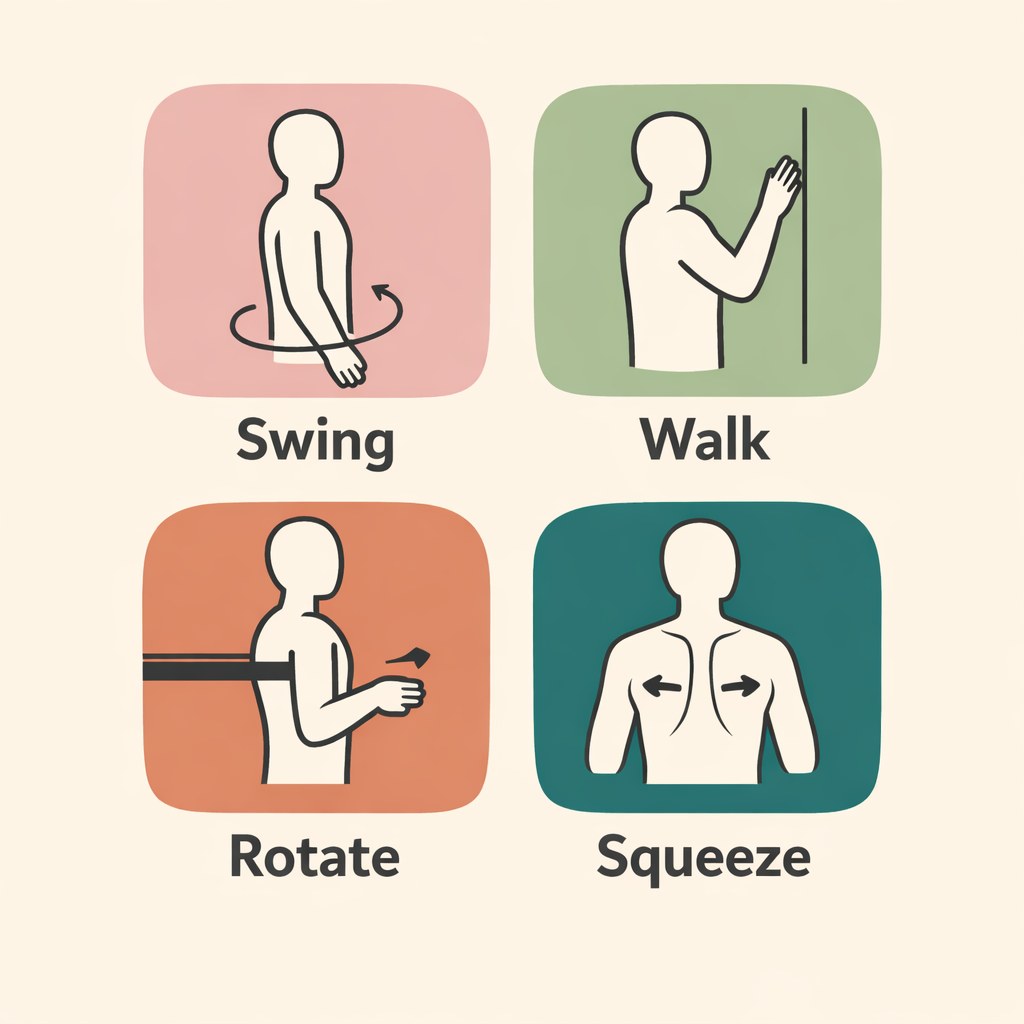
Start with pendulums. Stand next to a table or counter and rest your good hand on it. Lean forward slightly and let the sore arm hang straight down like a rope. Gently rock your body so the arm swings in small circles about the size of a dinner plate, ten times one way and ten times the other, then swing it front to back and side to side. The arm should stay relaxed and do almost no work. This loosens the joint without loading the tendons, and it’s often the first thing a physical therapist gives after an injury.
Next, try table slides. Sit at a table with a small towel under your hand on the sore side. Slowly slide the towel forward, leaning your body with it, until you feel a gentle stretch, then slide back. Repeat ten times. Once that feels easy, move to wall walks. Face a wall, put your fingertips on it at chest height, and walk your fingers up as high as you comfortably can, hold for a few seconds, and walk them back down. Do five to ten of these, and don’t hike your shoulder up toward your ear to get extra height.
For the back of the shoulder, use a cross-body stretch. Bring the sore arm across the front of your chest and use the other hand to press gently just above the elbow. Hold for 20 to 30 seconds, relax, and repeat three times. This stretch helps if your shoulder feels tight when you reach across your body, buckle a seatbelt, or wash the opposite armpit. If it pinches at the front of the shoulder, lower the arm a little and try again.
How do you rebuild strength once the pain eases?
Once you can move the arm without much pain, usually after a week or two for minor injuries, it’s time to add strength. Isometrics come first because the muscle works but the joint doesn’t move. Stand in a doorway with your elbow bent at 90 degrees and your upper arm at your side. Press the back of your wrist gently outward into the door frame and hold for five seconds, then rest. Do the same pressing inward with your palm, and forward with your fist into a wall. Use about half your effort and do ten reps in each direction.
Then try outward rotation with a light resistance band. Tie the band to a doorknob at about elbow height and stand with your sore side away from the door. Keep your elbow bent at 90 degrees and tucked against your side, and a rolled towel between your elbow and ribs helps with that. Slowly rotate your forearm outward, away from your belly, then let it come back slowly. Start with one or two sets of ten. This trains the rotator cuff muscles that keep the ball of the shoulder centered, which is exactly what breaks down in most tendon problems.
Don’t forget the shoulder blade. Sit or stand tall and squeeze your shoulder blades back and down, as if you’re tucking them into your back pockets. Hold for five seconds and repeat ten times. Good shoulder blade control gives the rotator cuff a stable base to work from. Hours at a desk or on a phone pull the shoulders forward and narrow the space the tendons pass through. This simple squeeze helps undo that, and you can do it at a red light.
How long does shoulder rehab take?
It depends on the injury and on you. A mild strain from yard work or a bad night’s sleep often feels much better within one to two weeks. Tendon irritation and impingement usually take six to twelve weeks of steady exercise to settle. That surprises people, because the pain often fades before the tendon has fully adapted, and going back to heavy lifting or overhead sports too soon brings it right back. Increase the load gradually, with a little more resistance or a few more reps each week. If you’ve done the work for four to six weeks and you’re not improving, it’s time for a professional opinion.
A physical therapist is worth a visit, even for injuries you could manage at home. They can check your form, spot the movement habits that caused the problem, and adjust the program as you improve. Every state allows some form of direct access to physical therapy without a referral, though the rules and insurance coverage vary. For many rotator cuff problems, including some tears, a structured therapy program is the first treatment doctors try before they talk about surgery. A few sessions plus consistent home exercise is often the quickest path back to normal.
Does shoulder recovery change after 60?

It does, and this is where I want to spend a little extra time. Tendons get less blood flow with age, so they heal more slowly. Muscle mass drops, which leaves the rotator cuff with less to work with. Bone density declines too, especially in women after menopause, so a fall onto an outstretched hand is more likely to crack the top of the arm bone than to simply strain a muscle. And because so many people over 60 already have silent rotator cuff tears, a small new injury can be the thing that finally makes an old tear hurt.
That changes the rules a bit. If you’re over 60 and you fall on the shoulder, and it’s badly bruised or you can’t lift the arm, get an X-ray rather than waiting two weeks. Watch stiffness closely, too. Arthritis becomes more common with age, and frozen shoulder is more likely in people with diabetes, thyroid conditions, or heart disease, all of which show up more often later in life. Keep exercises gentle and consistent rather than hard and occasional. Strength work helps at every age, and older adults respond to it well. It just takes patience and a slower ramp.
How do you keep a shoulder from getting hurt again?

Prevention comes down to strength, warm-ups, and a few smart habits. Before tennis, golf, or a day of overhead work, spend five minutes on arm circles and light band work to get blood moving. Lift heavy things close to your body, and use a step stool instead of reaching overhead for a heavy box. Keep doing your band exercises two or three times a week even after the pain is gone, because the weakness that let the injury happen doesn’t fix itself. And if you’re starting a new sport or workout after a long break, build up over several weeks instead of doing it all on the first Saturday.
Your daily setup matters more than most people think. A computer screen that sits too low pulls your head and shoulders forward for hours, and that posture crowds the tendons at the top of the joint. Raise the screen to eye level and keep your keyboard close enough that your elbows stay near your sides. If you carry a heavy bag, switch shoulders or use a backpack with both straps. And pay attention to sleep, since the same side every night with the arm tucked under the pillow can keep an old irritation from ever settling. None of this is dramatic, but small daily strain is how a lot of shoulder problems start.
FAQs
Should I use ice or heat on a shoulder injury?
Ice usually works better in the first two or three days, when pain and swelling are at their worst. Use it for 15 to 20 minutes with a towel between the ice and your skin. After that, heat can relax tight muscles, especially before stretching. For minor injuries, using whichever feels better is a reasonable approach.
Should I wear a sling for a sore shoulder?
Not for a minor strain. A sling keeps the joint still, and a still shoulder stiffens quickly, especially after 40. Slings make sense after a dislocation, fracture, or surgery. In those cases, your doctor should tell you how long to wear it.
Can a torn rotator cuff heal without surgery?
A full-thickness tear doesn’t grow back together on its own, but many people regain good strength and comfort with physical therapy as the surrounding muscles learn to compensate. Partial tears and many tears in older adults are commonly treated without surgery first. Large tears from a sudden injury in active people are more likely to need a surgeon’s opinion early, so don’t sit on those.
Why does my shoulder hurt more at night?
Lying on the sore side squeezes irritated tendons and the bursa, and there’s nothing else to distract you from the ache. Night pain is common with rotator cuff problems and frozen shoulder. If it wakes you most nights for more than a couple of weeks, have it checked.
How do I know if it’s my shoulder or my neck?
Pain that starts in the neck often spreads to the top of the shoulder or the shoulder blade. Clues that it’s coming from the neck include pain that changes when you turn or tilt your head, and tingling that runs down the arm past the elbow. Pain from the shoulder itself is more often felt at the front or outer side of the upper arm and changes with arm movement. A doctor or physical therapist can usually sort it out in one visit.
Most shoulder injuries in adults are the annoying kind, not the dangerous kind. They respond to a few calm days, steady gentle movement, and a slow return to strength. The real skill is knowing which kind you have. Deformity, sudden weakness, a hot swollen joint, numbness, or shoulder pain with chest pressure or shortness of breath means stop and get help now. Pain that lingers past two weeks, wakes you at night, or keeps getting stiffer means book an appointment. Everything else is a chance to do the small, boring exercises that keep your shoulders working for decades, and that’s worth doing whether you’re 35 or 75. This article is general information, so if your situation doesn’t fit neatly, let a doctor or physical therapist take a look.
Related Posts