Oct
If you click on links we provide, we may receive compensation.
You’ve probably stood in a store aisle holding a tiny jar that costs more than your face cream, reading the promises on the box. Brighter. Firmer. Less puffy. Fewer lines. You take it home, tap it on with your ring finger the way the instructions say, and look closely the next morning. Some days it seems to help. Other days you can’t tell what’s different, and you start to wonder if you’re doing it wrong. I’ve been there more than once, and I don’t think the problem is you. Eye creams get sold as a fix for everything that happens around the eyes, and most of what happens there isn’t on the surface at all.
This piece sorts the realistic from the wishful. Hydration, peptides and caffeine each do something real, and each one has a ceiling. Hollows, heavy lids and some kinds of dark circles come from fat, bone, muscle and blood vessels, and no topical product reaches those. Knowing which camp your concern falls into can save you money. It can also point you to the right doctor sooner, which matters more than any jar.
Why does the skin around your eyes behave so differently?
Eyelid skin is the thinnest skin on your body. It has fewer oil glands than your cheeks or forehead, so it dries out faster and shows fine lines sooner. It also never stops moving. You blink thousands of times a day, and every smile, squint and frown folds it again. That’s why crinkles often show up here first, sometimes in your early 30s. And because the skin is so thin, the blood vessels and muscle underneath show through more than anywhere else on the face.
The bigger story is what sits below the skin. The eye area is built in layers. There’s skin, then a thin muscle that closes the eye, then pads of fat held in place by a membrane, then bone. Over time those layers shift. Fat pads can push forward and form bags, or shrink and leave hollows. The bony rim of the eye socket slowly remodels, and the ligaments that hold everything in place loosen. None of these changes happen in the top layer of skin, and that top layer is the only one a cream can work on. Keep that picture in mind, because it explains almost everything that follows.
What can hydration realistically change?

Hydration is the most honest thing an eye cream does. Humectants like glycerin and hyaluronic acid pull water into the outer layer of skin. Emollients like squalane and ceramides fill the gaps between skin cells and slow down water loss. When thin eyelid skin is well hydrated, dry fine lines soften and the surface reflects light more evenly. Concealer settles into creases less. It’s a real change you can see within days, and it lasts about as long as you keep applying the cream.
What hydration can’t do is fill a groove, lift a lid or erase a line that’s etched in when your face is at rest. Plumped skin looks smoother, but the effect is tiny in physical terms. That’s why before-and-after photos on a box can be technically true and still feel misleading. A moisturized lower lid under bright, even lighting will always look better than a dry one. I think that’s fine, as long as you know what you’re paying for. If your main issue is dryness, crinkly texture or concealer that cracks by noon, a good hydrating cream is exactly the right tool. Many plain, fragrance-free face moisturizers do this job just as well.
Do peptides around the eyes do anything?
Peptides are short chains of amino acids. In skincare, some are meant to signal skin to make more collagen, and others are said to soften the muscle movement behind expression lines. The lab science is interesting. The human evidence is thinner than the marketing suggests, and much of it comes from small studies run or funded by the companies selling the ingredient. That doesn’t make peptides useless. It means results tend to be modest and slow.
A 2025 study of a peptide eye formulation gives a fair picture of what to expect. Twenty-two adults aged 47 to 65 used the product twice a day for 12 weeks. Skin hydration rose by about a third, and measured elasticity improved. But at the four-week check, fine lines had improved in fewer than half of the participants, and the average improvement was under 7 percent. The study had no placebo group, so some of that gain may simply come from moisturizing every day. You can read it here: https://pmc.ncbi.nlm.nih.gov/articles/PMC12127787/
My take is that peptides are a reasonable extra in a cream you’d use anyway. Expect softer texture over a few months and maybe slightly smoother crinkles at the outer corners. Don’t expect lift. Don’t expect bags or hollows to change either, because peptides work in the skin and those problems sit deeper. And be skeptical of any product that leans on one trademarked peptide name as if it were a medical treatment.
Advertisement
Does caffeine shrink puffy eyes?

Caffeine is the darling of morning eye products. The idea is that it narrows blood vessels and helps move fluid, so puffiness looks calmer. There’s some logic to that, and plenty of people like the cool, tightening feel of a caffeine gel. But the clinical support is weaker than the shelf space it gets. One of the few controlled trials on caffeine eye gel makes the point clearly.
In that study, researchers applied a 3 percent caffeine gel to one eye and the same gel without caffeine to the other. Both sides got less puffy over three hours. Across all 34 volunteers, the difference between the two wasn’t statistically significant, and the authors credited most of the effect to the cooling gel itself. Caffeine beat the plain gel in just 8 people, about 24 percent of the group. The trial was small and the volunteers were young adults, so it isn’t the final word. But it lines up with what many people notice at home. The study appeared in the Journal of Applied Pharmaceutical Science: https://www.japsonline.com/admin/php/uploads/20_pdf.pdf
So caffeine may help a little with temporary, fluid-related morning puffiness. A cold spoon, a chilled washcloth or keeping your eye cream in the fridge can do much of the same work. Sleeping with your head slightly raised and going easy on salt and alcohol in the evening help too. What caffeine can’t touch is a true under-eye bag, which is fat that has pushed forward over the years. If your puffiness is there all day and looks the same at night as it did in the morning, it’s probably structural.
Which dark circles can a cream help?

Dark circles aren’t one problem. Mayo Clinic lists a long set of causes, including genetics, eczema, rubbing the eyes, sun exposure, pigment changes like melasma, and puffy lids or hollows that cast shadows. Source: https://www.mayoclinic.org/symptoms/dark-circles-under-eyes/in-depth/sym-20050624. Each cause needs a different answer, which is why one eye cream rarely works for everyone who buys it. A simple check in good daylight can help you sort it out. If you gently stretch the skin under your eye and the color stays, pigment is likely part of it. If the color fades, you’re probably seeing blood vessels through thin skin or a shadow from a hollow.
Pigment-type circles respond best to topical care, though slowly. Daily sunscreen and good sunglasses do the most work. Ingredients like vitamin C, niacinamide and kojic acid can lighten some pigment over several months. Thin-skin circles with a bluish or purplish tone improve somewhat with steady hydration, since plumper skin hides vessels a little better. Shadow-type circles come from the shape underneath, and no cream changes that. For those, concealer and better lighting do more than anything sold at a counter.
Why can’t a cream fix hollows?
Under-eye hollows, often called tear troughs, form when the fat and bone under the eye lose volume and the ligament along the lower rim pulls tight into a groove. Light falls into that groove and leaves a shadow. Some people are born with them. For others they deepen with age or weight loss. Either way it’s a volume problem, and topical products don’t add volume, no matter how often the word plumping appears on the box.
This is where a doctor comes in. A dermatologist or an oculoplastic surgeon can place hyaluronic acid filler to soften the hollow. In 2023 the FDA approved Restylane Eyelight specifically for under-eye hollowing in adults over 21, and the company’s trial reported that 87 percent of patients had less hollowness at three months, with results lasting up to about 18 months. Source: https://practicaldermatology.com/news/fda-nod-for-galdermas-restylane-eyelight/2461760/. This is a tricky area to inject, and side effects can include swelling, lumps and a bluish tint under thin skin. The injector’s skill and experience matter more than the brand name on the syringe. For people with large bags sitting next to a hollow, surgery that repositions the fat is often the better fix.
What’s really behind heavy or droopy lids?
Heavy upper lids usually come from one of two things, and they’re easy to confuse. The first is extra skin. As skin loses elasticity, the upper lid can fold down toward the lashes, and sometimes fat bulges along with it. Doctors call this dermatochalasis. The second is ptosis, where the lid itself sits lower because the muscle that lifts it has stretched or weakened. A cream can’t firm away either one, because neither is a surface problem.
Treatment depends on which one you have. Extra skin is the main reason people have eyelid surgery, or blepharoplasty. The American Society of Plastic Surgeons counted 120,755 cosmetic eyelid surgeries in 2024, making it the fifth most common cosmetic operation in the country. Source: https://www.plasticsurgery.org/news/press-releases/interest-in-aesthetic-health-remained-consistent-despite-economic-uncertainty-in-2024-according-to-new-report-from-american-society-of-plastic-surgeons. When droopy lids block your field of vision, insurance sometimes covers the surgery as a medical procedure. For mild acquired ptosis, there’s also a prescription eye drop, oxymetazoline 0.1 percent, sold as Upneeq. It acts on a small muscle in the lid and gives a modest lift that lasts for the day. Source: https://www.aao.org/headline/first-blepharoptosis-drug-gains-fda-approval
One warning is worth saying plainly. A lid that droops suddenly, especially on one side, or droops along with double vision, a bad headache, weakness or slurred speech, needs urgent medical care that same day. Those can be signs of a nerve problem or a stroke. Slow change over years is a comfort and cosmetic question. Fast change is a medical one, and it has nothing to do with skincare.
How does this change for mature skin?

After menopause, skin loses collagen faster and makes less oil, and the eye area feels it first. Lids get crepier. Concealer clings to texture that wasn’t there ten years ago. Bags and hollows can both deepen, sometimes on the same face at the same time. For many women in their 60s and 70s, the change they notice most is the upper lid rather than the under-eye. All of this means the gap between what a cream can do and what you see in the mirror grows wider with age.
That doesn’t make eye care pointless after 60. It changes the goal from correction to comfort. A rich, fragrance-free cream with ceramides, glycerin and a little squalane keeps crepey skin soft and helps makeup sit better. A gentle retinoid or peptide product can improve texture over a few months if your skin tolerates it. Older eyes are also more prone to dryness and irritation, so skip strong acids and heavy fragrance near the lash line. And if heavy lids are getting in the way of reading or driving, tell your eye doctor, because at that point it’s a vision issue as much as a cosmetic one.
Do you even need a separate eye cream?
Honestly, not always. Eye creams tend to be gentler, fragrance-free and lower in strong actives, which suits thin skin. But plenty of face moisturizers meet that same bar, and they usually cost far less per ounce. If your face cream doesn’t sting or make your eyes water, you can pat it lightly along the orbital bone. A dedicated eye product earns its place when your face routine includes strong retinoids or acids that the eye area can’t handle. It also makes sense if you like a lighter texture made to sit under concealer.
It helps to know how labels are written. In the US, a product that claims to change the structure or function of the body is legally a drug, and cosmetics aren’t allowed to make those claims. Source: https://www.fda.gov/cosmetics/laws-regulations/it-cosmetic-drug-or-both-or-it-soap. That’s why eye cream boxes say things like reduces the look of puffiness or improves the appearance of dark circles. The wording is careful for a reason. When you see the word appearance on a label, read it as a cosmetic effect on the surface. Often it’s a real effect, but it’s a surface effect all the same.
When is it time to see someone?
Use a cream for what it does well and give it a fair trial of eight to twelve weeks. If dryness and fine lines improve, keep going. If your main concern hasn’t budged, it’s probably not a surface problem, and a fancier jar won’t change that. A board-certified dermatologist can tell you whether a dark circle is pigment, vessels or shadow. An oculoplastic surgeon, an eye doctor who specializes in the lids and the area around the eye, is the right person for hollows, bags and heavy lids.
Go sooner for anything that’s new, one-sided, painful, itchy or changing fast. Swelling that won’t go away can come from allergies, eczema, thyroid disease or kidney problems, and those deserve a real diagnosis. A red, flaky rash on the lids often turns out to be contact dermatitis from a product, sometimes the eye cream itself. None of this is meant to worry you. Most changes around the eyes are normal aging. It’s just worth knowing which ones a doctor should look at.
FAQs
Can eye cream get rid of bags under my eyes?
Not permanently. Cooling gels and caffeine can calm morning fluid puffiness for a few hours. Bags that stay all day are usually fat that has shifted forward, and only a procedure changes that. Less salt and alcohol at night and sleeping slightly propped up can make them look smaller.
How long should I use an eye cream before deciding if it works?
Hydration shows within days. Texture changes from peptides or retinoids take two to three months of steady use. If nothing has improved after twelve weeks, switch products or stop buying it.
Is retinol safe around the eyes?
Often, yes, in low strengths and with patience. Start two or three nights a week and keep it along the orbital bone rather than on the lid itself. If you get stinging, flaking or watery eyes, back off and use a plain moisturizer for a while.
Are expensive eye creams better?
Price tells you very little. Hydrating ingredients are inexpensive, and much of the cost goes to packaging, brand and marketing. Read the ingredient list and check for fragrance instead of judging by the price tag.
Can filler replace eye cream?
They do different jobs. Filler adds volume under the skin to soften a hollow. Cream hydrates and protects the surface. Many people who get filler still use a gentle cream for dryness and texture.
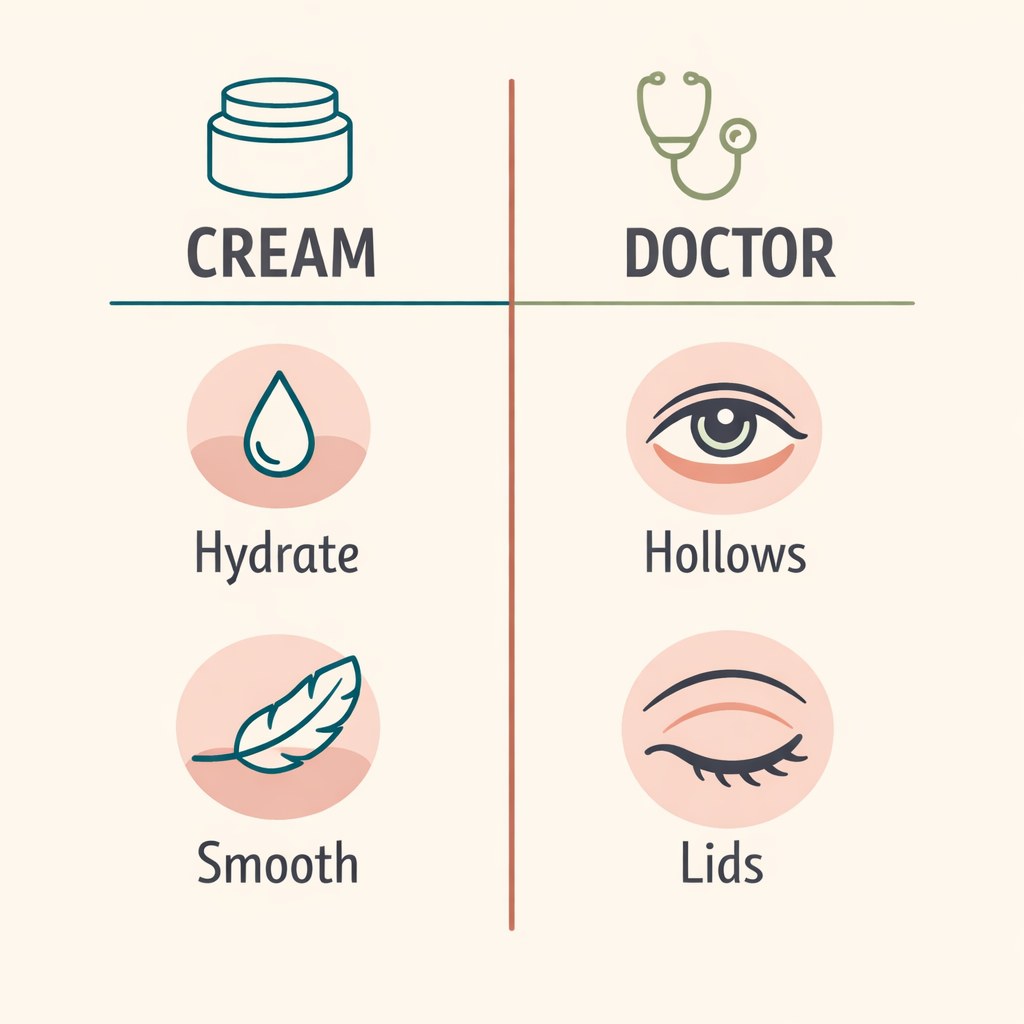
The skin around your eyes carries a lot of your expression, and it’s normal to want it to look rested. A good eye cream can make that skin softer, more comfortable and easier to wear makeup on. That’s worth something! But it can’t refill a hollow or lift a lid, and it was never built to. When you match the problem to the right fix – a cream for the surface, a doctor for what’s underneath – you stop paying for promises and start paying for results you can see.
Related Posts